


Absorbing the swings of renewables
By charging when generation exceeds demand and moving that electricity to the hours when it is needed, it makes renewable energy easier to use.

Creating success in grid-scale battery storage, together.
GRID-SCALE BATTERY STORAGE GUIDE
Store electricity when there is too much of it, and send it out when it is needed. This page explains the role of grid-scale battery storage (BESS), the three power markets, and the conditions to check when considering a project, in terms a first-time reader can follow.
* Whether a system can take part in a market, and whether a project is viable, depends on the equipment specifications, grid connection conditions, operating structure, regulatory requirements and other factors.
01 / Definition
It fills the time gap between generation and consumption, and smooths the flow of electricity.
The amount of electricity generated and the amount used must always be kept close. Grid-scale battery storage charges when there is a surplus and discharges when there is a shortfall, supporting stable operation of the grid. Unlike a home battery, whose main purpose is backup power, it is used mainly as a business, working with the power markets and grid operation.
02 / Why it matters
Solar and wind output changes with the weather and the time of day. Equipment that can move electricity across time, following the changes in supply and demand, is becoming more important.
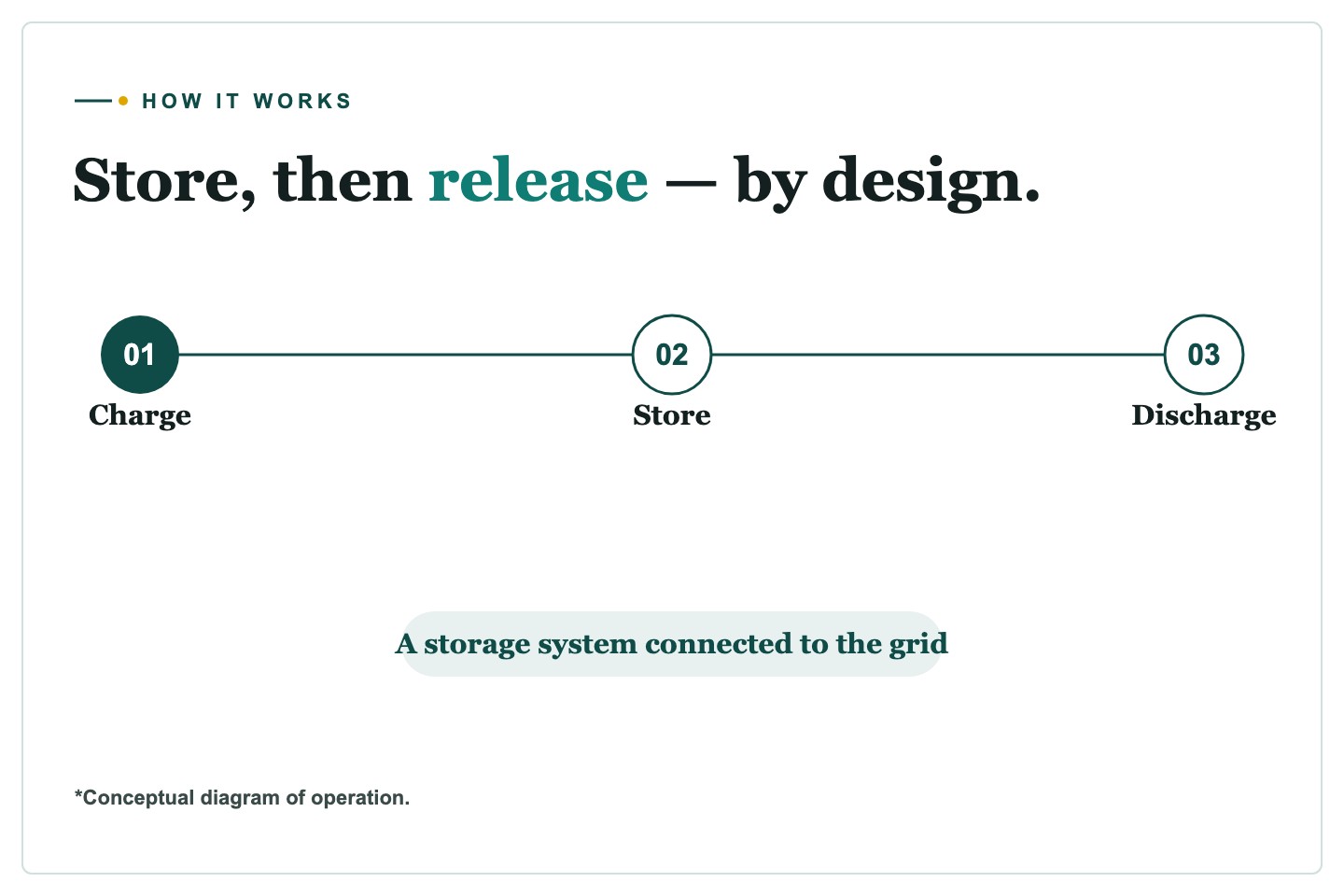
Store electricity when generation exceeds demand.
Operate while watching market prices, grid instructions and the state of the equipment.
Send electricity out when demand rises or when balancing capacity is needed.
03 / Position in the grid
Grid-scale battery storage is neither a generator nor a consumer: it is a resource that can both charge and discharge. Using that flexibility in both directions and its fast response, it takes on several roles.
This is a conceptual diagram. The actual connection, metering, control and method of market participation depend on the system configuration and the contract scheme.
04 / Three roles
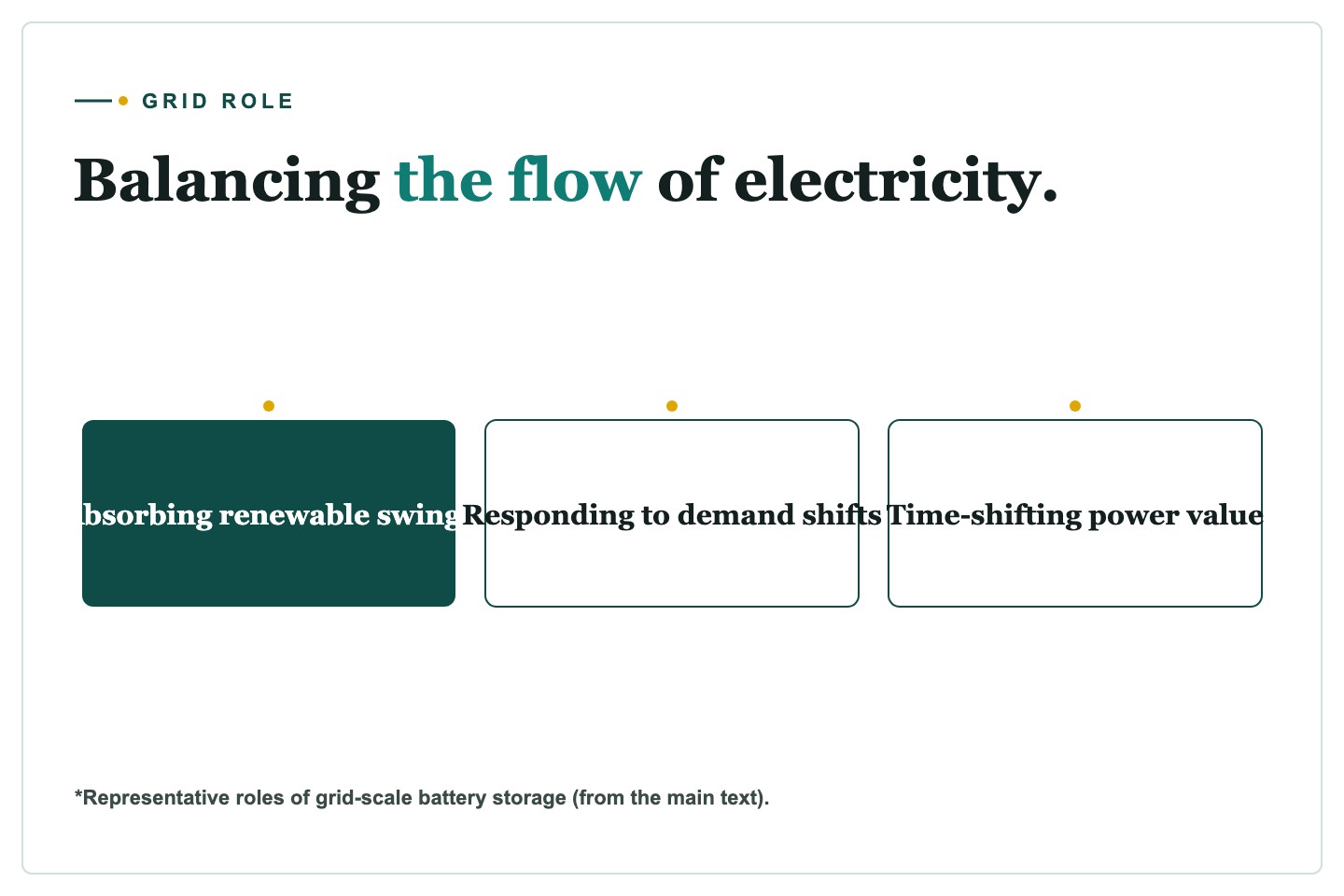
By charging when generation exceeds demand and moving that electricity to the hours when it is needed, it makes renewable energy easier to use.
Because its charge and discharge output is easy to control, it is used as balancing capacity for keeping frequency stable and for short-term swings in supply and demand.
Because the time it stores electricity and the time it sells can be separated, it opens up options for trading energy according to market prices and the operating plan.
05 / Electricity markets
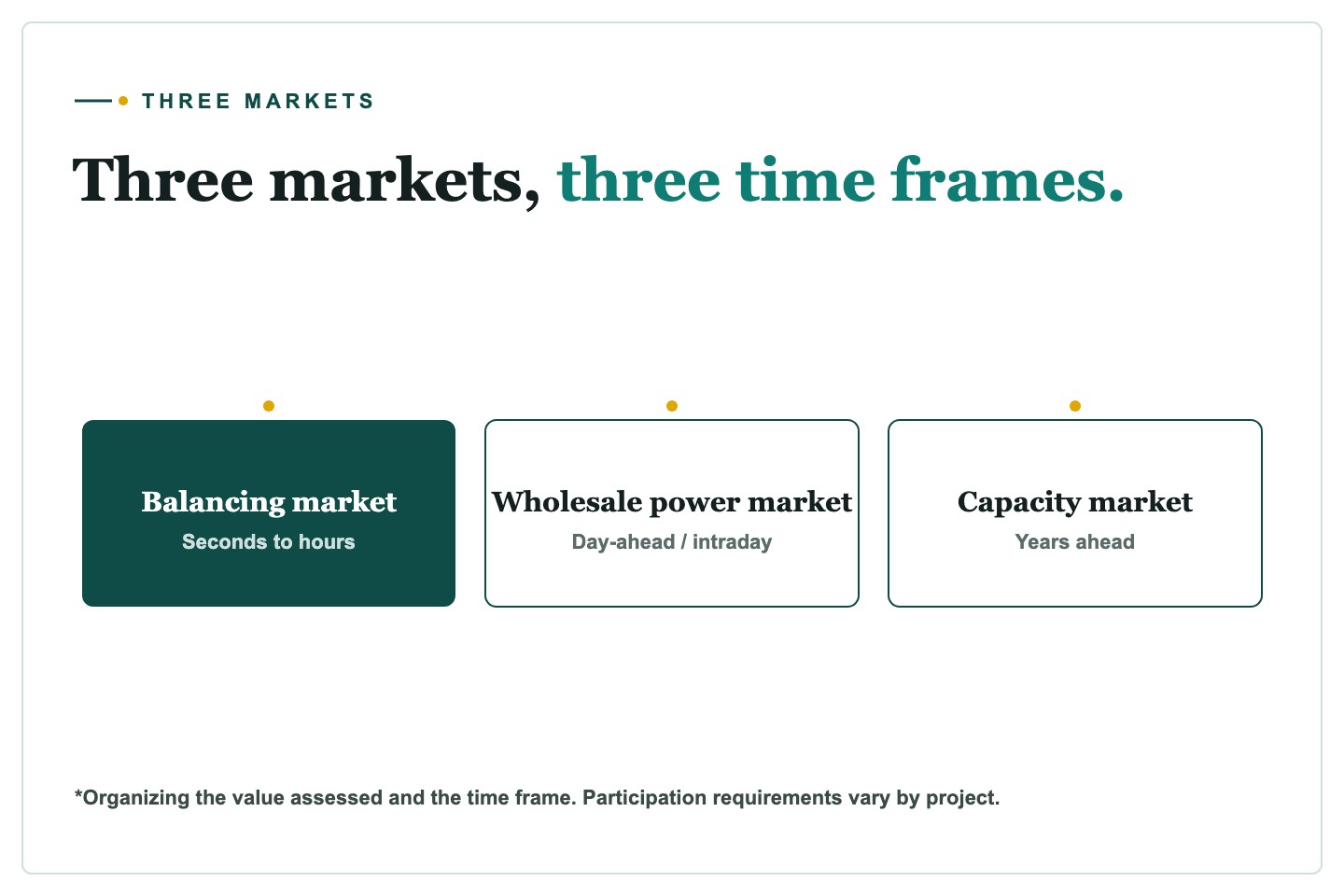
The business case for grid-scale battery storage is not built on one market alone. It comes from how several kinds of value are combined, within the limits of the equipment and its operation.
Revenue is affected by market prices, auction and activation results, charge and discharge efficiency, degradation, grid constraints, operating costs, regulatory changes and more. Nothing here guarantees market participation or revenue.
Official sources we referred to
06 / Due diligence
Only when grid connection, land, safety, equipment, operation and market participation are checked together does a project plan become realistic.
Whether connection is possible, the construction cost burden, the lead time, output curtailment and grid constraints.
Area, access for delivery, noise, consultation with the fire department, local conditions and contractual relationships.
Match kW and kWh, discharge duration, efficiency and degradation conditions to the purpose of operation.
PCS, BMS, EMS, metering, response to instructions and security.
Participation requirements, aggregators, settlement and the requirements to be met.
Build in monitoring, fault response, parts replacement, performance management and long-term costs.
07 / Choose your path
Low-voltage and high-voltage projects differ in equipment size, connection method, land needed, operating structure and how the business plan proceeds. Start from the entry point closest to where you are.
For those considering relatively small systems, use of idle land, or roll-out across several sites. There are entry points for landowners and for investors.
See the low-voltage overviewFor those considering a business plan with large output and capacity, a dedicated site, grid interconnection and long-term operation. Products, safety, maintenance and the revenue model are all covered.
See the high-voltage overview08 / Consultation flow
Land use, entering the business, comparing equipment: we confirm where your interest starts.
Candidate site, desired scale, grid connection status and schedule.
Low voltage or high voltage, system configuration, operating method and how to take part in the markets.
Identify the studies, documents and people needed, and assess feasibility.
09 / FAQ
The main differences are the purpose and the way it is connected and operated. Home and customer-side batteries mainly provide backup power or cut electricity bills, while grid-scale battery storage is connected to the power grid and charges and discharges in step with market trading and grid operation.
The balancing market deals mainly with balancing capacity for short-term swings in supply and demand, the capacity market with future supply capacity, and the wholesale market with the energy actually delivered. They differ in time frame, the value assessed, participation requirements and settlement.
Depending on the market and the contract, securing supply capacity or balancing capacity can itself be paid for. But that assumes meeting the participation requirements, winning the auction, responding to instructions and meeting the requirements; revenue does not arise all the time.
Yes. Market rules, participation requirements, product categories and settlement methods may be revised. A business plan needs to check the latest published materials and avoid relying on a single revenue assumption.
No. Results vary with market prices, auction and activation results, equipment efficiency, degradation, downtime, grid constraints, regulatory changes, maintenance costs and more. Any simulation needs its assumptions and sensitivities checked.
The relationship with the markets is not decided by the voltage class alone. It changes with the system output, discharge duration, metering unit, aggregation, connection contract, operating structure and more. Check the latest requirements for each system you are considering.
NEXT ACTION
REVIX JAPAN sorts out your purpose, candidate site, connection conditions, system configuration and operating method, and makes clear what to check next. You are welcome to get in touch while the idea is still taking shape.
* Depending on your inquiry, we may ask for additional documents or for the site and grid conditions to be confirmed.
