Creating success in grid-scale battery storage, together.

How to read the response / Special measures for battery storage

Do not overlook
“No Special Measures Applied”.

The grid connection construction cost alone cannot tell you whether a site works as a project.
We read through the assumptions in the response, down to wheeling charges, metering equipment and the conditions for change.

  • What the entry means
  • Impact on costs
  • Documents to check and how to proceed
A graded candidate site for grid-scale battery storage near a transmission tower and substation equipment

CONCLUSION

“No Special Measures Applied”
assumes the special measures for battery storage are not used.

It is not about whether connection is possible itself, but an important factor for decisions that affects wheeling charges on the charging side and the metering and construction conditions.

No Special Measures Applied

Examine whether the project works
on standard rate and contract conditions

Because you cannot assume the limit on what is billed that the special measures for battery storage provide, check the rate conditions for charging with the retail electricity supplier and the general transmission and distribution operator.
What it does not mean

It does not immediately mean
“connection not possible”

Do not decide yes or no from the entry in the response alone; judge overall, including charges, construction cost, metering, operation and market revenue.

How the system works

Documents from the Agency for Natural Resources and Energy set out a mechanism under which, to avoid wheeling charges being imposed twice on electricity supplied via battery storage, the storage losses and the like are billed when the special measures apply. For an actual project, whether they apply and the charges need to be checked by area, voltage, contract and equipment configuration.

MECHANISM

Understand why the special measures exist
through the flow of electricity.

Battery storage charges with electricity received from the grid and discharges it later. When the special measures apply, the idea is that wheeling charges are billed not on the full amount of electricity supplied to the battery but on the storage losses and the like.

  • 01
    Determine the charged amount

    Check the amount of electricity supplied from the grid to the battery.

  • 02
    Calculate the storage losses

    The loss rate may be a value agreed in consultation with the general T&D operator.

  • 03
    Separate other loads

    If there are auxiliary loads, a separate meter may be needed.

DOCUMENT CHECK

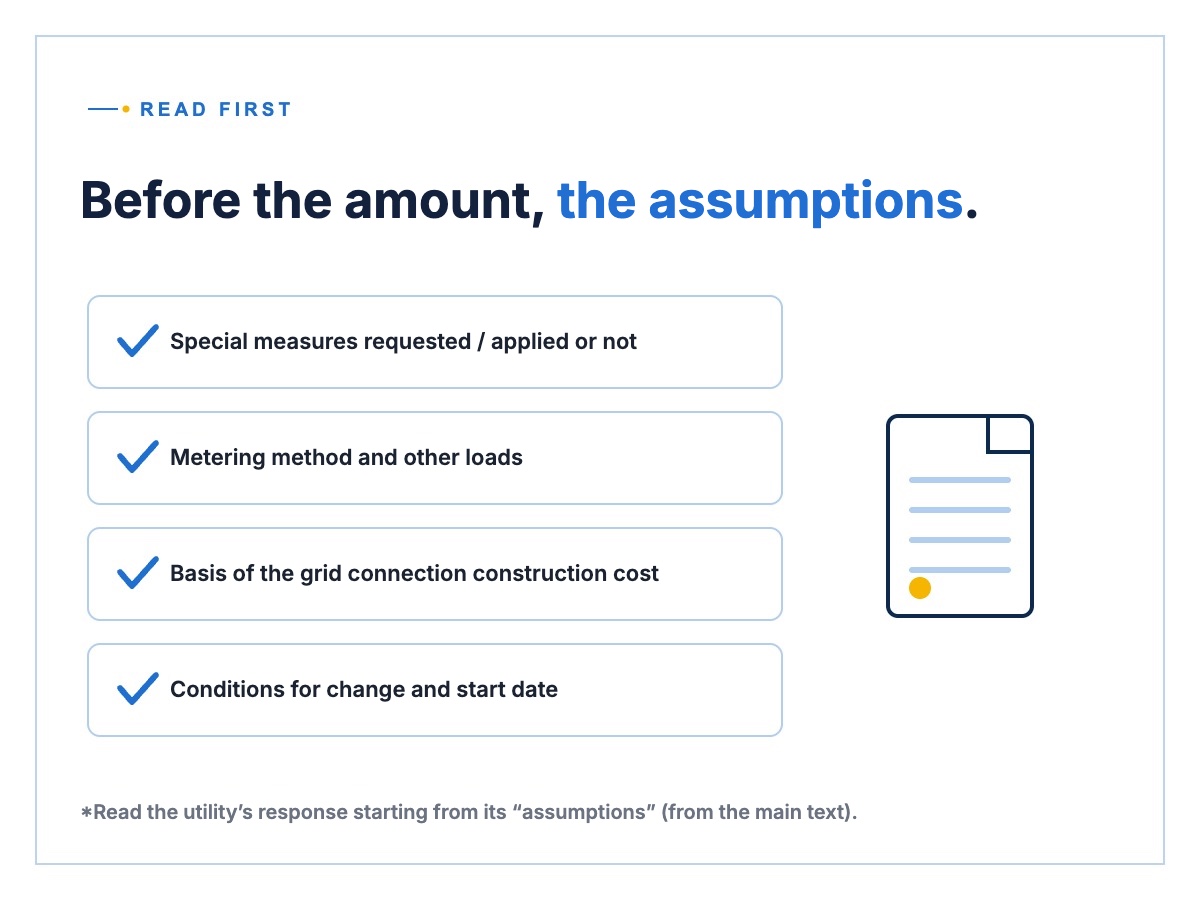
In the response, check the “assumptions”
before the amount.

The entries may be split between the main text, attachments and memorandums. Check across the related conditions, not just a single sentence.

Hands cross-checking the response, a map and equipment documents at a desk
01

Special measures requested / applied or not

Check wording such as “not applied” or “not requested” separately from whether the conditions of application are met.

02

Metering method and other loads

Check metering at the receiving point, separate meters, and how auxiliary loads such as the PCS and air conditioning are handled.

03

Basis of the grid connection construction cost

Check whether the construction cost or the meter configuration changes depending on whether special measures apply, and the scope included in the amount in the response.

04

Conditions for change and start date

Check whether a later change is possible, when consultations will be completed, the month from which the measures apply and so on.

Area to checkImpact if overlookedCheck before the purchase offer or contract
Operating costsThe wheeling charge assumptions on the charging side change, and expected revenue may fallRe-estimate with the rate plan, what is billed and the number of operating cycles
Equipment costsAdditional costs may arise for meters, wiring, design, testing and so onCheck the breakdown of the grid connection construction cost and the developer’s own equipment
ScheduleThe start date may shift because of memorandums, consultations and the design of the metering equipmentMap out the critical path of application, consultation and construction
Contract changesIn some cases you cannot change to “applied” for a set periodCheck the latest procedures for the area and contract category concerned

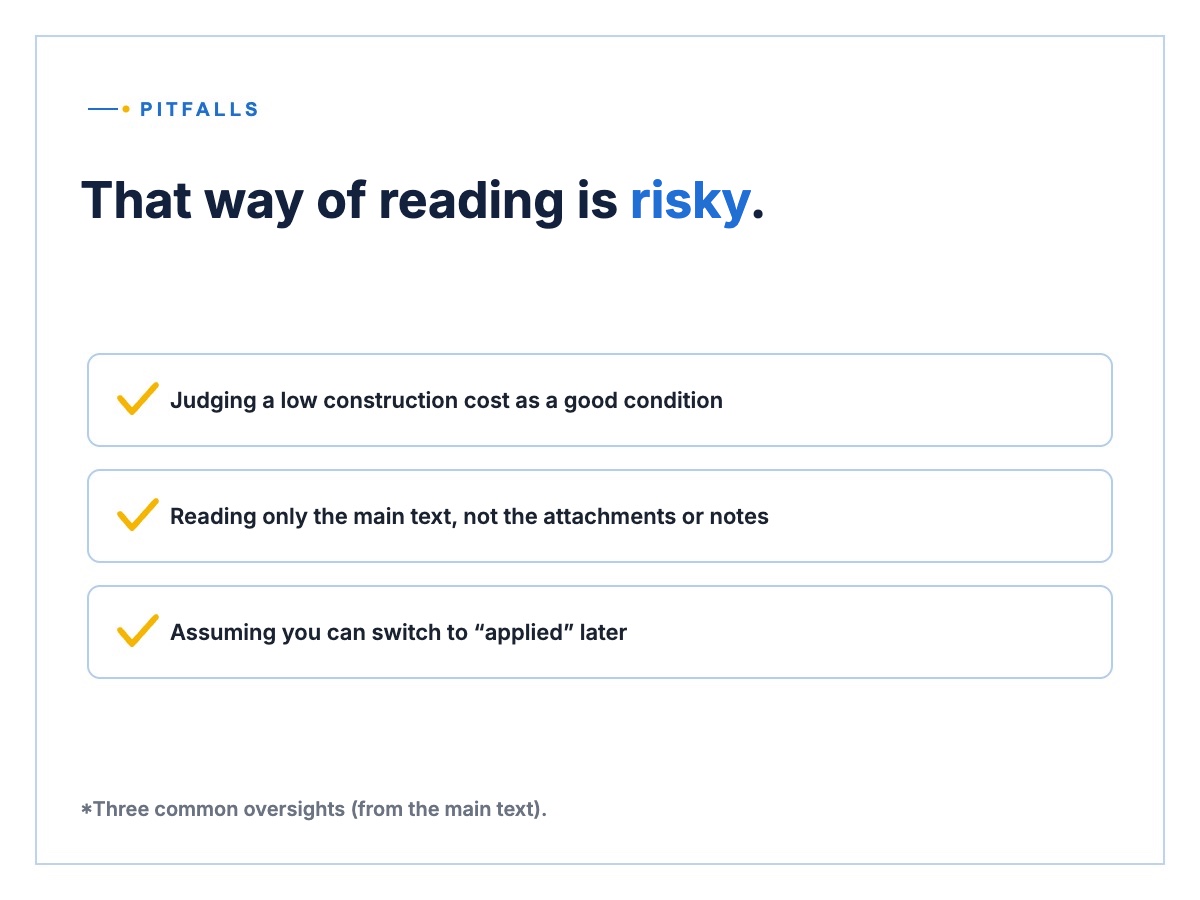
PITFALLS

3 common oversights

01

Judging a low grid connection construction cost
as a good condition

Compare including not only the initial cost but also wheeling charges over the operating period and additional equipment.

02

Reading only the main text of the response,
not the attachments or notes

Metering, special measures, voltage fluctuation, the construction period and so on may be written in attachments or small notes.

03

Assuming you can switch
to “applied” later

In some cases restrictions on changes are set. Check the latest rules for the area before signing.

A surveyor checking a candidate battery storage site with drawings and a tablet

WHO SHOULD CHECK

The issues to check differ by your position.

If you are selling a site

Sort out the conditions in the response so that you can explain them to the buyer.

If you are buying a site

Judge whether the acquisition price is reasonable, including OPEX and additional CAPEX.

Brokers and developers

Share the application conditions, restrictions on changes and unconfirmed items as important matters.

BEYOND THE DOCUMENT

Site DD does not end with the response.

Even once the special measures conditions are sorted out, checks remain on hazards, road frontage, boundaries, noise, laws and regulations, the construction period, rights and more. The value of a site is judged on a combination of several conditions.

See the Hazard & Noise Standards
A candidate grid-scale battery storage site where road frontage, boundaries and the surrounding environment need to be checked

FREE DESK DILIGENCE

A free DD assessment
sorts out what to check next.

Based on the documents you have and public information, we sort out the conditions to watch in the response and the site risks through a desk review.

Send your documents and consult us

* The assessment is an initial desk review. It does not guarantee the final decision on whether connection is possible, compliance with laws and regulations, revenue or a purchase.

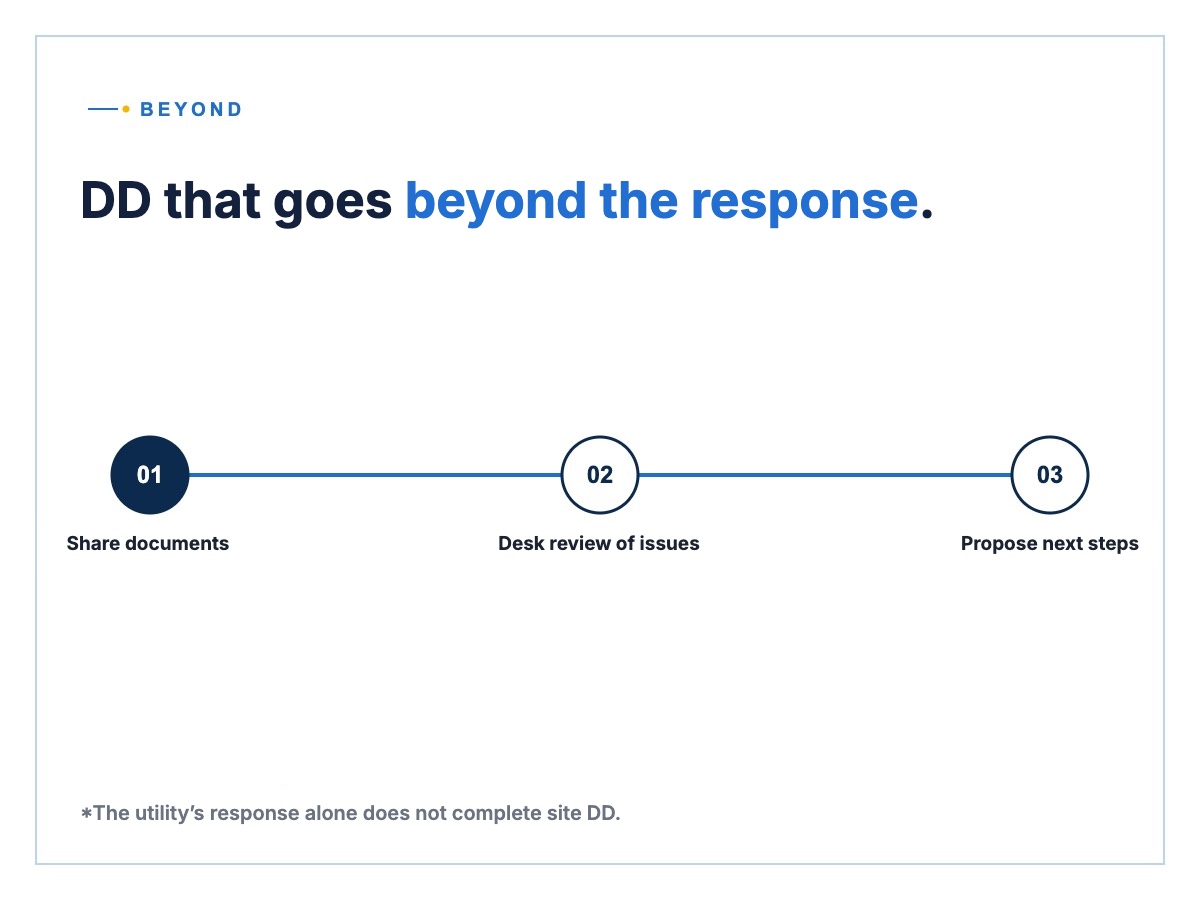
STEP 1

Share documents

Share the documents you have now, such as the response, a copy of the application, a single-line diagram and land documents.

STEP 2

Desk review of the issues

We pick out items for further checks, such as special measures, metering, construction cost, construction period and hazards.

STEP 3

Next actions

We set out how to proceed with checks with the utility, re-estimates, on-site surveys and consultation on sale or entrustment.

WHAT TO PREPARE

Documents that speed up
the check before the assessment

You can consult us even if you do not have them all. First, let us know which documents you have.

  • 01Reply to the connection study / reply to the connection application
  • 02Copy of the application form, memorandums, records of communication with the utility
  • 03Single-line diagram, equipment capacity, PCS specifications
  • 04Cadastral map, registry, land survey map, location map
  • 05Breakdown and payment status of the grid connection construction cost
  • 06Planned operation and financial simulation

FAQ

Frequently asked questions
on “No Special Measures Applied”

We have gathered questions that often come up before judging a response.

QWhat does “No Special Measures Applied” mean?
A

It is an entry showing that, for the demand location where the battery storage is installed, the assumption is that the special measures for battery storage under the wheeling service terms and conditions will not be applied. It does not directly mean that grid connection is not possible, but because assumptions such as wheeling charges and equipment costs change, the project’s finances need to be checked again.

QDoes “No Special Measures Applied” mean the project can never go ahead?
A

You cannot judge across the board from the entry alone. We check the contract category, how the general T&D operator handles it, the rate conditions, the operating plan and the equipment configuration, and examine the finances and any additional measures case by case.

QCan I switch to “Special Measures Applied” later?
A

How this is handled needs to be checked by area and contract category. The guidance from TEPCO Power Grid for low-voltage customers states that if no special measures are applied, you cannot change to “applied” for 3 years after connection supply starts.

QIf the grid connection construction cost is low, is it a good project?
A

You cannot judge on the grid connection construction cost alone. Re-estimate the total cost and revenue, including wheeling charges, metering and wiring costs on the developer’s side, the construction period and the operating conditions.

QCan I consult you even if I do not have the response?
A

Yes, you can. Because a specific judgment requires the response, a copy of the application, equipment specifications and the like, we first check the documents you have and the status of obtaining them.

QWhat does the free DD assessment tell me?
A

We sort out the conditions to watch in the response, site risks based on public information, and the issues to check additionally with the utility and other parties. It does not guarantee final contractual or technical judgments.

Project staff consulting while checking site documents and the response

LAND DD / FREE CONSULTATION

Why not check that response
once before signing?

We sort out the issues on special measures, metering and operation that the grid connection construction cost alone does not show.

Note on information about the system

This page sets out the general approach based on public documents. The name of the special measures, the conditions of application, the application method, charges and restrictions on changes differ by general T&D operator, voltage class, contract type, equipment configuration and the timing of revisions. For an actual project, check the latest terms and conditions, procedure documents and your individual response.