


GRID CONNECTION
Low-voltage grid-scale battery storage:
the connection application process and costs
For a low-voltage grid-scale battery storage system with an output of 49.9kW, the procedure starts with a contract application to the utility. There is no paid connection study as there is for high voltage. We take on the land survey, preparing the drawings and submitting the application form, either as single items or as a set of all 3.
If you are planning a high-voltage system with an output of 50kW or more and under 2,000kW, see the page High-voltage grid-scale battery storage: the connection study, grid connection process and costs.
VOLTAGE
What can be connected at low voltage is equipment under 50kW
Of the utility's distribution lines, what can be connected to a low-voltage line is, in principle, equipment with an output under 50kW per installer. REVIX's low-voltage package keeps within this range by setting a 50kW hybrid power conditioner to 49.9kW.
At 50kW or more, the system is connected at high voltage, and the planning has to cover the transformer, substation equipment and even the safety management structure. If you start at low voltage, you keep the output of each site at 49.9kW and plan the overall scale by the number of sites where you install.
PROCEDURE
Low voltage has no connection study procedure
For high-voltage and extra-high-voltage equipment, the rules of the Organization for Cross-regional Coordination of Transmission Operators (OCCTO), set out in its Guidelines for Transmission and Distribution Operations, require you to apply for a paid "connection study" before you apply to the utility for a contract. Low voltage has no such procedure, and you start with the contract application from the outset. This is why the price list on this page has no row for the utility study fee that appears for high voltage. For details, see the BESS NEWS article "Low-voltage grid-scale battery storage: proposal to check land split by owner name going back 5 years".
Taking the TEPCO Power Grid area as an example, the flow is as follows. After a prior consultation where needed, you submit the application form, and the utility studies the technical impact on other users and on the grid. After the design stage, a notice of approval arrives, and if a grid connection construction cost applies, you pay it before moving on to construction and grid connection.
Under the rules, the reply to a contract application for low voltage is due within 1 month of acceptance in principle (6 months in principle for high voltage). At present, low voltage can be applied for without a deposit, and government materials describe it as taking about 1 month at the earliest from application to grid connection. However, the period becomes longer depending on corrections to the documents and the content of the work. The low-voltage connection application (No.05, 33,000 yen incl. tax) covers preparing and submitting the application form, and the correspondence from corrections after acceptance through to receiving the reply.
FLOW
Low voltageSteps up to the connection application
We proceed in stages, from checking the land conditions to the connection application to the utility. Each stage can be ordered on its own, so you can also start by asking for "just the land survey first".
Land assessment and site check
We check land conditions such as hazards and city planning, and the situation on site.
No.01〜03
Drawings
We prepare the single-line diagram and layout plan needed for the connection application.
No.04|¥22,000 incl. tax
Connection application and corrections after acceptance
We apply to the utility and handle the correspondence from corrections after acceptance through to receiving the reply.
No.05|¥33,000 incl. tax
Reply from the utility
Based on the reply on whether connection is possible and on what conditions, you move on to the contract and construction.
* The lead time, the content of the reply and the grid connection construction cost vary with the utility and the grid conditions in the area. We will give you an individual outlook at the consultation.
* We also offer the low-voltage connection application set (No.06|¥54,780 incl. tax), which combines the land survey, drawings and the connection application.
SITE
Low voltagePlots from about 6 tsubo can be considered
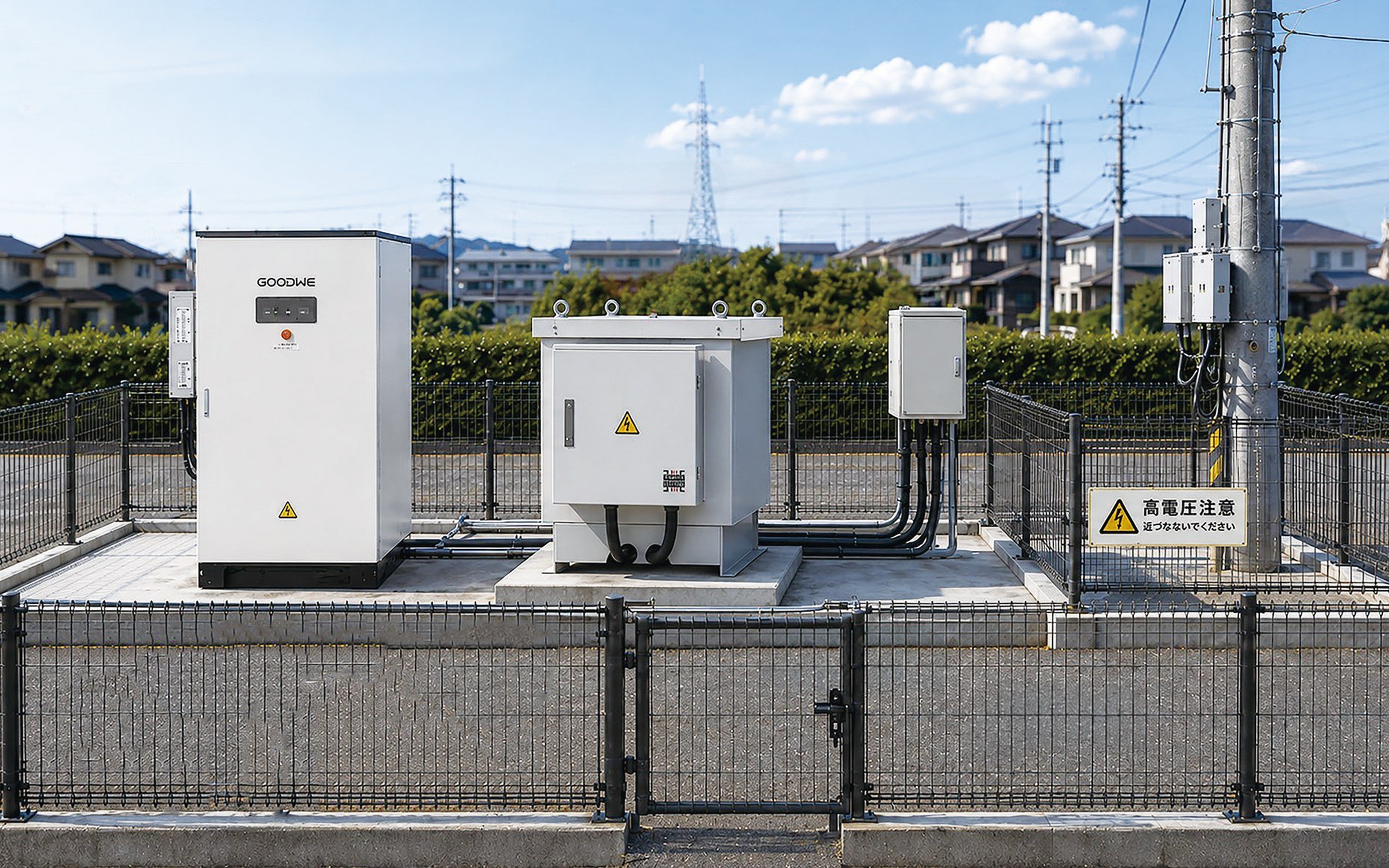
The low-voltage package is a cabinet that integrates the battery and the power conditioner, and the unit itself has a footprint of about 1.1 m². Including the foundation, wiring, access for maintenance and clearances, the guide for installation is about 6 tsubo, so idle land and small plots around buildings can also be candidates. The area needed varies with conditions on site, so it is decided with the final layout.
Of the application drawings, the layout plan shows the position of the equipment and the service entrance route from the nearby utility pole to the installation site. The photos taken and the distances measured in the site check (No.01 and 02) are used as they are in this drawing. If you increase the capacity to the 160kWh class or above, the system may count as a small quantity of hazardous materials under the Fire Service Act, so when expanding, a separate check with the local fire department is needed. For details, see the BESS NEWS article "Can even a low-voltage battery count as a small quantity of hazardous materials?".
SCALE
Low voltageApply site by site, and build scale across separate sites
A low-voltage battery is limited to 49.9kW per site, so to aim for a larger scale you install at several candidate sites. The contract application is made for each installation site, and the utility's reply also arrives for each site. Even in the same area, it is not unusual for the grid connection construction cost and the timing of the work to differ from site to site.
"Separate" here means placing the systems on separate pieces of land apart from each other. Dividing one continuous piece of land into parcels under different owners' names and lining up low-voltage systems on them may fall under the measures against split installations under the Electricity Business Act. In October 2026, the government presented a proposal to extend, for battery storage equipment, the period over which it is checked whether the landowner is the same, from the current 1 year to 5 years. REVIX checks how the land is divided and its position relative to existing power plants nearby before the application. For details, see the BESS NEWS article "Low-voltage grid-scale battery storage: proposal to check land split by owner name going back 5 years".
If you have several candidate sites, consult us about them together and we will work out with you which sites to start the land survey and application on.
MARKET
Low voltageIn the balancing market, an aggregator bids for systems together
As of October 2026, the minimum bid quantity in the balancing market is 1MW (1,000kW) for every product. A low-voltage battery of under 50kW per site cannot bid on its own, so an aggregator bundles several systems in the same utility's area and bids for them together. From April 2026, low-voltage systems can also bid in the balancing market in this way. For details, see the BESS NEWS article "Balancing market × low-voltage grid connection, batteries: using low-voltage resources in fiscal 2026, individual equipment metering and points to watch".
The quantity that can be bid is not the sum of the equipment outputs but the "amount that can actually be delivered", confirmed in prior screening. Which products a system can bid into depends on its response speed and the conditions of its communication line. REVIX's low-voltage package is designed on the assumption that a communication unit and an EMS control several sites together and that it is operated in cooperation with an aggregator.
APPLICATION COST
Low voltageApplication fees (price list)
This is the list of low-voltage application menu items. The connection application set (No.06) includes the land survey, the low-voltage drawing set and the low-voltage connection application (No.03 to 05).
* The table scrolls sideways
| No. | Category | Item | Excl. tax | Incl. tax | Notes |
|---|---|---|---|---|---|
| 01 | Site check | Online site check (remote) | ¥20,000 | ¥22,000 | You take the photos and measurements on site. We guide you online on where to shoot and measure, and check that no data is missing. We do not compile the data into materials or prepare a survey report. |
| 02 | Site check | Site check (site visit) | ¥110,000 | ¥121,000 | Travel and accommodation costs, where incurred, are charged at cost. |
| 03 | Land assessment, single item | Land survey | ¥10,000 | ¥11,000 | Survey report on hazards, city planning, noise and buried cultural property. |
| 04 | Low voltage, single item | Low-voltage drawing set | ¥20,000 | ¥22,000 | Single-line diagram, layout plan. |
| 05 | Low voltage, single item | Low-voltage connection application | ¥30,000 | ¥33,000 | Application form, submission and corrections after acceptance. Includes the correspondence up to receiving the reply. |
| 06 | Low voltage, set | Low-voltage connection application setSET | ¥49,800 | ¥54,780 | Set contents: No.03, No.04 and No.05 are included. Electrical work is not included. |
- Consumption tax of 10% is added to the prices shown excluding tax (shown alongside in the incl. tax column).
- For the site check (site visit), travel and accommodation costs, where incurred, are charged at cost.
- Electrical work is not included in the set.
RULES
Discussions on revising the low-voltage connection rules are under way
As of the end of August 2026, contract applications for low-voltage grid-scale battery storage have reached about 130,000kW across about 2,800 applications. For high voltage and above, rules such as the cap on the number of connection studies, the submission of land documents and deposits have been added over the past year, but they do not yet extend to low voltage, which has no connection study. A national advisory council has started discussions aimed at taking measures for low voltage too at an early stage. For details, see the BESS NEWS article "Connection restrictions coming for low-voltage grid-scale battery storage too".
What the materials of October 2026 presented were proposals for measures on how land is divided, described above. All of them are still at the stage of secretariat proposals, and when they will apply has not been decided. In addition, for low-voltage projects whose contract application is made on or after October 1, 2027, a requirement to use security-certified products (JC-STAR★1) for power conditioners and EMS with communication functions is planned to be added (a proposal under public comment). REVIX checks the timing of the application and the choice of equipment against these planned changes. For details, see the BESS NEWS article "Revision proposal to require JC-STAR★1 for batteries; comments due November 6".
POINTS
Low voltageWhat to know before you apply
A utility pole nearby does not settle it on its own
Being close to utility poles and distribution lines is an advantage, but whether connection is possible is decided after the utility checks the available capacity, voltage, protection coordination, the content of the work, and the impact on the grid when charging.
The grid connection construction cost in the reply differs by site
Even for the same 49.9kW system, the grid connection construction cost changes with the content of the service entrance and distribution line work. The amount shown in the reply is reflected in the business plan.
Checking the land conditions before applying reduces rework
Even if connection to the grid looks likely, conditions such as hazards, city planning, noise and buried cultural property may stop the plan from going ahead. We recommend carrying out the land survey (No.03, 11,000 yen incl. tax) before applying.
DOCUMENTS
Low voltageMain documents submitted in the TEPCO Power Grid area
When newly connecting low-voltage equipment (not using FIT or FIP) in the TEPCO Power Grid area, the main documents submitted are as follows: the grid connection consultation request form, the application form for the generation balancing supply and basic contract, the consent form for non-firm connection, the request for confirmation of the specifications of a power conditioner with an output control function, and the notification of information on the cybersecurity manager. Because the utility sometimes revises the forms, REVIX checks the latest forms and prepares them for each application.
BESS NEWS
Related articles on BESS NEWS
BESS NEWS also covers developments in low-voltage connection and market rules.
- Low-voltage grid-scale battery storage: proposal to check land split by owner name going back 5 years
- Connection restrictions coming for low-voltage grid-scale battery storage too
- Balancing market × low-voltage grid connection, batteries: using low-voltage resources in fiscal 2026, individual equipment metering and points to watch
- Revision proposal to require JC-STAR★1 for batteries; comments due November 6
Discuss connection conditions or place an order
If you know where the land is, we can tell you which menu item to start from.
The form opens with the subject "I want to request a grid application" already selected.
Consult by phone (general reception)050-8890-6112