


The ability to adjust
The value of changing charge and discharge at the moment it is needed, to match supply with demand.

Creating success in grid-scale battery storage, together.

Electricity Market Guide
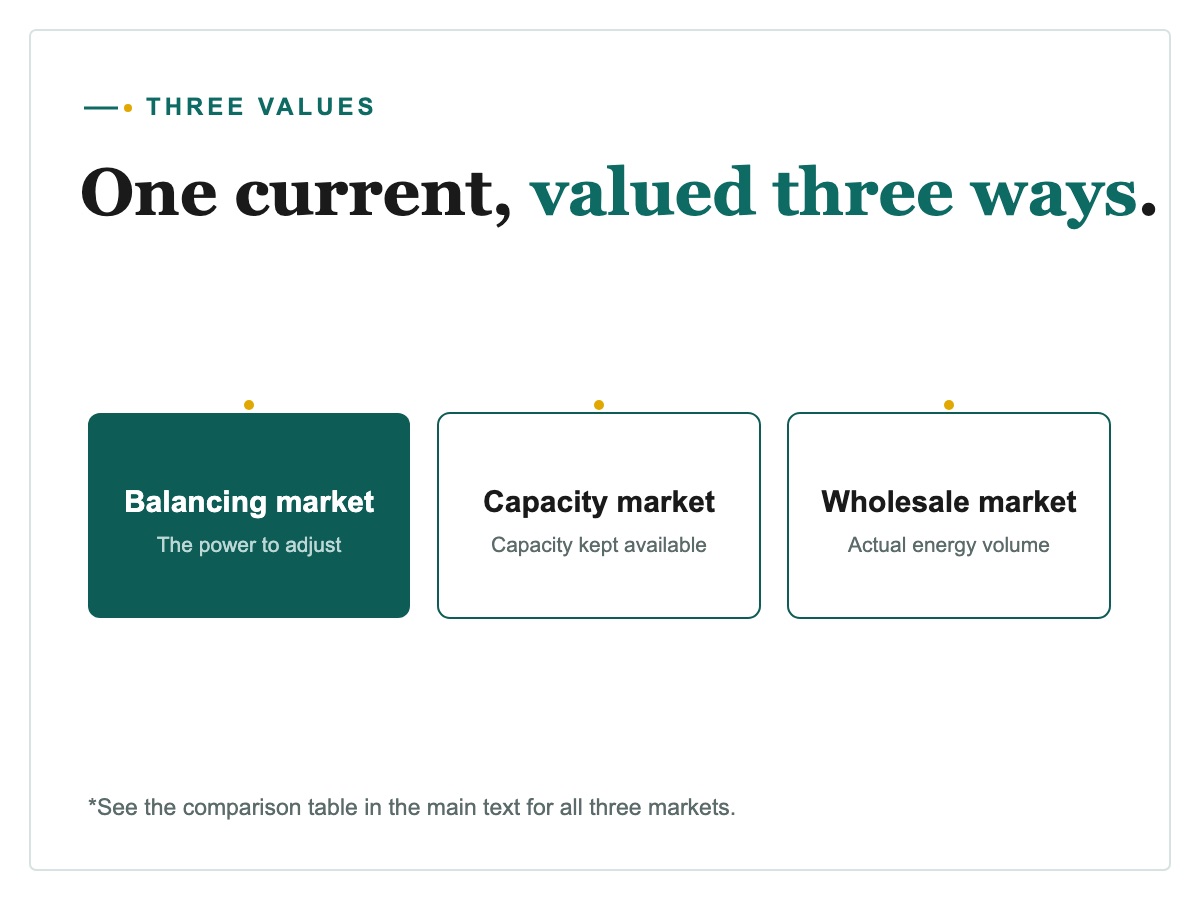
Balancing, capacity and wholesale. This page sorts out the 3 markets, each with a different role and time frame, and explains what value a battery provides in each and what to check when considering a project.
* This page is a general explanation of the overall system. It does not guarantee the revenue or market participation of any particular project.
Answer in 1 minute
The value of changing charge and discharge at the moment it is needed, to match supply with demand.
The value of keeping equipment available that can supply power when it is needed in the future.
The value of buying and selling the stored electricity according to prices and supply and demand.
Electricity needs demand and supply to match
A battery switches between charging and discharging, absorbing the gap between supply and demand across hours of the day.
Why Markets Exist
Electricity is hard to store in bulk, so the amount used and the amount generated must always be kept close. To cope with the swings of renewable energy and changes in demand, several markets share the work, from short-term balancing to future supply capacity.
Small mismatches caused by weather or changes in demand are covered by resources that can respond.
Energy is bought and sold on the basis of forecasts, balancing surplus and shortfall economically.
To prepare for future peak demand, the generation and storage capacity needed is secured in advance.
Three Market Roles
Separating the value traded, the time frame and the main operating body makes the overall picture easier to grasp.
Market participation has requirements covering products, equipment, metering, communications and response. Check the specific conditions in the latest rules.
MARKET 01
MARKET 02
MARKET 03
Comparison
Beyond the names of the revenue streams, it matters to lay out the value provided and the conditions to be met.
| Item | Balancing market | Capacity market | Wholesale power market |
|---|---|---|---|
| Purpose | Fill short-term gaps between supply and demand, and keep frequency and grid operation stable | Secure the supply capacity needed for future demand | Buy and sell energy on the basis of generation and demand plans |
| Value assessed | The ability, and the record, of changing output on instruction | The ability to supply when needed | The energy actually delivered |
| Typical time frame | Seconds to hours | Secured years in advance | Day-ahead and same-day, slot by slot |
| The battery's role | Absorb swings with fast charge and discharge control | Stay available as supply capacity | Charge and discharge while watching prices and supply and demand |
| Main points to watch | Response performance, metering, communications, compliance with instructions, penalties | Obligation to provide capacity, effectiveness tests, capacity contracts | Price volatility, efficiency, degradation, fees, imbalance charges |
* Names, operating bodies and the description of the system are an outline. Check product categories, participation requirements and settlement methods in the latest official materials.
Time Horizon
Using its fast response and flexible charge and discharge, a battery takes part in value on different time frames.
SECONDS
Follows frequency changes and small supply-demand gaps
HOURS
Corrects forecast errors and sudden changes in demand
DAY
Operates on energy volumes and price spreads
YEARS
Secures the equipment capacity needed, in advance
MARKET GUIDE
How each market works, the participation requirements, how revenue is thought about and the frequently asked questions are explained on the market pages. This page focuses on how the 3 markets differ and how they combine.
A market that pays for balancing capacity that fills the gap between forecast and actual.
See how it works Medium to long termCapacity marketA market that secures the supply capacity needed years ahead. Winning bids come with an obligation to provide it.
See how it works Day-ahead and same dayWholesale power marketA market for buying and selling energy. Price spreads become revenue opportunities through charging and discharging.
See how it works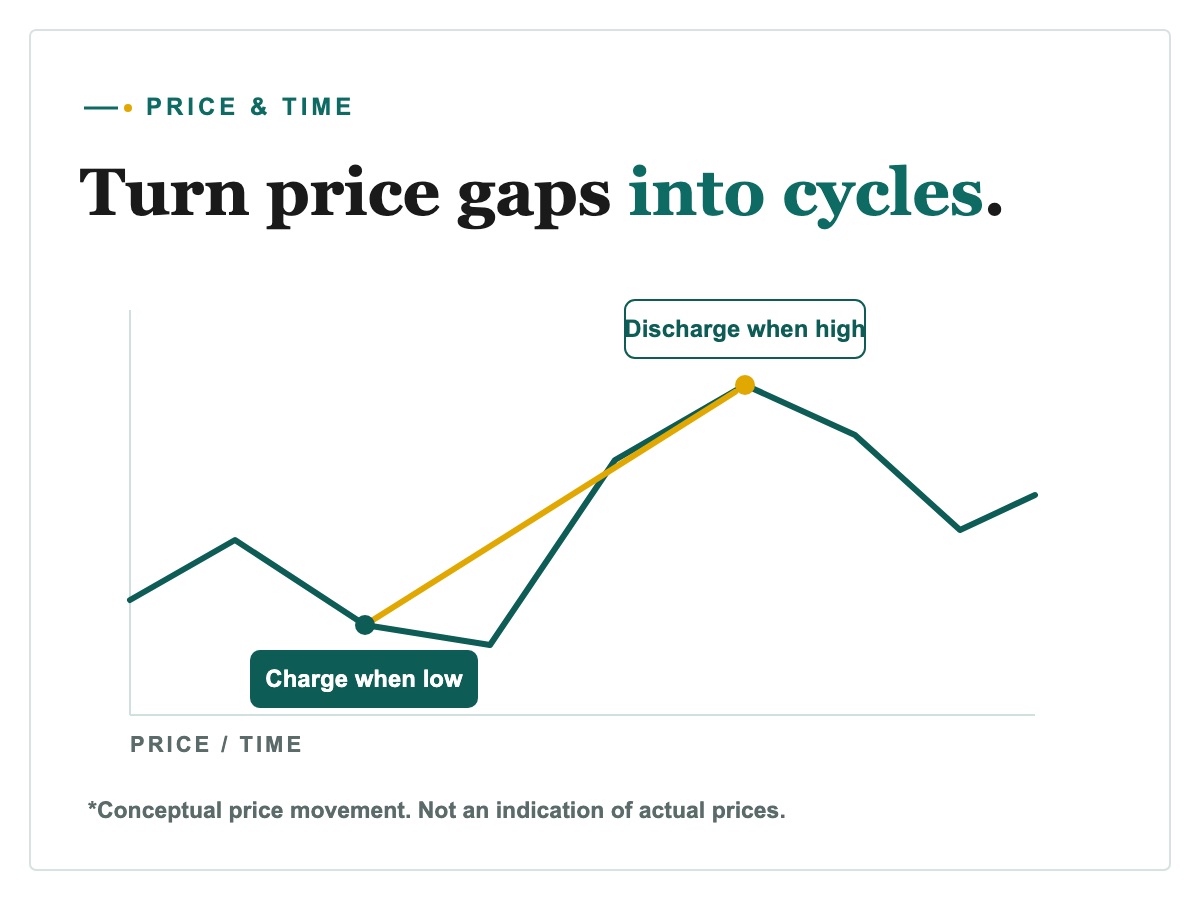
Allocating a finite battery capability
Operation has to watch output, state of charge, degradation and the capacity already committed, so the same capability is not used twice.
Portfolio Operation
Combining several markets is an option, but a battery's output, capacity, state of charge and cycle count are limited. Portfolio operation has to take in equipment life and the fulfilment of obligations, not just market prices.
Do not let output and capacity promised in the capacity market or as balancing capacity overlap with other uses.
Keep headroom to move in both directions, charging and discharging, so the system is ready for instructions.
Judge on efficiency losses, degradation, maintenance and fees, not on sales alone.

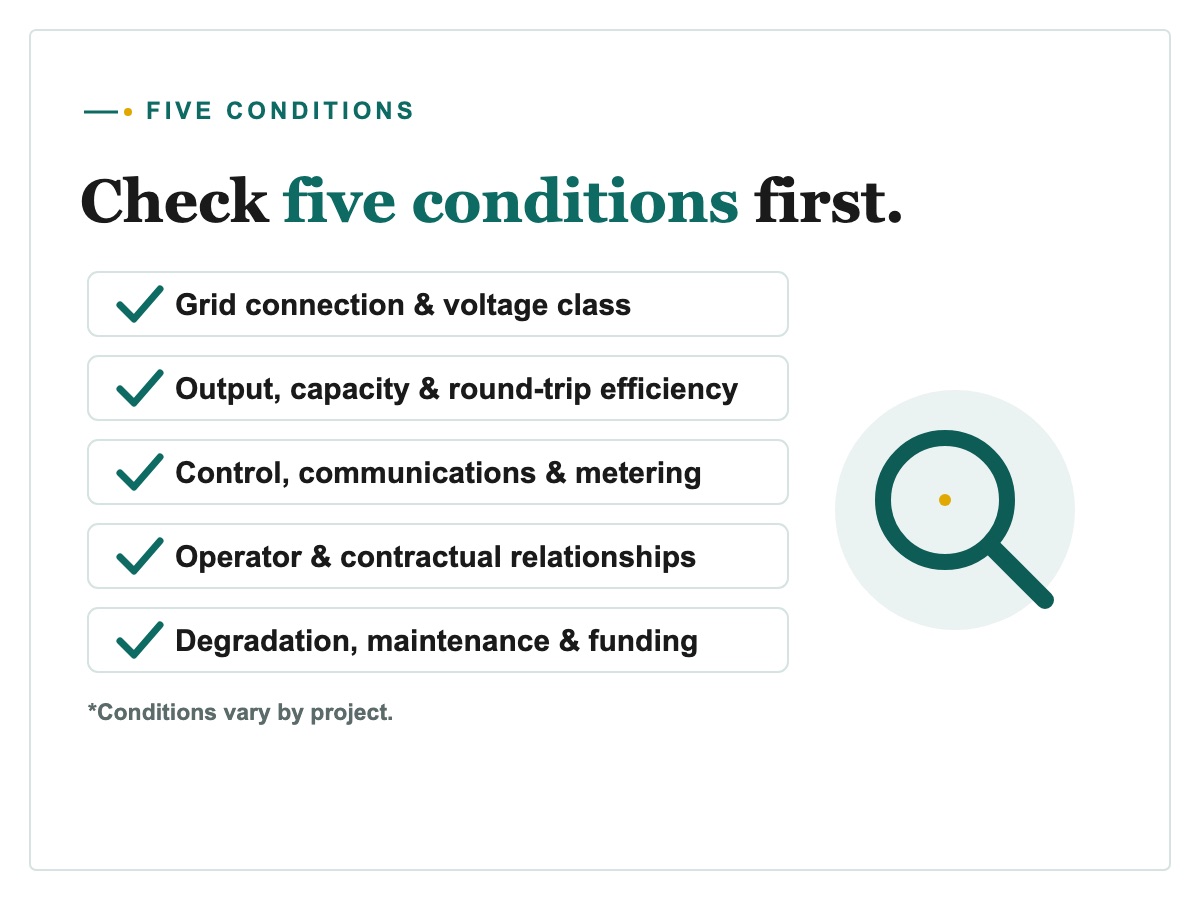
Feasibility Check
Assumptions about market prices alone cannot tell you whether a project is viable. Equipment, grid and operation are checked together.
Connection study, construction cost burden, construction period, output constraints and other grid-side premises.
Not only the market requirements, but the output and energy actually usable in operation.
Receiving instructions, responding, remote monitoring, metering accuracy and data links.
Aggregator, balancing group, generation and sales, O&M: who is responsible for what, and at what cost.
Verify long-term cash flow including cycle conditions, warranties, replacement, insurance, interest and tax.
Important Notes
FAQ
How the markets differ, revenue, regulatory change, and how low voltage and high voltage compare.
The balancing market deals with balancing capacity for smoothing short-term swings in supply and demand, the capacity market with future supply capacity, and the wholesale market with the energy actually delivered. They differ in time frame and in what is valued.
In some markets and products, keeping the system ready to deliver is itself what is valued. But there are conditions: participation requirements, response to instructions, delivery record and penalties. Simply installing a battery does not produce revenue.
It depends on the equipment specifications, how the aggregator operates, the rules of each market, and the output and capacity that can be reserved in the same time slot. Operating plans and constraint management are needed so the same capability is not promised twice.
Yes. Product requirements, bidding methods, price rules, settlement and penalties may be revised. A business plan should check the latest trading rules, procurement guidelines and published materials, and be tested against several scenarios.
No. It varies with clearing prices, contracted volumes, availability, electricity price spreads, degradation, efficiency, maintenance costs, fees, imbalance charges and more. The content here is a general explanation for understanding the system, not an indication of future revenue.
The way the markets work is the same, but equipment size, connection conditions, metering, control, aggregation method and participation unit differ. Whether a particular system can take part has to be checked system by system.
Not always. Charge and discharge efficiency, battery degradation, fees, forecast errors, imbalance charges and output constraints all have to be deducted. Check the full operating cost of the system, not just the price spread.
Check, in order: grid connection feasibility, system output and capacity, control response, metering and communications, the operating entity, degradation conditions, the maintenance structure and the financing plan. Evaluate equipment, grid and operation together, not just the choice of market.
Start With Conditions
The viability of grid-scale battery storage is decided by the combination of interconnection, equipment, operation and maintenance, not by the market alone. We sort out the points to check and the next actions to fit where you are in your study.