


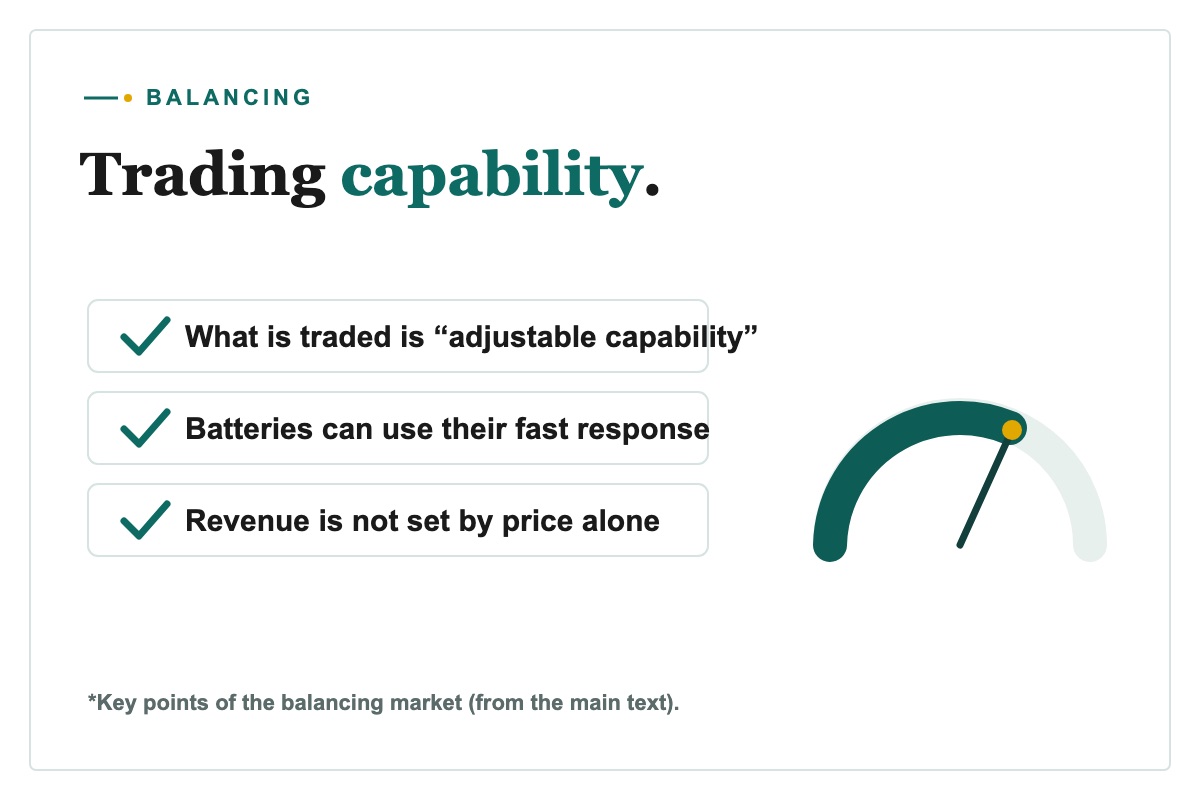
What is traded is "adjustable capability"
General transmission and distribution operators procure balancing capacity, product by product, to keep supply, demand and frequency stable.

Creating success in grid-scale battery storage, together.
A market guide for investors and operators
The market for "balancing capacity", which keeps electricity supply and demand close in real time. This page sorts out how it relates to a battery investment and what to look at.
One-minute answer
The balancing market is not a market for selling electricity. What is valued is the ability to respond to swings on the grid.
General transmission and distribution operators procure balancing capacity, product by product, to keep supply, demand and frequency stable.
Because it can switch between charging and discharging in a short time, it is a candidate to provide balancing capacity if the equipment and operating requirements fit.
Viability has to be evaluated including the share of bids accepted, availability, degradation, aggregator fees and regulatory change.
Simultaneous balanceGeneration and consumption must be kept close at every moment.
Why it matters
Electricity is hard to store in bulk. When the gap between demand and supply widens, frequency drifts and the stability of supply is affected. The more renewable energy there is, with output that changes with the weather, the more valuable the flexibility to close that gap in a short time becomes.
For the rules and product requirements, check the latest versions from the Electric Power Reserve eXchange (EPRX) and the related bodies.
How it works
The actual procedures and timing differ by product, area and year. Here we show only the overall picture needed for an investment study.
Check the requirements for each product: equipment performance, measurement and communications, operating structure.
Bid the balancing capacity that can be delivered, and its price, in the set trading units.
Once cleared, stay in a state that can respond to the output changes requested.
Respond to supply and demand conditions, by online instruction or by the method set for the product.
The delivery record and compliance with the requirements are assessed, and payment is settled under the rules.
Five products
"Primary, secondary, tertiary" is not a ranking. The names reflect the speed of the fluctuation addressed and the way the product is operated.
| Item | Primary | Secondary 1 | Secondary 2 | Tertiary 1 | Tertiary 2 |
|---|---|---|---|---|---|
| Response time | Within 10 seconds | Within 5 minutes | Within 5 minutes | Within 15 minutes | Within 60 minutes |
| Duration | 5 minutes or more | 30 minutes or more | 30 minutes or more | 30 minutes | 30 minutes |
| Main role | Instantaneous frequency changes | Automatic following of short-cycle swings | Adjusting long-cycle forecast deviations | Adjusting same-day supply-demand gaps | Day-ahead renewable forecast errors and similar |
* The above is an outline for understanding the system. For detailed conditions such as the online/offline distinction, measurement, communications, instructions and assessment, check the trading rules and product requirements in force when you take part.
Battery advantage
A battery can be controlled to charge, discharge or stand by. But it is the design for running without interruption over the long term, not performance alone, that decides viability.
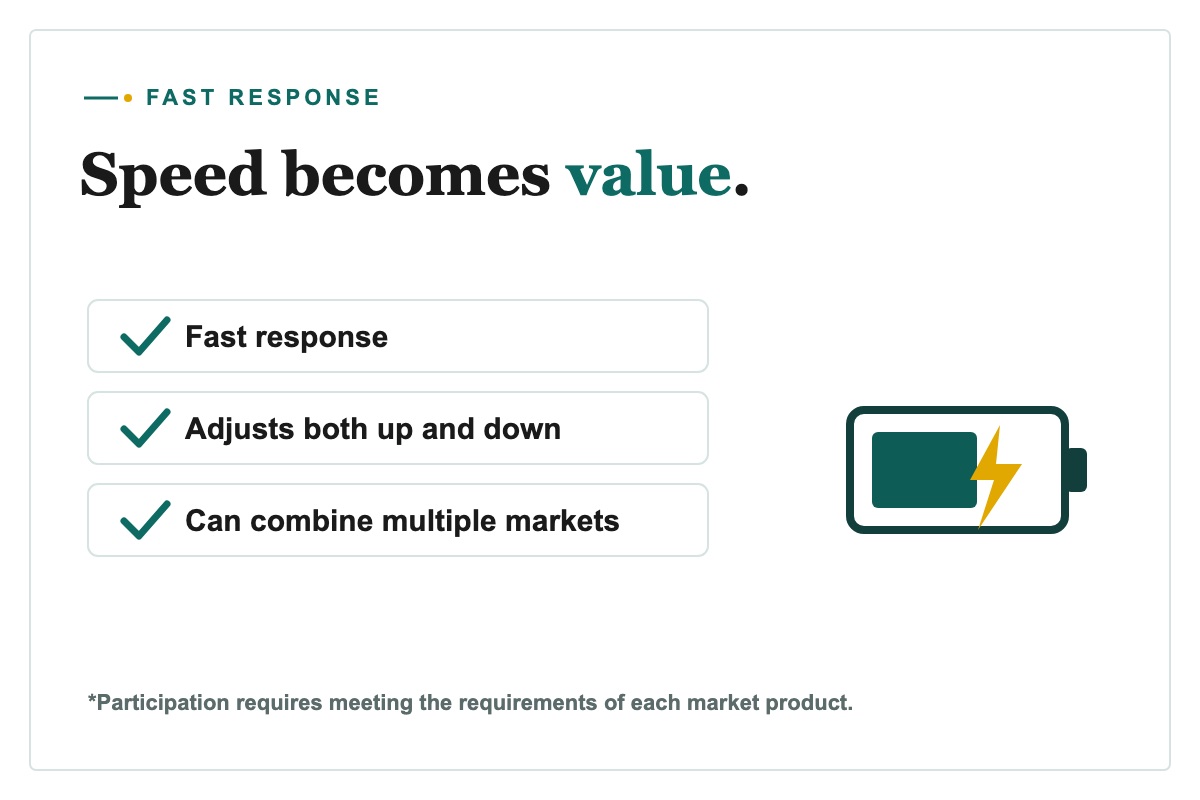
It can respond to control instructions in a short time, without waiting for a generator to start up.
Within its state-of-charge range it can switch between charging and discharging, responding to changes on both the demand and supply sides.
The operating plan can take in the capacity market and the wholesale market as well as the balancing market.
Revenue structure
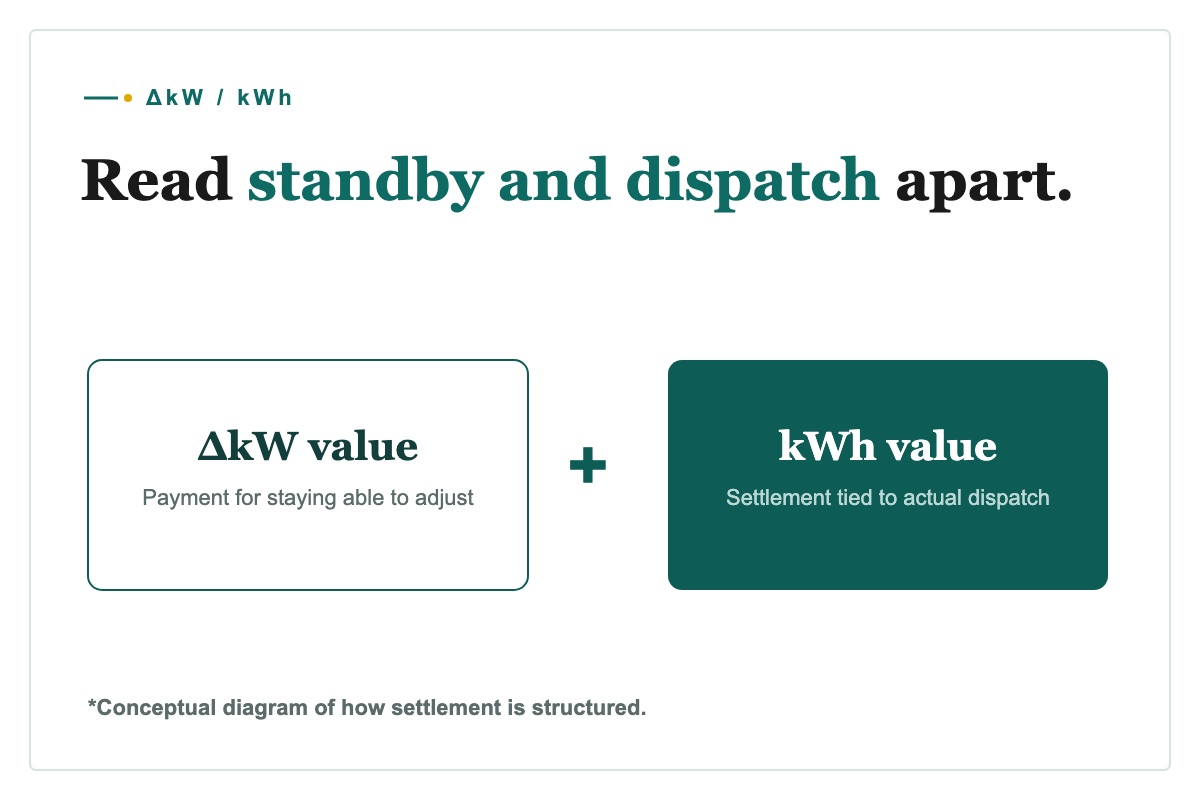
The viability of the balancing market is judged not by the names of the payments but by the full set of conditions from clearing to assessment.
The actual calculation and settlement differ by product, rules and assessment.
Rather than simplifying to "standby alone always pays", check the operating costs and the conditions at the same time.
Market watch
Even after the product line-up was expanded, the balancing market keeps revising its trading methods, procurement volumes and price rules. Do not simply extend recent prices into long-term revenue; test regulatory change and the competitive environment separately.
As of June 2026. For the latest information, see the Electric Power Reserve eXchange (EPRX) official site and related sources.
What changes returns
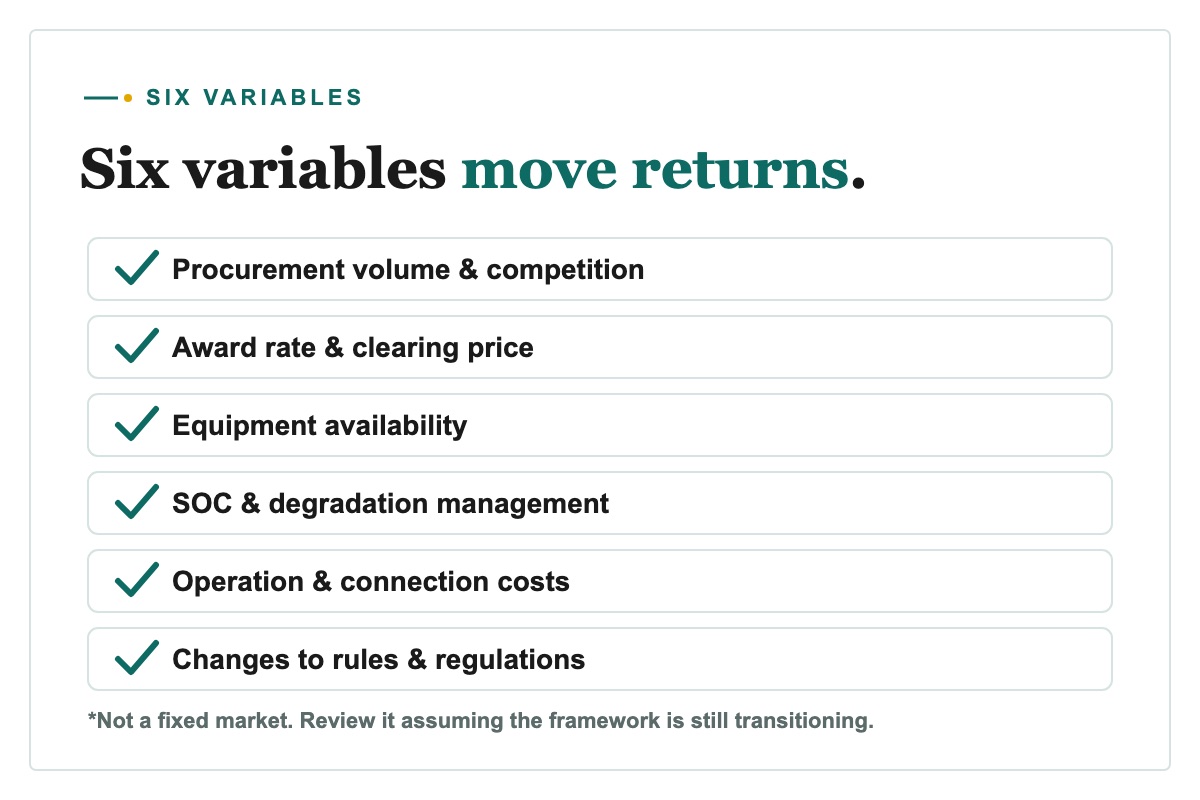
Following market prices alone will not tell you whether a project is viable. Run a sensitivity analysis across several variables covering equipment, contracts and operation.
The clearing environment changes with the volume procured, the number of participants and the bidding situation.
Bids will not necessarily be accepted in every slot you plan for.
Faults, maintenance and communications outages affect bidding opportunities and the assessment of performance.
Operation has to keep the state of charge while managing cycle degradation.
Build in the aggregator, communications, electricity procurement, O&M and more.
Prepare for revisions to product requirements, trading timing, price rules and more.
Decision checklist
Before the upside, check the risks of not being able to take part, of stopping, and of fewer accepted bids than assumed.
FAQ
The balancing market mainly keeps supply and demand in balance close to real time, the capacity market secures future supply capacity, and the wholesale market trades the energy itself. Because their purpose, what is traded and the time frame all differ, a battery project evaluates the revenue and the constraints of each market separately.
The idea is that, once a bid is accepted and the system is kept ready to deliver in line with the requirements, payment arises for the balancing capacity secured. But there are conditions, such as bidding, clearing, assessment and availability, and revenue does not arise all the time.
The main differences are response time, duration, how the signal is followed and the kind of fluctuation addressed. Primary handles instantaneous frequency changes, secondary short to medium cycles, and tertiary more planned adjustments such as forecast errors. Check the detailed requirements in the latest product requirements and trading rules.
Installing a system does not automatically qualify it. The response performance, measurement and communications, prior screening, operating structure, aggregation and other requirements for each product have to be met.
They can. Procurement volumes, trading timing, product requirements, price rules, fees and assessment may be revised. Rather than fixing a business plan on a single price assumption, it is important to check it against several scenarios and a sensitivity analysis.
No. It varies with clearing prices, the share of bids accepted, availability, degradation, the cost of procuring electricity, aggregator fees, regulatory change and more. Any estimate shown should be read with its assumptions, and understood as not promising future revenue.
The basic purpose of the market is the same, but equipment size, connection conditions, measurement and communications, participation unit and whether aggregation is needed all differ. Each project is checked by combining the equipment specifications with the participation scheme.
Check that the equipment specifications fit the product requirements, the connection and construction conditions, the aggregator contract, O&M, degradation and availability, the revenue scenarios, and how well the project holds up if the rules change. REVIX JAPAN sorts out the conditions of your project before the consultation.
For your project
Tell us the system size, connection conditions and operating method, and we will sort out the points for a project study that includes the balancing market.
Market revenue, yield and clearing are not guaranteed. Each study is based on the individual conditions and the latest rules.
