


01
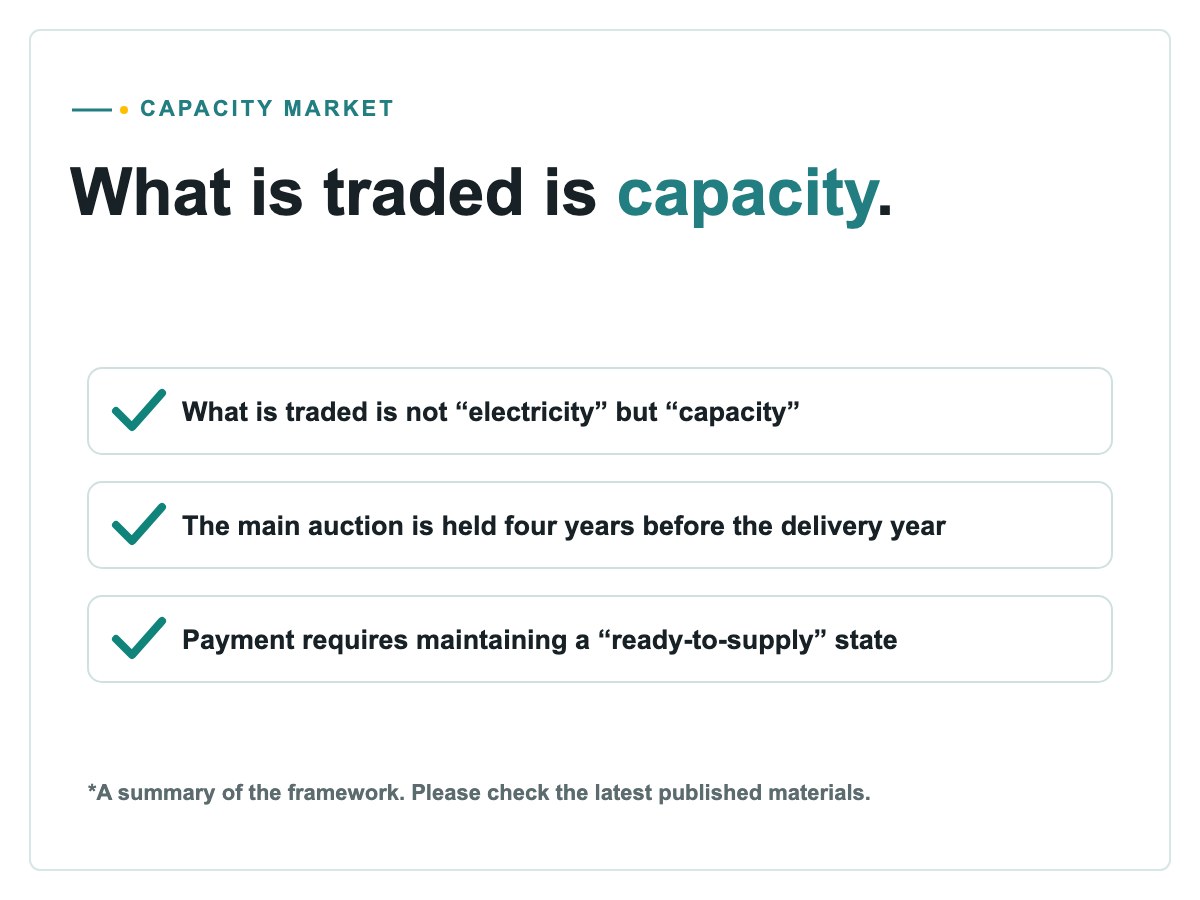
What is traded is "supply capacity", not "electricity"
Not the energy actually bought and sold (kWh), but the value of being able to supply power when needed (kW value) is secured.

Creating success in grid-scale battery storage, together.

CAPACITY MARKET GUIDE
A market that secures future power supply capacity now.
This page covers how it relates to grid-scale battery storage, the premises for revenue and the points to watch.
CONCLUSION
01
Not the energy actually bought and sold (kWh), but the value of being able to supply power when needed (kW value) is secured.
02
The volume needed is calculated from the future demand outlook, and supply capacity is secured in advance through an auction.
03
After winning a bid, the requirements must be kept; falling short can lead to a reduction in payment.
* The rules, participation requirements and assessment methods differ by target delivery year and resource category. Check the latest procurement guidelines and operating manuals.
BASIC
Electricity needs demand and supply to match at the moment it is needed. But as power plants are retired, demand grows and renewable energy expands, leaving future supply capacity to the market alone could delay investment decisions.
So the capacity market procures in advance the supply capacity that will be needed, and pays generators, batteries and other resources for keeping that capacity available.
MECHANISM
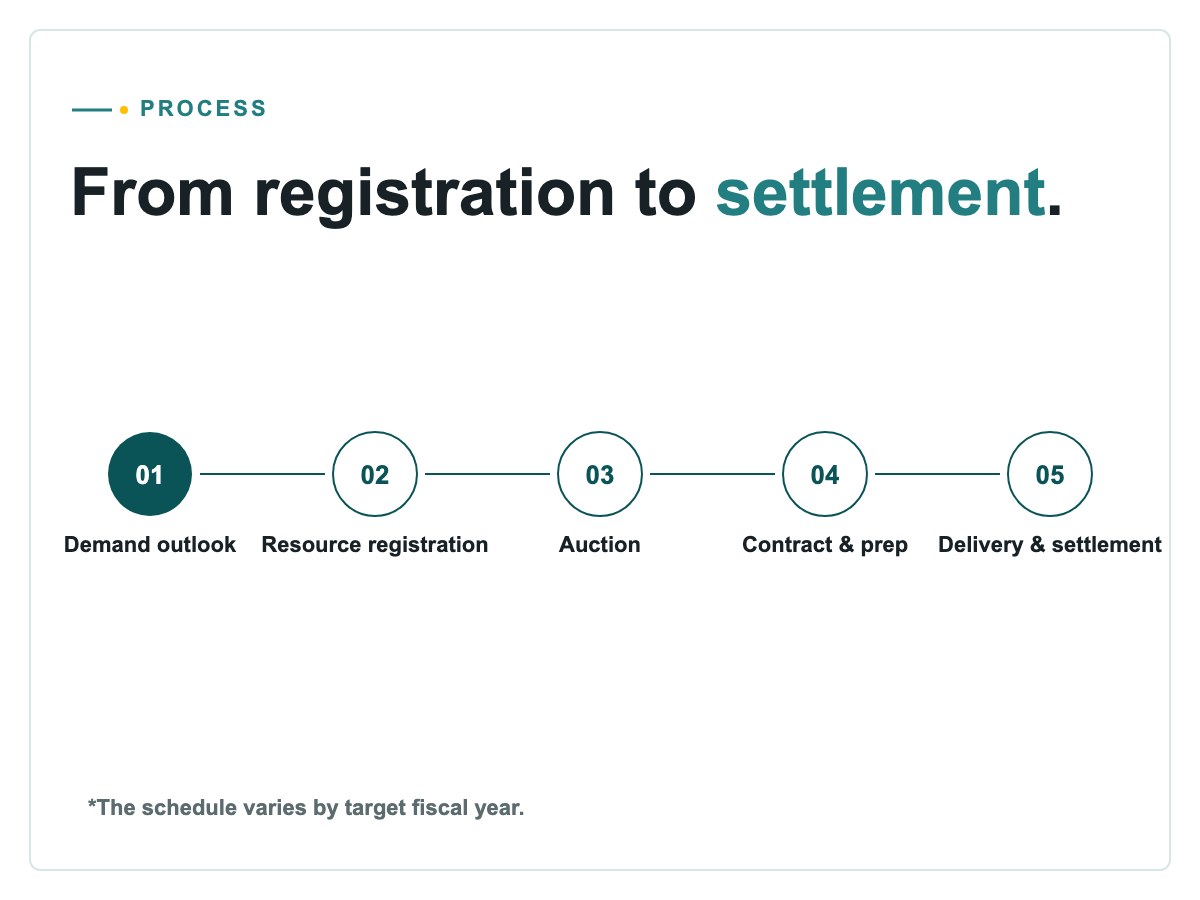
An outline in 5 stages. In practice there are registration, screening, contract and operating procedures for each resource category.
The supply capacity and procurement volume needed in the future are calculated
Equipment, expected capacity, category and so on are confirmed
Bids clear on the basis of the bidding results and the demand curve
Supply capacity is maintained toward the delivery year
Fulfilment of obligations is assessed and the contract amount settled
Winning a bid does not mean automatic fixed revenue. What matters is maintaining the equipment up to the delivery year and meeting the requirements during that year.
THREE MARKETS
| Market | Main value traded | Role | Time frame |
|---|---|---|---|
| Capacity market | Supply capacity (kW) | Secures future supply capacity | Medium to long term |
| Balancing market | Balancing capacity (ΔkW and others) | Adjusts real-time gaps | Real time to short term |
| Wholesale power market | Energy (kWh) | Buys and sells electricity itself | Day-ahead to same day |
When combining several markets, the obligations in the same time slot, the state of charge, output constraints and degradation costs all have to be managed together.
BATTERY & CAPACITY
Because a battery can discharge stored electricity in the hours it is needed, it may be counted as future supply capacity if it meets the conditions.
PROJECT CHECK
We confirm the system size, interconnection and operating policy, and consider not only the capacity market but how it combines with other markets.
REVENUE LOGIC
The capacity market can make revenue more predictable, but the amount, the bid result and fulfilment are not fixed.
The result varies with the demand curve, bid prices, area conditions, adjustment factors and more.
The basis is the expected capacity recognized under the rules, not the rated capacity of the equipment.
Failing to meet the obligation to provide capacity can lead to a reduction in the capacity contract amount.
With the capacity market obligations given priority, the room for operation in the balancing and wholesale markets is designed.
RISK & CHECK
Knowing the system is not enough for an investment decision. Equipment, contracts, operation and the financing plan are checked together.
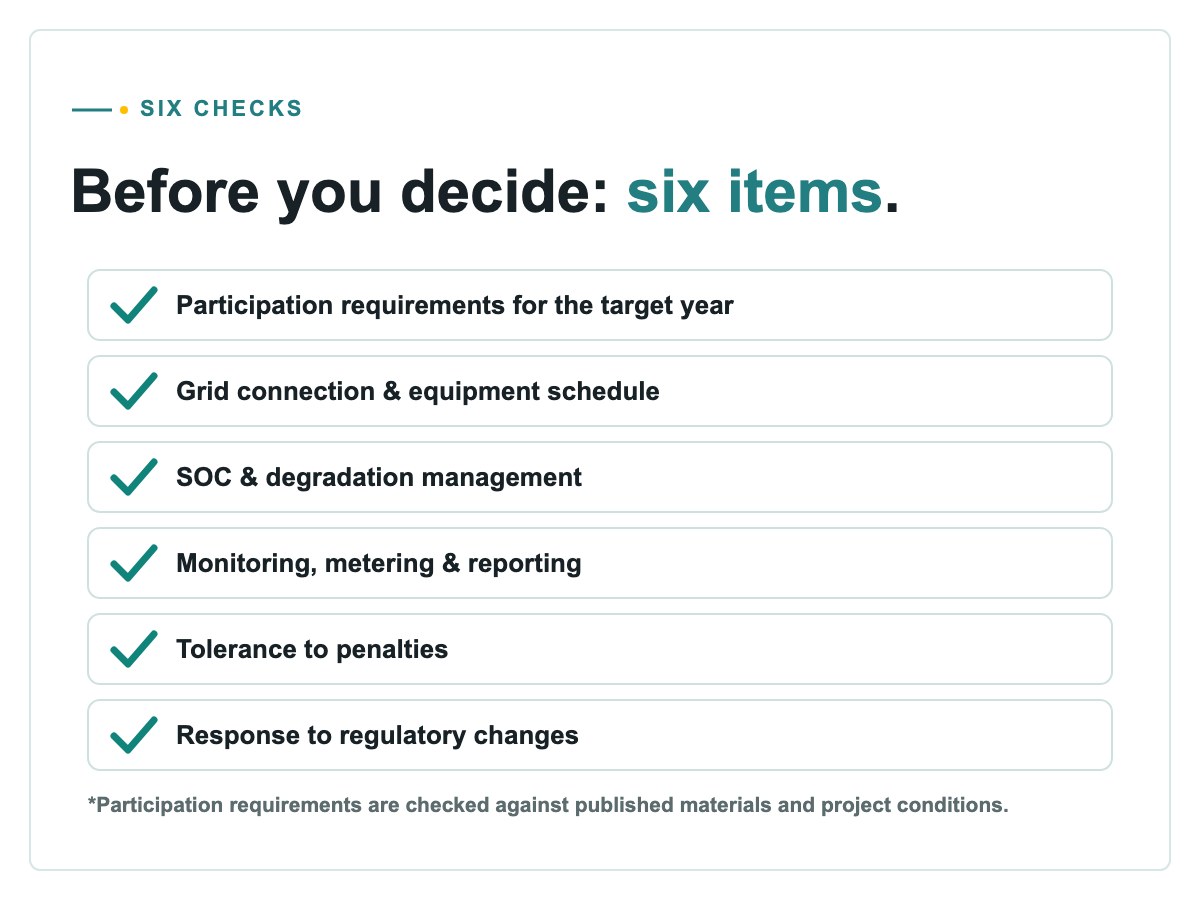
Check the procurement guidelines, resource category, expected capacity, minimum capacity and so on
Check that supply can start by the delivery year
Keep the operating headroom to sustain the required output when instructed
Check the practical structure for telemetry, metering, testing and reporting
Build reductions for shortfalls into the financial model
Keep operating and contractual room so the project does not depend on a single market
FAQ
Not the energy itself, but the ability to supply power over a set future period: the value of supply capacity (kW value).
The capacity market mainly trades future supply capacity, the balancing market balancing capacity close to real time, and the wholesale market energy.
It can be considered, but several requirements have to be checked: expected capacity, discharge duration, metering, resource category and the procurement guidelines for the target year.
Not by simply standing by. The premise is keeping the contracted supply capacity available in the delivery year and meeting the various requirements.
No. It varies with whether the bid is accepted, the contracted capacity, the price, fulfilment of obligations, assessment, regulatory change and more.
Combination can be considered within the regulatory requirements and operating constraints. Actual operation is designed including contractual obligations, the charge and discharge plan and equipment degradation.
The approach differs with equipment size, metering unit, whether aggregation is used and other factors. The conditions of each system need to be checked.
The premises for turning the project into a business: system size, interconnection, operating policy, participation category, combination with other markets and the expected risks.

CONSULTATION
Rather than deciding on the market rules alone, we check equipment, interconnection, operation, maintenance and the financing plan together.
You do not need to have decided on an investment or installation to get in touch.
