


01
Land alone is not enough to decide
Beyond the area and road frontage, we check the surroundings, the site grading conditions, the rights to the land and whether the equipment layout actually works.

Creating success in grid-scale battery storage, together.
HIGH-VOLTAGE BESS / INVESTMENT PROCESS
For corporate investors and operators
From the site check to grid connection and operation.
We split a complex process into 7 steps, so the next decision you need to make is clear.
What this page tells you
WHY THE PROCESS MATTERS
Land, grid, design, contract, construction and operation all depend on each other. Sorting out the issues early, and getting ahead of the points where projects tend to stall, makes your business decision more accurate.
01
Beyond the area and road frontage, we check the surroundings, the site grading conditions, the rights to the land and whether the equipment layout actually works.
02
The answers to the connection review and the contract application can change the assumptions for the scope of work, the schedule and the cost.
03
A plan only becomes workable once you can see through to the monitoring, maintenance, contact structure and contract terms that apply after the equipment is completed.
7 STEPS
Some stages run in parallel on each project, but dividing the order of decisions into 7 makes it easier to see where you are and what comes next.
* The stages, the required procedures and their order differ with the equipment scale, the connection point, the site conditions, the contract structure and more.
PROCESS DETAIL
We separate the decisions made on the investor or operator side from the practical work REVIX supports.
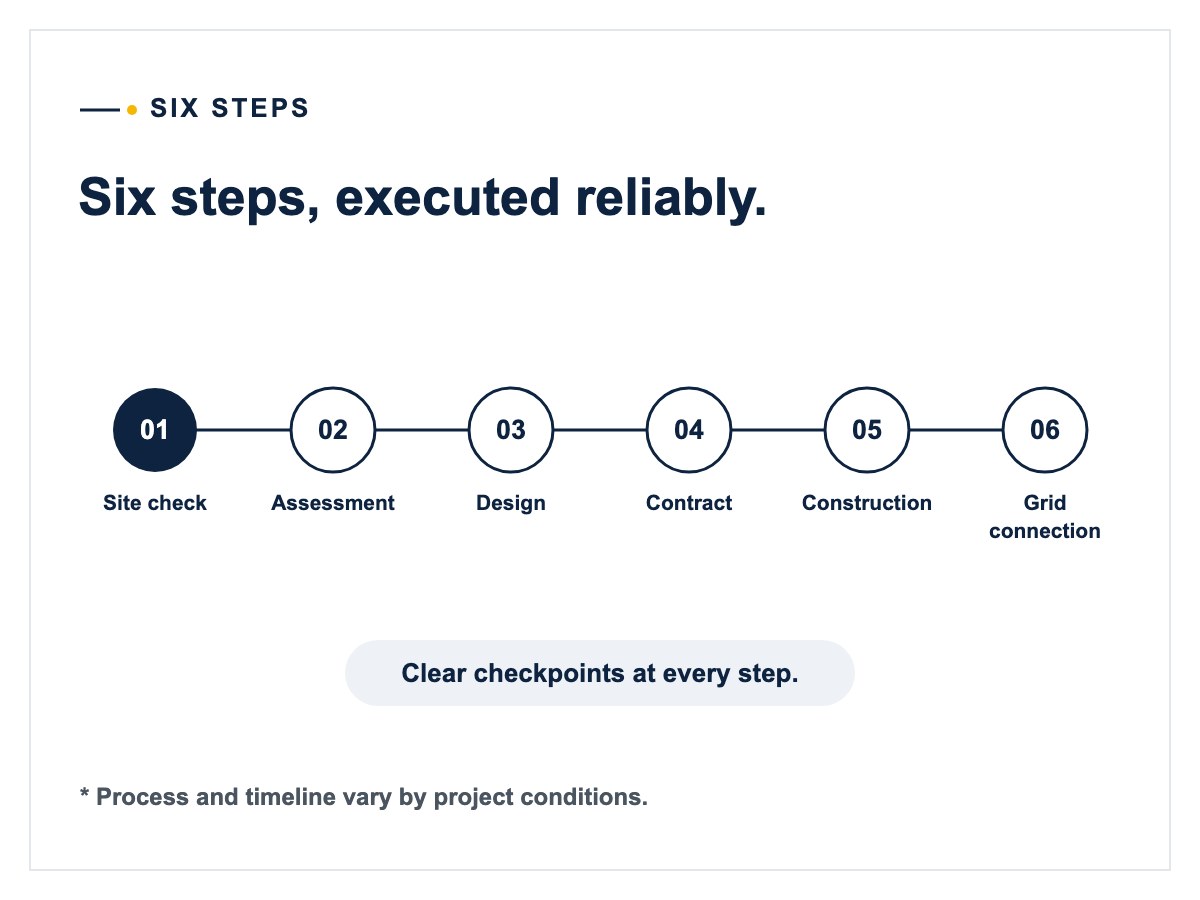
PHASE 1 / FEASIBILITY
STEP 01
We check the location, area, shape, road frontage, surroundings and the rights to the land, and sort out the assumptions for the equipment layout and the construction.
STEP 02
We identify the issues across the land, the grid, the equipment and the business scheme, and set out the conditions for moving on to the next survey or study.
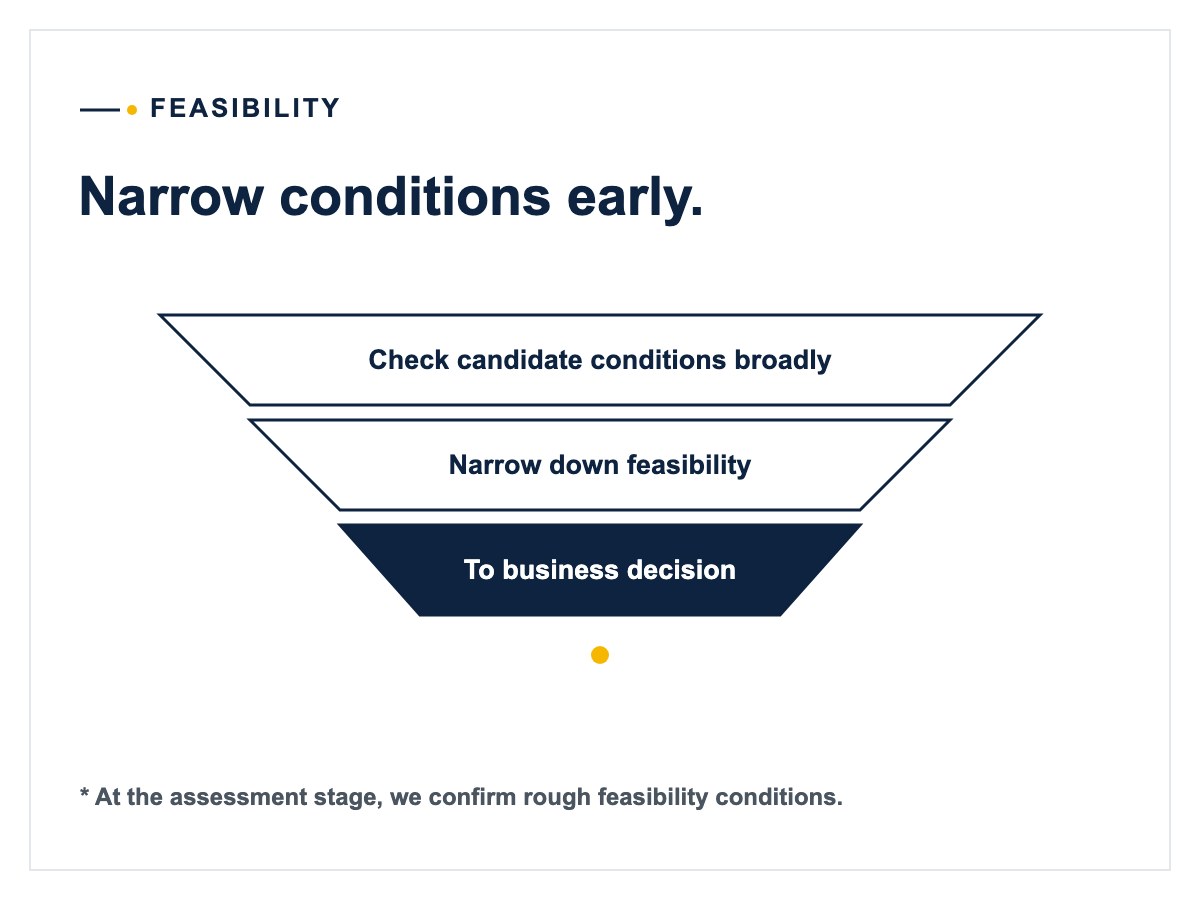
PHASE 2 / PLANNING & DECISION
STEP 03
We sort out the equipment configuration, the layout, the substation and connection equipment, monitoring and communications, the scope of work and more, and make the assumptions behind the business plan concrete.
STEP 04
We confirm the costs, payment terms, demarcation of responsibility, schedule, scope of warranty and maintenance, and the assumptions, and reflect what has been agreed in the contract.
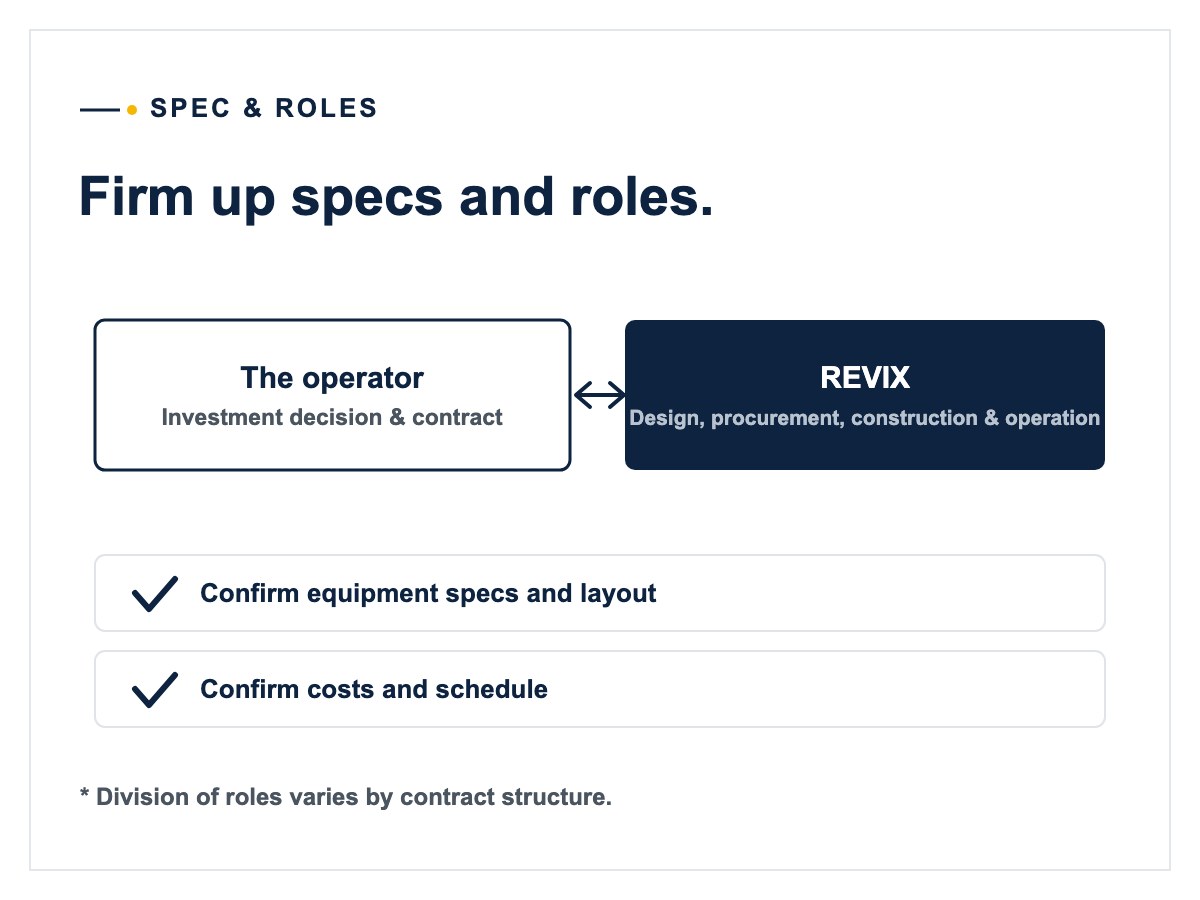
PHASE 3 / EXECUTION & COMMISSIONING
STEP 05
Based on the detailed design, we proceed with equipment procurement, grading, foundations, electrical work, equipment installation and the set-up of the communications and monitoring environment.
STEP 06
We carry out the procedures with the general transmission and distribution operator and others, and run the required tests and checks. Once the connection conditions are in place, we move to the start of operation.
PHASE 4 / OPERATION
STEP 07
Operational monitoring, periodic inspections, fault response, reporting and improvement continue. The specific scope of maintenance, warranty and monitoring is set for each project, based on the equipment adopted and the contract terms.
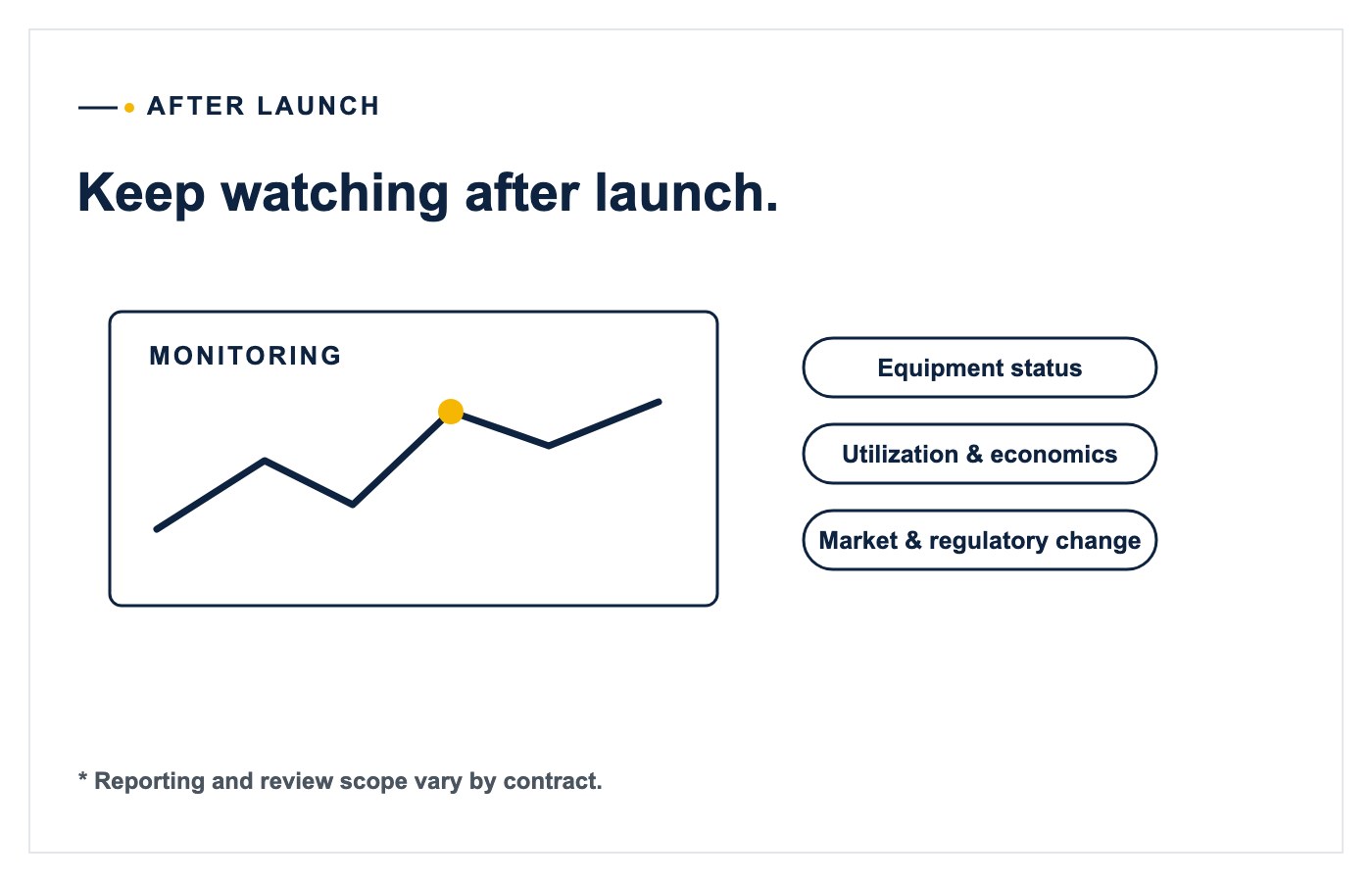
ONE-STOP SUPPORT
With a high-voltage BESS, the people in charge of technology, contract, construction and operation are easily split up, and a mismatch in assumptions leads to rework later on. REVIX organizes a single point of contact for the project and supports the coordination with the specialists and parties involved.
We bring the assumptions on land, grid, equipment, contract and operation together in one review sheet.
We share the design intent and the scope of work, and check how any change affects the business plan.
We sort out the items to confirm with the general T&D operator, the construction company, the equipment suppliers and others.
We get the scope of monitoring, maintenance, warranty and fault response into a state you can confirm before the contract.
APPLICATION COST
We publish the process and the costs of the grid application (the connection application to the utility)
START WITH YOUR CURRENT INFORMATION
Tell us what you know, such as the location and the scale you have in mind. We will sort out what needs checking next and how to proceed.
DECISION GATES
Rather than fixing everything at the start, we raise the accuracy of the information stage by stage.
| Decision stage | What mainly becomes clear | Documents often needed | Variable factors |
|---|---|---|---|
| Initial consultation and site check | Whether to continue the study, items for further investigation | Location, land area and shape, current photos, rights | Land conditions, delivery, surroundings, rights |
| Initial assessment and basic design | Equipment configuration, rough conditions, main risks | Planned scale, operating requirements, grid and equipment assumptions | Equipment specifications, grid conditions, permits, scope of work |
| Contract and detailed design | Costs, schedule, roles, contract terms | Design documents, quotations, draft contract, schedule | Equipment procurement, grid connection construction cost, change conditions, consultations with the parties |
| Construction, connection and preparation for operation | Completion conditions, testing, operation and maintenance structure | Construction and inspection records, as-built documents, operating procedures | Construction progress, test results, connection conditions, operation contract |
Because it differs greatly with conditions such as the connection review, the contract application, the construction and equipment procurement, we do not show a fixed timeline. We present the schedule after sorting out the assumptions for each project.
FAQ
Where the answer depends on the project conditions, we sort out the items to confirm at the first consultation.
See all high-voltage BESS FAQsWe work through 7 basic steps: site check, initial assessment, design, contract, construction, grid connection and operation. In practice some stages may run in parallel, and we also adjust the order to the project conditions.
It varies a great deal with the site conditions, the review of grid connection, permits, equipment procurement, the scope of work and more. After the initial assessment we sort out the assumptions and the schedule, and give you a guide for your project.
Documents showing the location, the land area and shape, current photos, and the rights to the land all help the review move forward. You can still consult us before the documents are complete.
It is not confirmed by an initial consultation or a connection review alone. It is confirmed through the set procedures with the general transmission and distribution operator and others, such as the connection approval that follows the contract application.
At the early stage we sort out rough conditions, and the accuracy improves once the design, the answer on grid connection, the equipment specifications and the scope of work become concrete. Some costs change with conditions set by third parties.
For each project we sort out the support needed after operation starts, such as operational monitoring, maintenance and the contact structure for faults. The specific scope and the warranty terms are confirmed before the contract.
Yes. We check the location, area, road frontage and surroundings, and sort out what to look into next. It is not an assessment that guarantees a viable project, but a check that gathers the inputs for an initial decision.
FROM LAND TO OPERATION
We ask about your stage of review, whether you have land, and the scale you expect, and sort out what to confirm next. Depending on what you tell us, we guide you on the documents you need and how to proceed.
* A consultation or assessment does not guarantee a viable project, grid connection or revenue.
