


Electricity is traded hour by hour
In the JEPX spot market, electricity for next-day delivery is traded as 48 products in 30-minute units.

Creating success in grid-scale battery storage, together.

WHOLESALE ELECTRICITY MARKET
For investors and project developers
Turning the hours when the price of electricity changes into value for a battery.
This page sorts out the spot and intraday markets and how price spreads are put to use.
* Market prices and revenue fluctuate. Nothing here guarantees future revenue.
ONE-MINUTE SUMMARY
In the JEPX spot market, electricity for next-day delivery is traded as 48 products in 30-minute units.
By charging in relatively cheap hours and discharging in expensive ones, it aims to put the price spread to use.
The design has to include charge and discharge efficiency, degradation, fees, forecast errors and competition with other markets for the same capability.
MARKET BASICS
Electricity is hard to store in bulk, and the balance between supply and demand changes hour by hour. In the wholesale market, generators, retailers and others state the volume and price they need and trade for each delivery period.
PRICE ARBITRAGE
The diagram below is conceptual, to show how it works. Actual price movements, operating hours and revenue differ by day, area and equipment conditions.
Value of electricity sold − cost of charging − losses, degradation and operating costs = contribution to the business
Even where a price spread is visible, once you allow for energy lost to round-trip efficiency, the cost of battery degradation, fees and operating constraints, the difference does not turn into profit as it stands.
MARKET COMPARISON
| Item | Spot market | Intraday market |
|---|---|---|
| Main role | Trades next-day delivery the day before | Adjusts post-spot mismatches on the delivery day |
| Trading unit | 30-minute units, 48 products a day | Trading by delivery product |
| Clearing method | Blind single-price auction | Continuous trading |
| From the battery's point of view | Next-day price forecast and charge-discharge plan | Room to respond to same-day changes, and the constraints |
* For participation conditions, bidding, settlement and metering requirements and fees, check the latest JEPX rules and the related contracts.
BESS OPERATION
Beyond following price movements, a structure is needed to run the battery safely and to plan, and to feed the results back into the next round of operation.
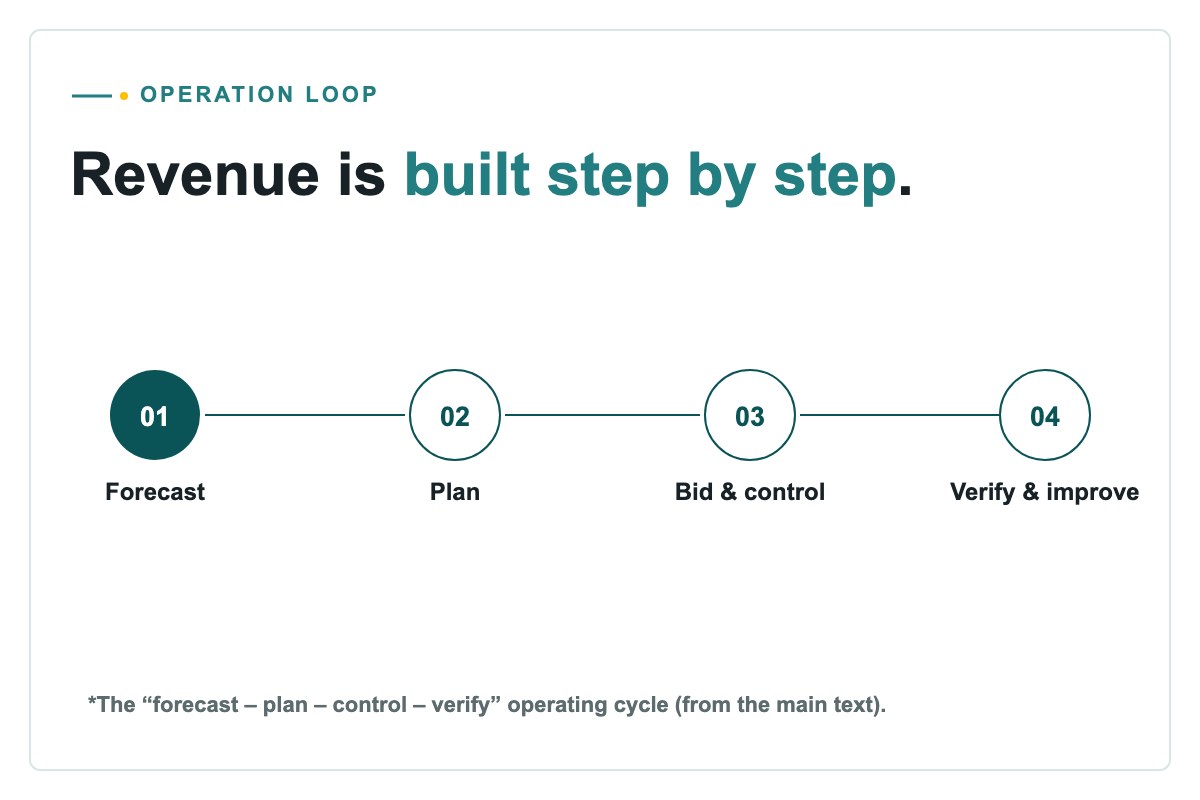
Form a view of next-day and same-day movements from weather, demand, generation plans and past prices.
Turn it into a plan that can actually be run, allowing for state of charge, output, capacity, bids in other markets and maintenance schedules.
Bid under the participation scheme, and charge and discharge within the equipment limits and safety conditions.
Reconcile clearing, instructions, actual results and degradation, and keep reviewing profitability and the quality of operation.
BUSINESS FEASIBILITY
Tell us the system size, land, interconnection, intended operation and combination with other markets, and we will set out the premises of the study and what to check next.
DECISION FACTORS
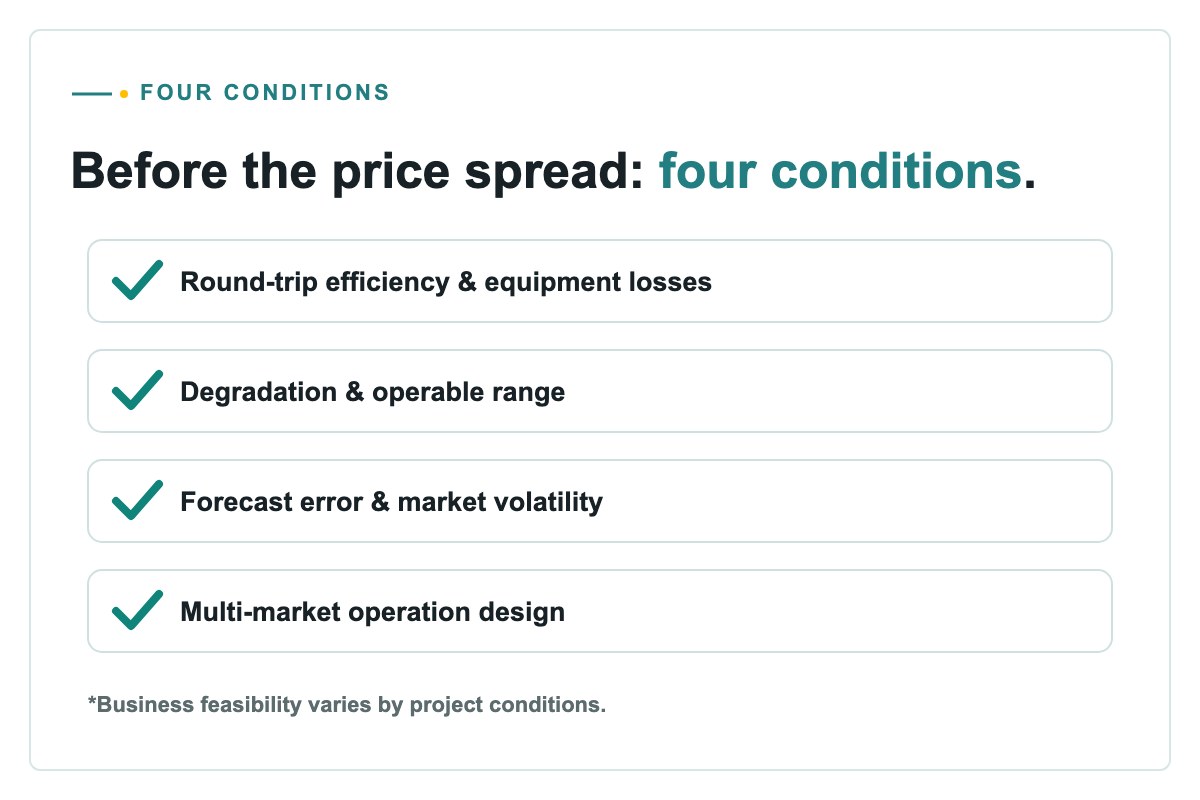
Not all the energy bought can be sold in the same amount. Check the losses, including the PCS and auxiliary equipment.
The best operating intensity changes with cycle count, temperature, state-of-charge range and warranty conditions.
Allow for cases where the spread does not appear as expected and cases where the plan has to change.
Sort out the roles and binding conditions of the wholesale, balancing and capacity markets, and avoid counting the same capability twice.
THREE MARKETS
The same battery provides different kinds of value: energy, balancing capacity and supply capacity. Operation is built with an understanding of the binding conditions of each market.
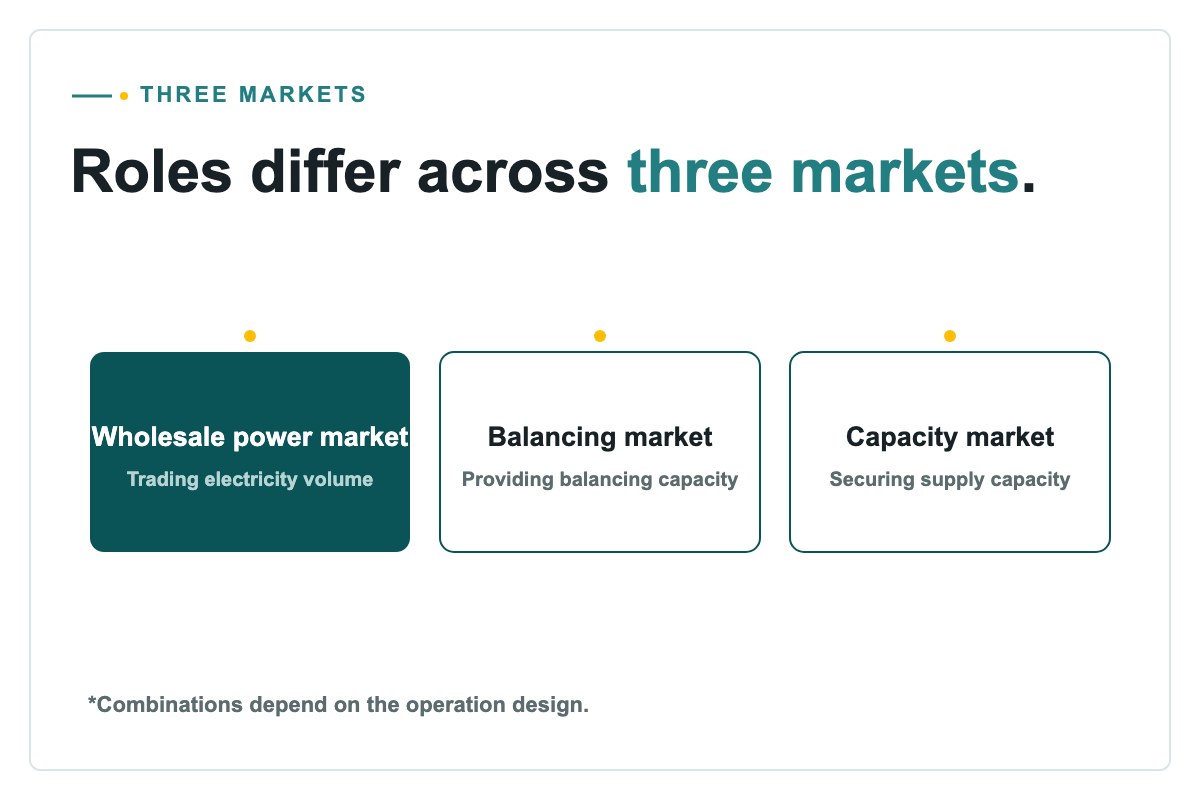
kWh value
Buy and sell electricity, aiming to use price differences by time of day and area.
This pageΔkW value
Provide the balancing capacity needed to keep frequency stable and correct supply-demand gaps.
Read morekW value
Supply capability is assessed in order to secure the supply capacity needed in the future.
Read moreRISKS & CHECKS
The wholesale market is a revenue opportunity, but it comes with volatility and uncertainty. We make the risks visible at the study stage.
Changes in the supply-demand structure or the generation mix may narrow the spread in the hours you counted on.
Trading rules, fees, settlement, metering and participation conditions may be updated, and need to be checked continuously.
Faults, maintenance, output limits or a low state of charge may stop you trading in the hours you aimed for.
Do not treat past high-price days as a normal year. Check the business case under several cases.

CONSULTATION FLOW
You do not need all the information yet. We separate what is settled from what is assumed, and set the priorities for the study.
Project conditionsLand, connection class, system size, desired timing
Operating assumptionsIntended markets, control structure, maintenance and warranty terms
Decision materialRevenue cases, costs, risks, further studies needed
FAQ
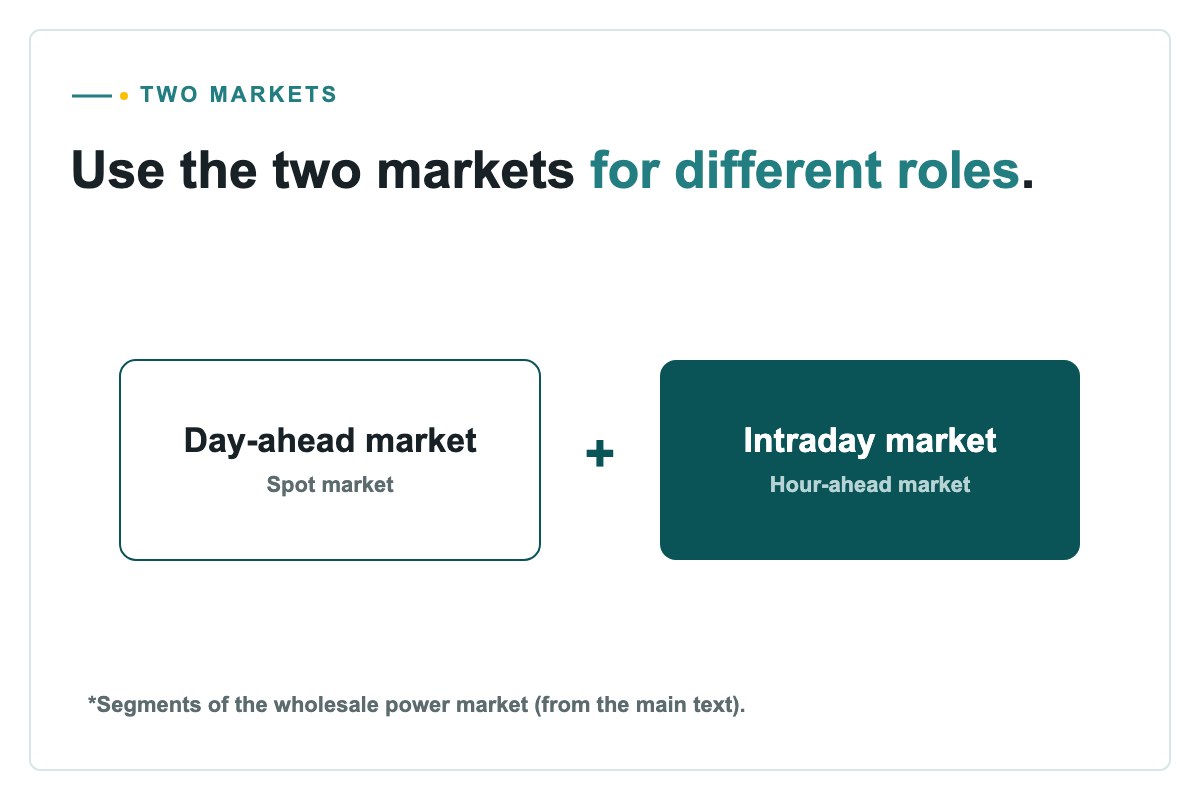
A market where generators, retailers and other businesses buy and sell electricity. JEPX runs the day-ahead market (spot market) for next-day delivery and the intraday market, which adjusts mismatches between supply and demand on the delivery day, among others.
The spot market trades next-day delivery the day before. The intraday market handles changes in demand, generator outages and similar events between the spot trade and delivery. The clearing method and the purpose of trading also differ.
The usual approach is to use the price spread: charge in hours when prices are relatively low and discharge in hours when they are high. But the business case has to be assessed after deducting charge and discharge efficiency, degradation, operating costs, fees and forecast errors.
Not always. There are days when the spread is small, days when the forecast is wrong, and days when equipment constraints stop the system running as planned. Revenue is not guaranteed, and a simulation covering several conditions is needed.
In the wholesale market, trading through charging and discharging is the basis. The value of standby capability itself may be assessed in relation to other systems and markets, such as the capacity market and the balancing market, so the roles need to be understood separately.
In practice it differs with equipment size, connection class, control and metering requirements, whether aggregation is used and other factors. The participation scheme and contract terms need to be checked for each project.
Yes. Trading rules, fees, and bidding, metering and settlement requirements may be updated. A structure for continuously checking official information matters not only at the investment decision but also after operation starts.
Tell us the system size, the land and the operating method you have in mind, and we will sort out the business case without leaning only on market revenue, the points to check and the next steps in the study. We do not guarantee the revenue of any particular project.
START WITH FACTS
We handle early-stage consultations, requests for materials and the premises of a business case.
Depending on your inquiry, we will let you know what needs checking and which documents are needed. Revenue is not guaranteed.