


Grid conditions
We check the response, the grid connection construction cost, the schedule, additional measures and the application conditions together as one set.

Creating success in grid-scale battery storage, together.

For investors and businesses considering buying a site
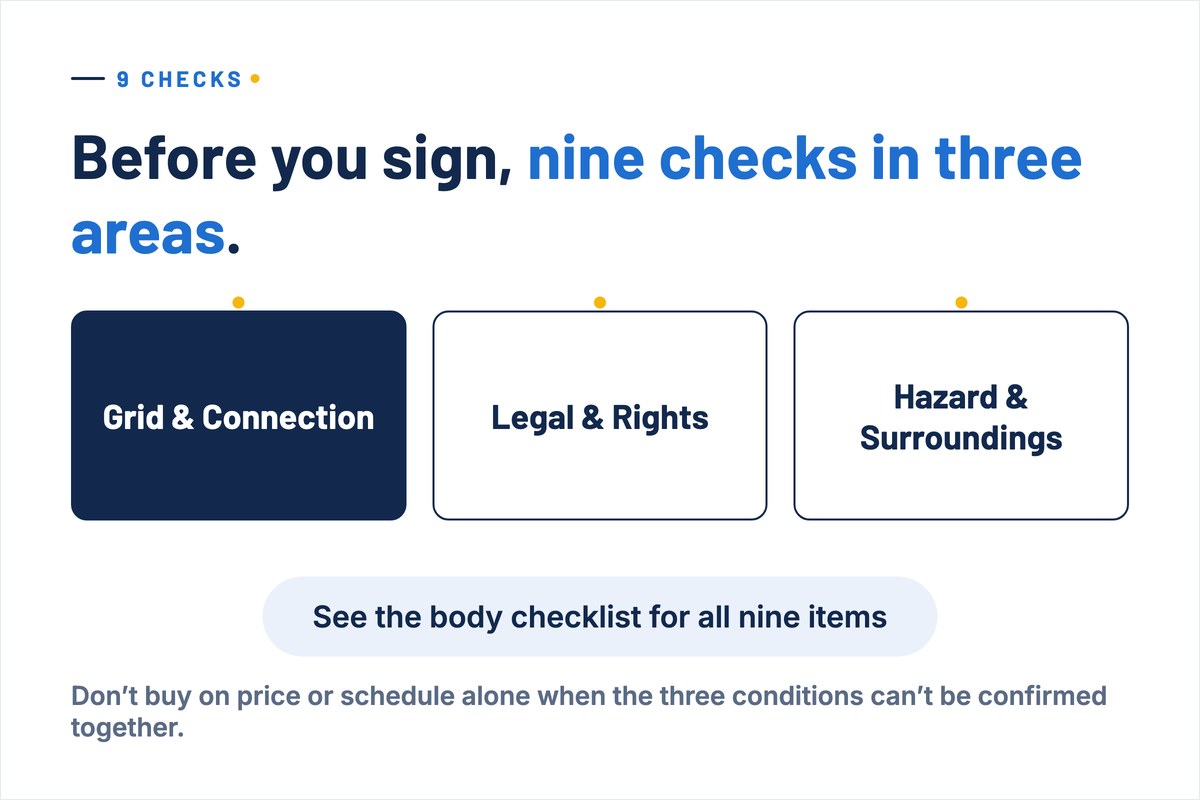
Looks and price alone cannot tell you whether a project will work. Before you buy, we sort out what may be overlooked on the grid, regulations and hazards, and give a free initial assessment based on the utility's response and public information.
Conclusion
Whether a battery storage site works as a project depends not only on the land itself but also on “whether it can connect to the power grid”, “whether permits and rights can be sorted out” and “whether measures against disasters and noise can work”. If you sign while even one of these is unconfirmed, it may lead to extra costs, changes to the plan or a longer timeline.
We check the response, the grid connection construction cost, the schedule, additional measures and the application conditions together as one set.
We check landowner consent, boundaries and road frontage, procedures for development, farmland and the like, and buried cultural properties.
We check disaster risks such as flooding and landslides, noise at the site boundary, and the surrounding environment.
Official sources we referred to
Pre-purchase checklist
“There is a response”, “The site is already graded” or “A substation is nearby” is not enough to decide. We check that the documents are consistent with each other, and how the conditions affect the project’s finances and schedule.
GRID CONNECTION
LEGAL & RIGHTS
HAZARD & NEIGHBORHOOD
If even one item is “no documents”, “unclear explanation” or “impact of the conditions unclear”, do not rush to sign; go to a specialist DD.
Not being able to confirm something is itself important risk information.
Common pitfalls
In some cases the problem is not the land itself but the order of the checks or a lack of information to decide on. Before you buy, we separate out the following 3 points.
PITFALL 01
The response may contain information that affects whether the project works, such as application conditions, technical constraints and items needing further checks. We check not only individual wording but also the application history and the status of the connection application.
Entries such as “No Special Measures Applied” and “Voltage Fluctuation Over 2%” are not judged on the spot; we work out their impact from the response as a whole.
PITFALL 02
Even flat land with road frontage needs checks on disaster risks, boundaries, land category, development and grading, buried cultural properties and more. We sort out the issues through a desk review of public information and lead on to the on-site and administrative checks that are needed.
We judge how easy the site looks to build on separately from whether construction is legally and technically possible.
PITFALL 03
The criterion is not simply the distance to the nearest home, but the sound pressure at the site boundary, which depends on the municipality, the zoning district, the time of day and so on. We consider the equipment layout, orientation, clearances and noise control measures from the early planning stage.
The surroundings change. A layout with room to spare, which also allows for future use of neighboring land, is important.
Even if your documents are not complete, we check the current situation and sort out the documents and surveys needed next. Please consult us even if you have not decided between sale and entrustment.
What the diagnosis covers
Rather than giving a definitive yes or no on the purchase, we make clear, from the documents available now, “what should be checked before going ahead”.
We sort out the connection conditions, the schedule and construction cost, and wording that needs further checks.
We check hazards, noise, buried cultural properties and more on the basis of public information.
We sort out missing documents and the priorities for moving on to on-site, administrative and technical checks.
* The preliminary assessment is a rough assessment based on desk research, public information and the documents you provide. It does not make legal judgments or finalize surveying, ground investigation, design or permits.
Documents & flow
Tell us the location, the status of your study and what you want, such as sale, entrustment or considering a purchase.
Share the documents you have at this point, such as the response, a location map and land-related documents.
We sort out the issues in grid conditions, regulations and rights, and hazards and the surrounding environment.
We guide you on the order of the next steps, such as additional documents, on-site checks, inquiries to the authorities, and consultation on sale or entrustment.
Related guidance
Check location risks and how the site boundary is considered.
CONNECTION ANSWERPoints to check beyond the schedule and construction cost.
SPECIAL PROVISIONSorting out how this entry in the response affects whether the project works.
VOLTAGE FLUCTUATIONA starting point for judging whether additional measures may be needed.
FAQ
An initial check is possible within the scope of public information and the documents you can provide. However, the reply to the connection study or similar documents are needed to confirm the grid conditions.
Not necessarily across the board. We judge each case individually, including the type of disaster, the expected depth and zone, grading and equipment measures, insurance and project conditions.
As a rule, the preliminary assessment is a rough assessment based on desk research, public information and the documents you provide. Site entry, surveying and definitive legal and technical investigations need to be checked separately.
Because they can affect whether the project works and whether additional measures are needed, we check them together with the conditions of the response as a whole. Do not decide on the entry alone; consult a specialist, taking in the related documents and the application status.
Yes, you can. We check the site conditions and your wishes and sort out the options of sale, entrustment or continuing to consider.
Documents confirming landowner consent, the reply to the connection study, a copy of the connection application, and a location map, cadastral map, land survey map and the like help the check move forward.

Before you sign
Based on the response and the land documents, we sort out what can be confirmed now, which documents are missing and what surveys are needed next.