
Creating success in grid-scale battery storage, together.

LOW-VOLTAGE GRID-SCALE BESS

What Is Low-Voltage BESS

It does more than store electricity.
It is commercial equipment that supports the power grid.

From how it differs from a home battery, to how market participation works and the conditions to check before installation. We sort it out so that first-time readers can move on to their next decision without misunderstandings.

* Market participation conditions and profitability differ with the rules, the market product category, contracts and operating conditions.

Low-voltage grid-scale battery storage equipment installed on a site in Japan
TYPICAL SYSTEM 49.9kW / 100kWh Varies by product and configuration

01

DEFINITION

Low-voltage grid-scale battery storage,
in a word

It is small-scale commercial battery storage equipment that connects to the power grid of a general transmission and distribution operator and helps balance supply and demand by charging and discharging electricity.

"Low-voltage" refers to the voltage class at which it connects to the grid. "Grid-scale" means that, rather than being used only inside a home or a factory, it serves the stable operation of the power network.

The basic approach for low-voltage resources is that an aggregator controls and operates several systems together to meet the market participation requirements.

02

DIFFERENCE

How it differs from a home battery

Both are "batteries", but they differ in purpose, what they connect to, who operates them and how they are expected to earn.

Comparison of a home battery and low-voltage grid-scale battery storage
Item Home battery Low-voltage grid-scale battery storage
Main purpose Self-consumption, lower electricity bills, backup for power outages Contributes to grid supply-demand balancing and is operated as a business
Connection and scope of use Used mainly with the electrical equipment inside the home Connected to the grid of the general transmission and distribution operator
Who operates it Homeowner, HEMS, etc. Business operator, aggregator, EMS, etc.
How it creates value Less electricity bought, emergency power Provides balancing capacity under markets and contracts
Checks before installation Installation location, home wiring, subsidies, etc. Grid connection, site, laws and regulations, market participation, maintenance structure, etc.

* Capacity, configuration and contract type differ by product and business scheme.

WHY

WHY NOW

Why grid-scale battery storage is needed now

Solar, wind and similar sources change their output with the weather. On the power grid, however, generation and consumption must be kept matched at all times.

Batteries are a flexible resource that closes this gap by charging and discharging when needed. The balancing market was established in 2021, and trading in all market product categories began in fiscal 2024. A policy has also been set out to start using low-voltage resources and individual device metering from fiscal 2026.

As the conditions for bundling and using small systems begin to fall into place, land that has been hard to use and dispersed equipment can also become options for supporting the power infrastructure.

Rules checked against: information published by the Electric Power Reserve eXchange (EPRX) and the Ministry of Economy, Trade and Industry (checked on June 20, 2026)

03

BUSINESS MECHANISM

The basic mechanism that creates revenue

A single low-voltage unit does not bid directly on its own. Several systems are bundled and take part in the market together.

  1. 01

    Install and connect the equipment

    Check the site conditions and whether grid connection is possible, then configure the battery, PCS, EMS and other equipment.

  2. 02

    Bundle several resources

    The aggregator controls the systems together and meets the market participation requirements.

  3. 03

    Provide balancing capacity

    The systems charge and discharge in line with instructions under the market and contracts, providing value such as standby and activation.

  4. 04

    Earn revenue under the contracts

    Depending on market results and contract terms, this leads to revenue for the business operator and rent for the land.

Be sure to check

Revenue varies with the market environment and contract terms. The factors behind the variation and the points to check are explained in detail on the "Risks" page. See how to read the risks

Start with the details in our materials
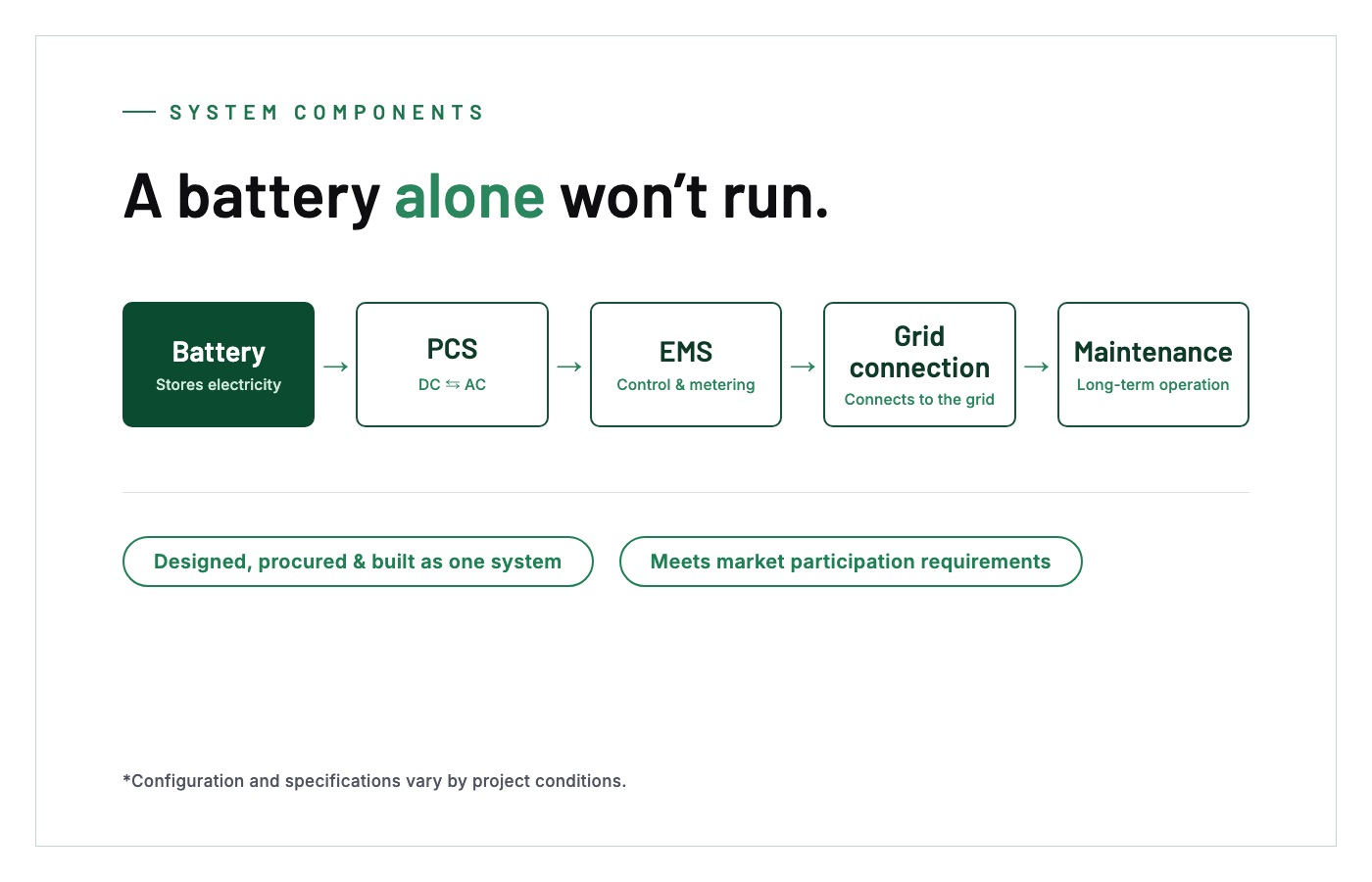
Diagram: a battery alone won’t run. The battery, PCS, EMS, grid connection and maintenance are designed, procured and built as one system to meet the market participation requirements

SYS

SYSTEM COMPONENTS

A battery alone
won’t run the business

To take part in the markets, the equipment, control, grid connection and maintenance have to be designed as one system.

  • 01
    Battery and PCSStore electricity and convert between DC and AC
  • 02
    EMS and communicationsCharge and discharge commands, monitoring, data links
  • 03
    Substation and connection equipmentTransformer, metering, service entrance, protection devices
  • 04
    Foundation, fence and disaster preventionSafe installation, clearances, delivery access, upkeep
  • 05
    Market operation and maintenanceAggregation, inspections, fault response

04

TWO ROUTES

How you can use it depends on your position

LANDOWNER

01

Lease your land
as a landowner

We check whether idle land, a parking lot, surplus factory land or similar can be a candidate site. If the conditions fit, you move on to a land lease agreement.

  • Consult us starting from an initial assessment of the land
  • Consider a scheme in which the business operator bears the equipment investment and operation
  • Check the rent, contract period and removal conditions
See the conditions for using your land

INVESTOR / OPERATOR

02

Own and operate the equipment
as an investor or business partner

Site acquisition, equipment procurement, the financing plan, grid connection, market operation and maintenance are designed as one, aiming to earn revenue as a business.

  • Sort out the initial investment and the operating costs
  • Assess the risks of market price changes, degradation and downtime
  • Also consider a plan to roll out several projects
See the business scheme

05

CONDITIONS & RISKS

"It fits" and "it works as a business" are separate decisions

Even if the equipment physically fits, it cannot become a business unless the grid, legal, revenue and contract conditions are in place.

Site and delivery access

We check the area, road frontage, delivery route, ground conditions, clearances, surroundings and flooding risk.

Grid connection

Whether connection is possible, the grid connection construction cost, the conditions in the utility’s response, the construction period and more are checked through the procedures with the general transmission and distribution operator.

Laws and safety

Checks are needed according to the area and the equipment configuration, covering fire safety, building, electrical, land use and other rules.

Project economics

We study several scenarios that include equipment costs, connection costs, maintenance costs, degradation, downtime and price changes.

Contract terms

We check everything through to the division of responsibilities, revenue sharing, the contract period, early termination, restoration to the original condition and removal of the equipment.

FREE CHECK

Start with an initial check of your candidate site or plan

Even before your documents are ready, we can sort out the items that need to be checked.

Request materials or consult us

REVIX JAPAN SUPPORT

We do more than sell equipment.
We connect the issues all the way to a working business.

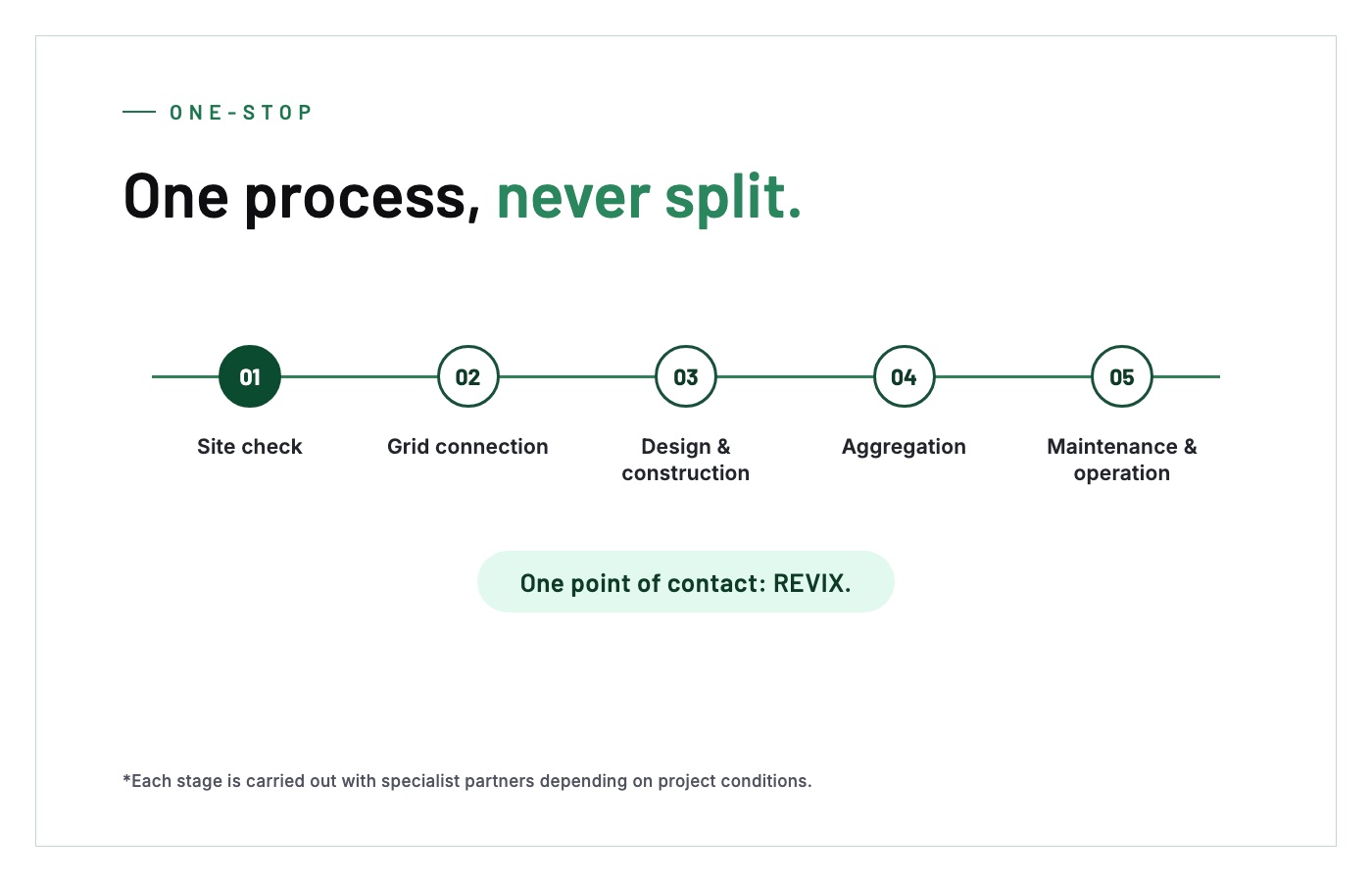
From checking the candidate site to grid connection, design and construction, aggregation and maintenance. We do not split the process into separate stages, and we move forward while sorting out what you need for each decision.

  1. 01Initial consultation and interview
  2. 02Site and grid check
  3. 03Business scheme and economics study
  4. 04Contract, design and construction
  5. 05Operation and maintenance
Diagram: one process, never split. Site check, grid connection, design and construction, aggregation, and maintenance and operation, with REVIX as the one point of contact

FAQ

FREQUENTLY ASKED QUESTIONS

Frequently asked questions

Q How is it different from a home battery?
A

A home battery is used mainly for self-consumption and as a backup for power outages. Low-voltage grid-scale battery storage is commercial equipment that connects to the power grid and takes part in power markets such as the balancing market through an aggregator.

Q Can a single low-voltage battery take part in the market on its own?
A

In principle, a single low-voltage unit does not bid directly on its own. An aggregator bundles several resources to meet the market participation requirements. The specific way of taking part and the requirements differ with the market product category, the fiscal year and the operating conditions.

Q Can it be installed on any land?
A

Not every piece of land is suitable. We check road frontage, the delivery route, clearances, flooding risk, laws and regulations, whether connection to the power grid is possible and other points, and make an overall judgment.

Q Is the revenue guaranteed?
A

Revenue varies with market prices, auction results, operating conditions, contract terms and other factors, so it is not guaranteed. It is important to sort out the assumptions for your own case and then check the estimate.

Q What should I check first?
A

If you are considering using your land, please have the location, area and road frontage ready. If you are considering it as a business, please have the site conditions, budget, preferred timing and similar information ready. It is fine if some items are still undecided at the initial consultation.

NEXT STEP

Why not apply this to your own land or plan,
and sort out what you need for your next decision?

It is fine if some information is still undecided at the initial consultation. We guide you through the items to check for your position, whether you are looking at land use or at running a business.

Sources for information on the rules

The rules and product requirements may be revised. When you actually study a project, check the latest published materials and the conditions of your own case.