


The basis for the revenue is hard to see
You need to check which markets are used, what the estimate assumes, and how far the figures include costs and risks.

Creating success in grid-scale battery storage, together.

High-voltage BESS / FAQ
Viability, grid connection, warranty, operation and exit. We have sorted the points you will want to check before an investment decision into what can be answered from public information and what has to be checked project by project.
For the first consultation, the candidate site, scale and investment policy can still be undecided.
Firm facts kept apart from case-by-case checks
We do not make blanket statements about revenue, timelines or warranty. We make the conditions for a decision clear.
Business, technology and operation covered together
Not only the market. Site, grid connection, maintenance and exit are checked as one sequence.
Answers matched to your project
We ask about the candidate site and investment policy, then sort out the surveys and documents needed next.
Before investment
High-voltage BESS cannot be judged by comparing equipment alone. Revenue, grid and operation need to be lined up on the same assumptions.
You need to check which markets are used, what the estimate assumes, and how far the figures include costs and risks.
Unless the connection prospects, the grid connection construction cost, permits, fire service consultation and site development conditions are all in place, the schedule for the project cannot be fixed.
If the scope of responsibility of the equipment maker, EPC, EMS, aggregator and O&M is not lined up before the contract, the response to a fault becomes unclear.
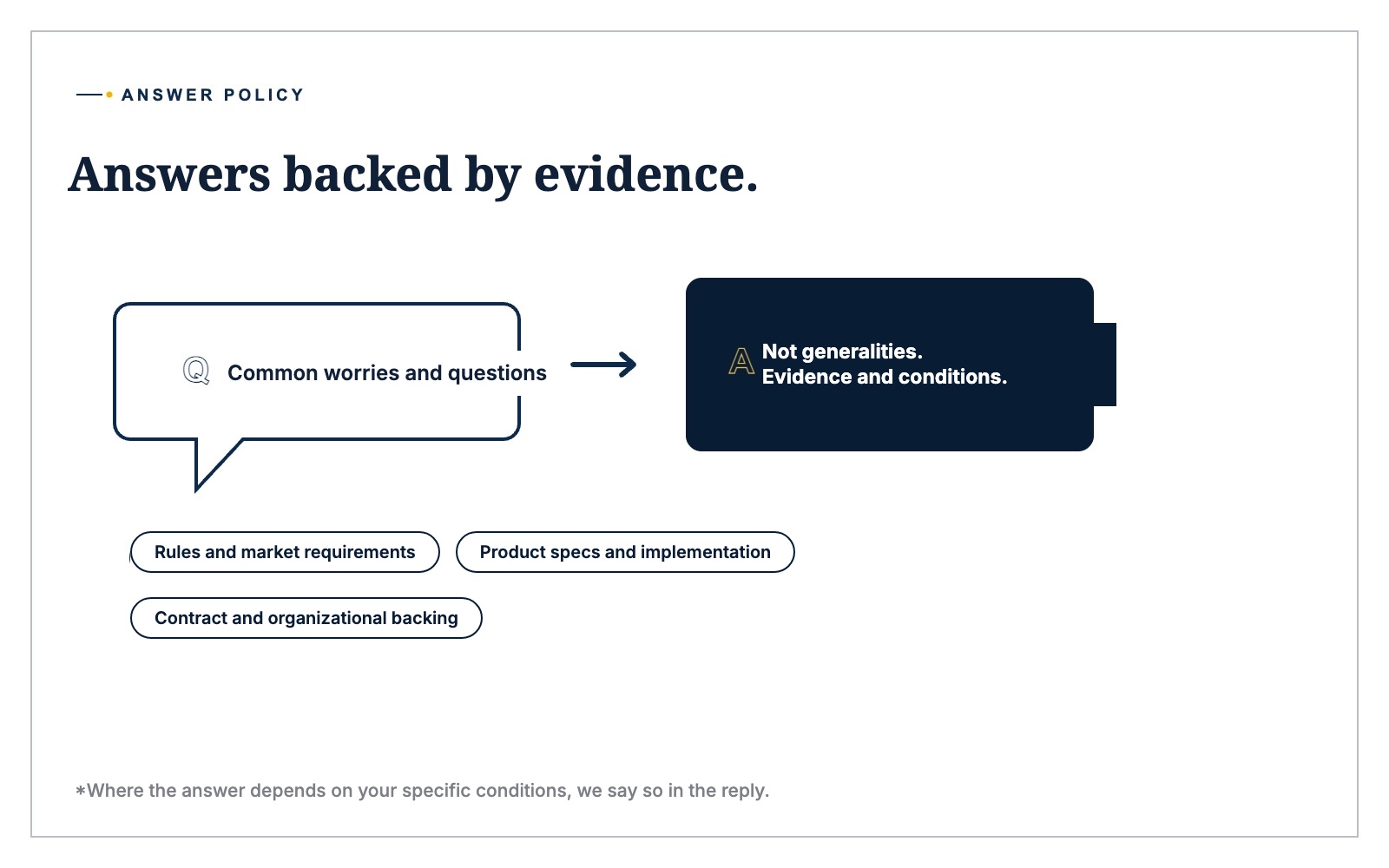
Answer policy
We do not mix up what can be answered in general terms with what cannot be answered without seeing the evidence, the contract and the site conditions.
The basic structure of the markets, the usual installation steps, the points to check, and so on.
Site, grid connection, construction cost, equipment capacity, revenue estimate, schedule and so on.
Warranty scope, maintenance response, performance conditions, division of responsibility, penalties and disclaimers, and so on.
Case-by-case judgments on legal, tax, accounting, permit, insurance and business transfer matters.
Find your question
Type a keyword to narrow the list down to the matching questions.
Showing 12 questions
Which markets the revenue comes from, the assumptions behind the yield, regulatory change and how to choose an aggregator are answered on the page about how revenue works.
See the FAQ on how revenue works Questions about estimates and costsHow to read the estimate figures, the stage at which costs become clear, and how maintenance costs are built in are answered on the Nippachi Simulator and costs page.
See the Nippachi Simulator FAQ Questions about sites and grid connectionHow much land is needed, whether grid connection is possible, permits and the connection study are answered on the site requirements page.
See the site requirements FAQ Questions about safety and disaster preventionSafety design against fire and natural disasters, certification, fire service consultation and conditions in the surrounding area are answered on the NEXTES safety page.
See the safety FAQ Questions about warranty, maintenance and operationWho to contact when a fault occurs, how the warranty relates to the maintenance contract, and what work arises after operation starts are answered on the O&M and maintenance page.
See the maintenance FAQ Questions about timelines and the processThe steps from consultation to the start of operation, how long they take, and the documents needed are answered on the installation process page.
See the installation process FAQHow to think about long-term holding, sale, business succession and removal
We assume options such as continued ownership, business transfer, sale of the equipment, succession of the land contract, renewal investment, and removal with site restoration, and sort out in advance the contract period, the residual value of the equipment, warranty transfer, the grid contract, and disposal and recycling costs. The legal, tax and accounting treatment is confirmed with specialists.
Exit conditions depend on the contract structure and on laws and regulations, so each project needs its own check.No matching question was found. Try another keyword, or use an individual consultation.
Discuss your assumptions
Once we know the candidate site, the planned scale and the investment policy, we sort out the grid connection, site, revenue and contract items to check, and guide you through the order of the next surveys.

Prepare for consultation
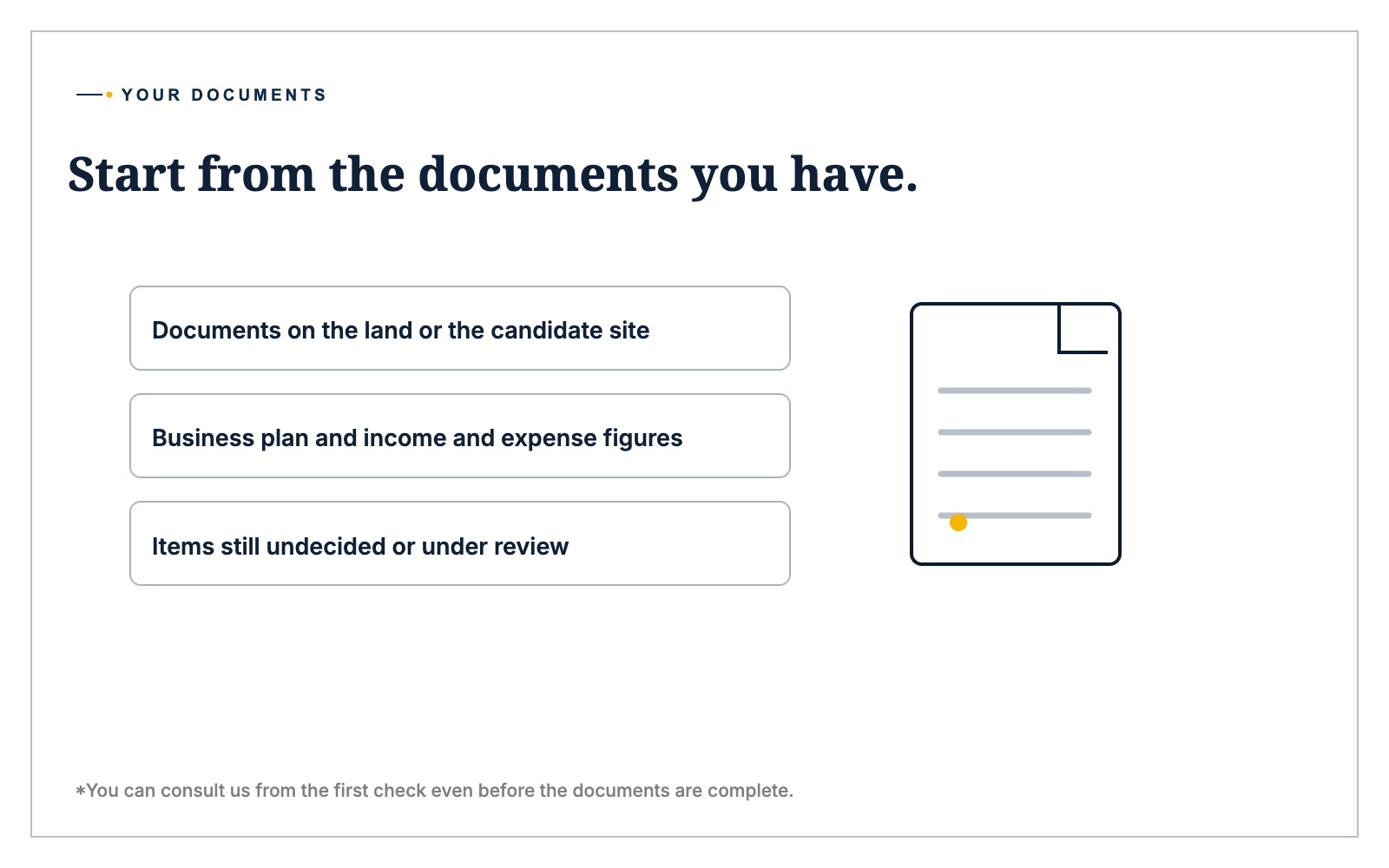
None of it has to be settled. Share where your study stands, including the items still undecided.
Location, area, owned or leased, road frontage, current condition, and the lot number and drawings if you have them.
The output and capacity you have in mind. A figure worked back from the investment budget is fine too.
Your preference, such as owning it yourself, a joint venture, using financing, or a planned sale.
Share any grid connection response, land documents, quotations, design proposals or revenue estimates you have.
How we answer
We do not stop at answering the question. We connect it to the next step for deciding whether the project can go ahead.
We ask about the candidate site, scale, budget, investment policy and preferred timing, and make the undecided items visible.
Among grid, site, equipment, contract and revenue, we sort out which items to check first.
If the project looks viable, we make the documents needed and the schedule clear and move to the next stage.

Start with a fact check
Not only revenue, but site, grid, warranty, operation and exit. We sort out the assumptions of your candidate project and guide you through the order in which to investigate.
Estimates and answers are based on the information you provide and on the rules, market and contract conditions at the time of the check.