


Small, with limited uses
Even land too small for a house or shop, or hard to use as a parking lot, may allow an equipment layout to be considered.

Creating success in grid-scale battery storage, together.
Low-voltage BESS × land use
A way of using land in which you lease land you are not using and aim for long-term rent income, without buying equipment or handling day-to-day operation.
* About 6 tsubo, 30,000 yen a month and 15 years are an assumed example. They vary depending on the land conditions, whether grid connection is possible, the contract details and so on.
All subject to individual conditions and the contract details
LANDOWNER CONCERNS
You are not thinking of selling it, yet management work and fixed costs keep coming. For land like that, there is a way to use it without owning equipment.
Even land too small for a house or shop, or hard to use as a parking lot, may allow an equipment layout to be considered.
Land far away or inherited land tends to leave you with nothing but the work of managing it. We set out the option of switching it to business use.
In this assumed model the landowner does not build or invest in equipment, so you can consider it without a large initial investment.
THREE BENEFITS
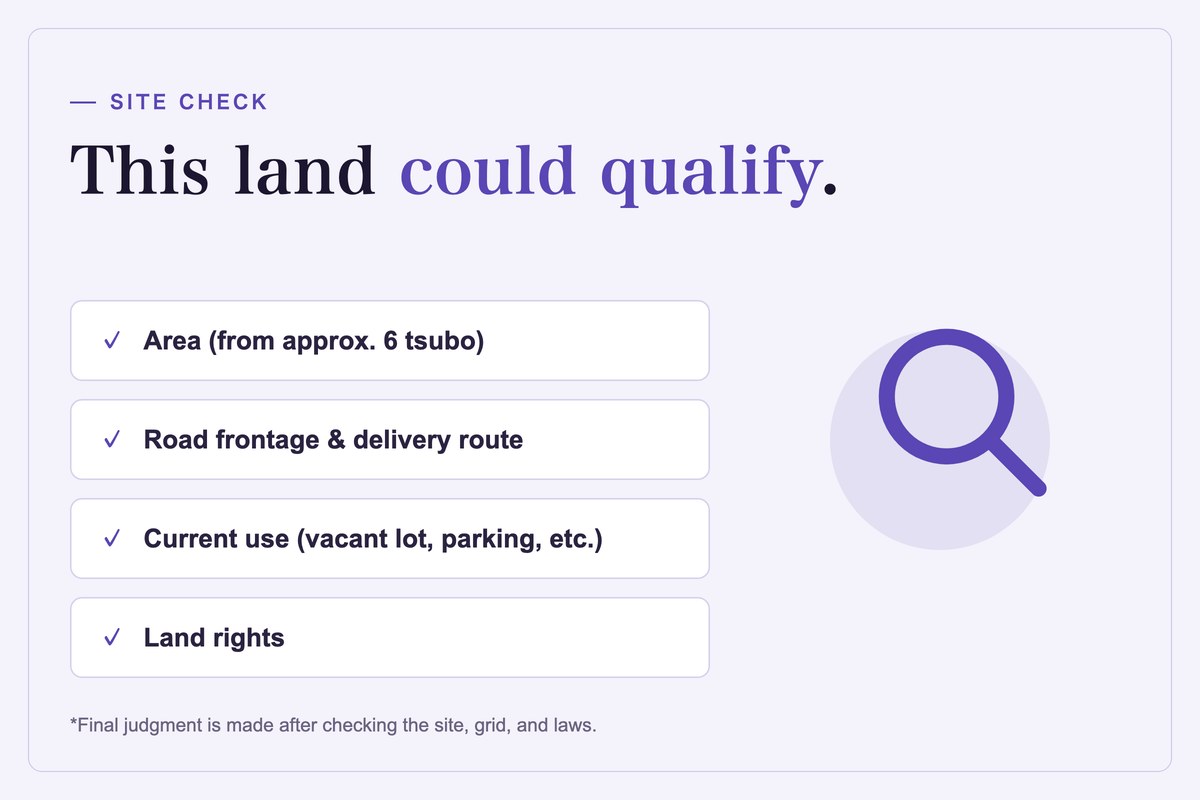
We check the land conditions, delivery access, grid connection, laws and regulations, and the surroundings. The design, construction and operation of the equipment are assumed to be carried out by the operator.
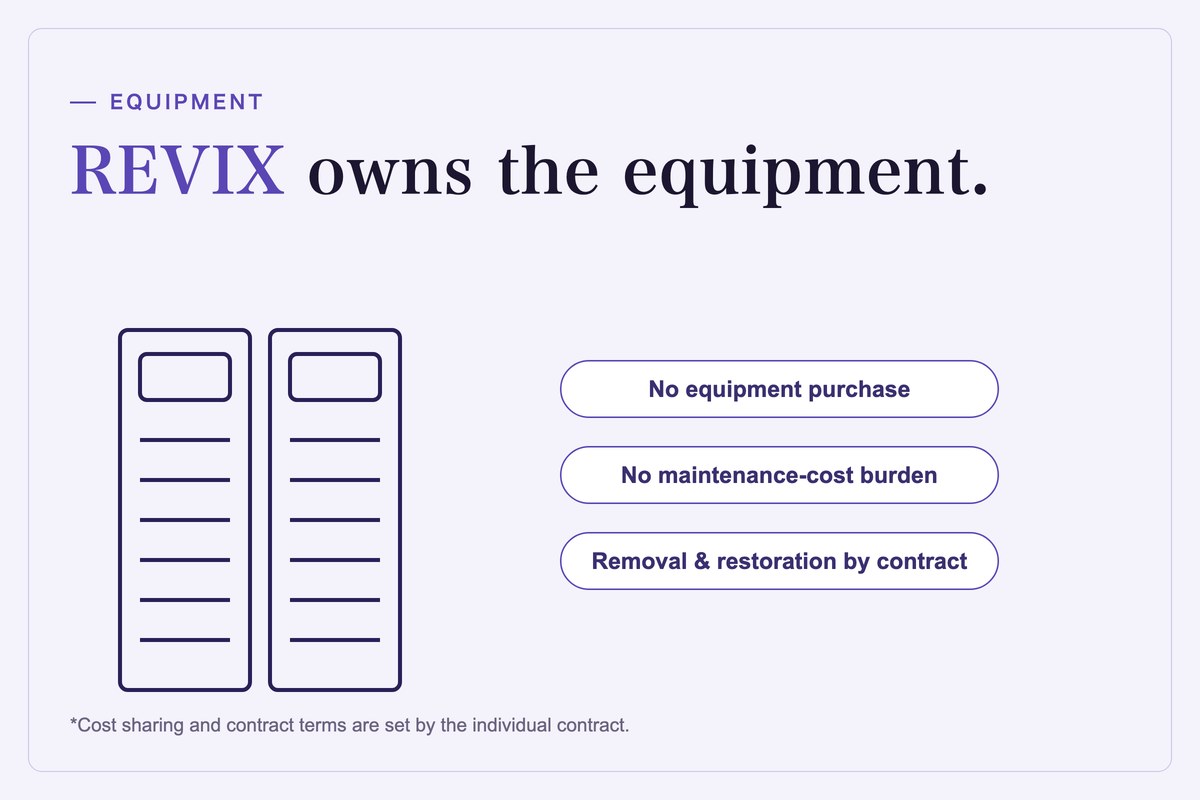
In this model you check the monthly rent and the contract term in advance, and earn ongoing rent income from idle land. It is not designed for the landowner to bear fluctuations in market revenue directly.
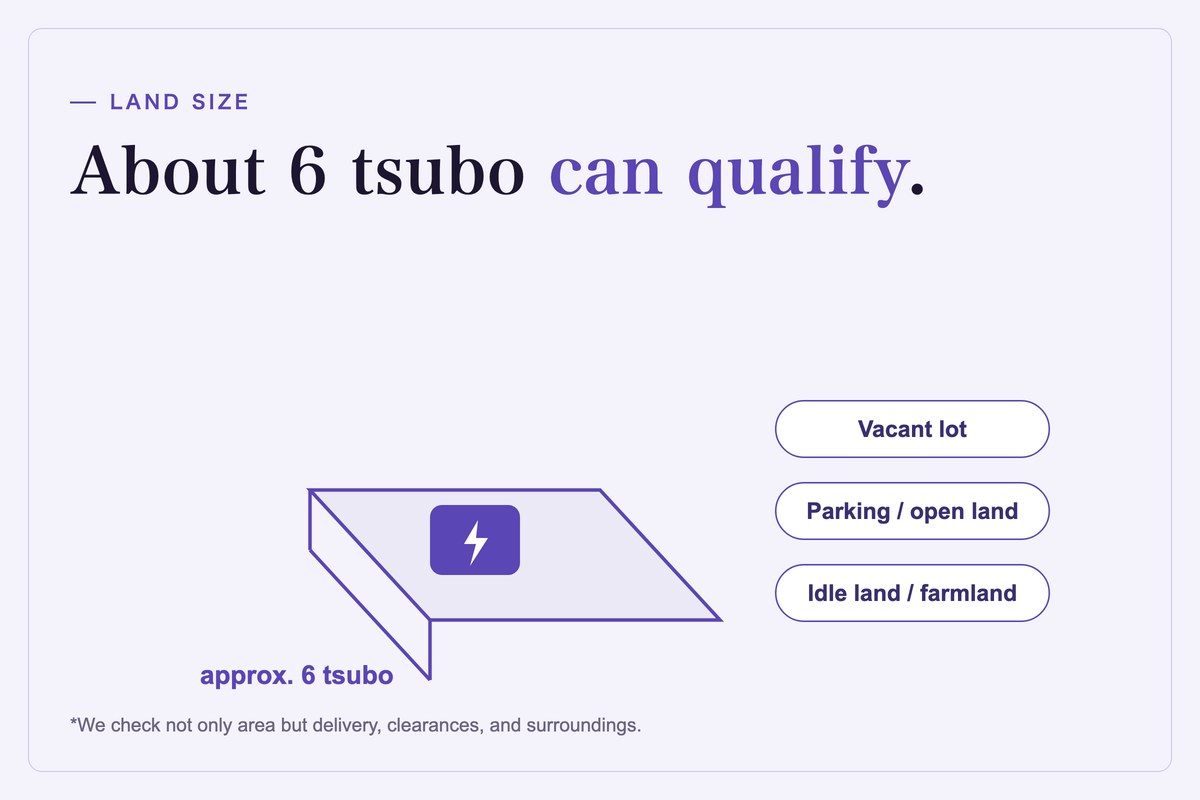
Before the contract, we set out how things are handled at the end, such as equipment removal, foundations, wiring, fences and the condition in which the land is returned.
RENT MODEL
This is not a fixed rent. It is an assumed model for when the target land, the equipment plan and the connection conditions are all met.
Rent is set by conditions such as the location, the shape of the land, whether grid connection is possible, and laws and regulations. The assumptions behind the estimate, the division of costs and the details through to after the contract ends are set out on the revenue model page (main guide).
* The figures shown are assumed examples as of the time this page was made, and do not guarantee the rent or the contract term. Formal terms are presented after the site, the grid, laws and regulations and so on have been checked.
FREE SITE CHECK
Based on the location and an outline of the land, we make an initial check of whether it may be possible to move on to the next stage of study.
Approximate area and shape
Points to check for delivery access and road frontage
Issues of law and land use
Documents needed next and the steps to check
An assessment alone is fine. There is no obligation to sign a contract.
SITE CONDITIONS
We check the condition of the land and its surroundings as a whole. Even if some items do not apply, please consult us first.
| Item to check | Guide for the initial check |
|---|---|
| Area and shape | Whether there is room for the equipment, clearances, fences and working space |
| Road frontage and delivery access | Whether construction vehicles and the equipment can be brought in |
| Ground and differences in level | Whether additional work for grading, foundations or drainage is needed |
| Land category | Whether farmland conversion or land-use procedures are needed |
| Surroundings | Whether consideration is needed for homes, roads, rivers, hazards and so on |
| Grid connection | Whether the utility is likely to study the connection and give a response |
Whether installation is finally possible is decided after an on-site check, a contract application to the utility and its response, and checks with the authorities and on laws and regulations.
PROCESS
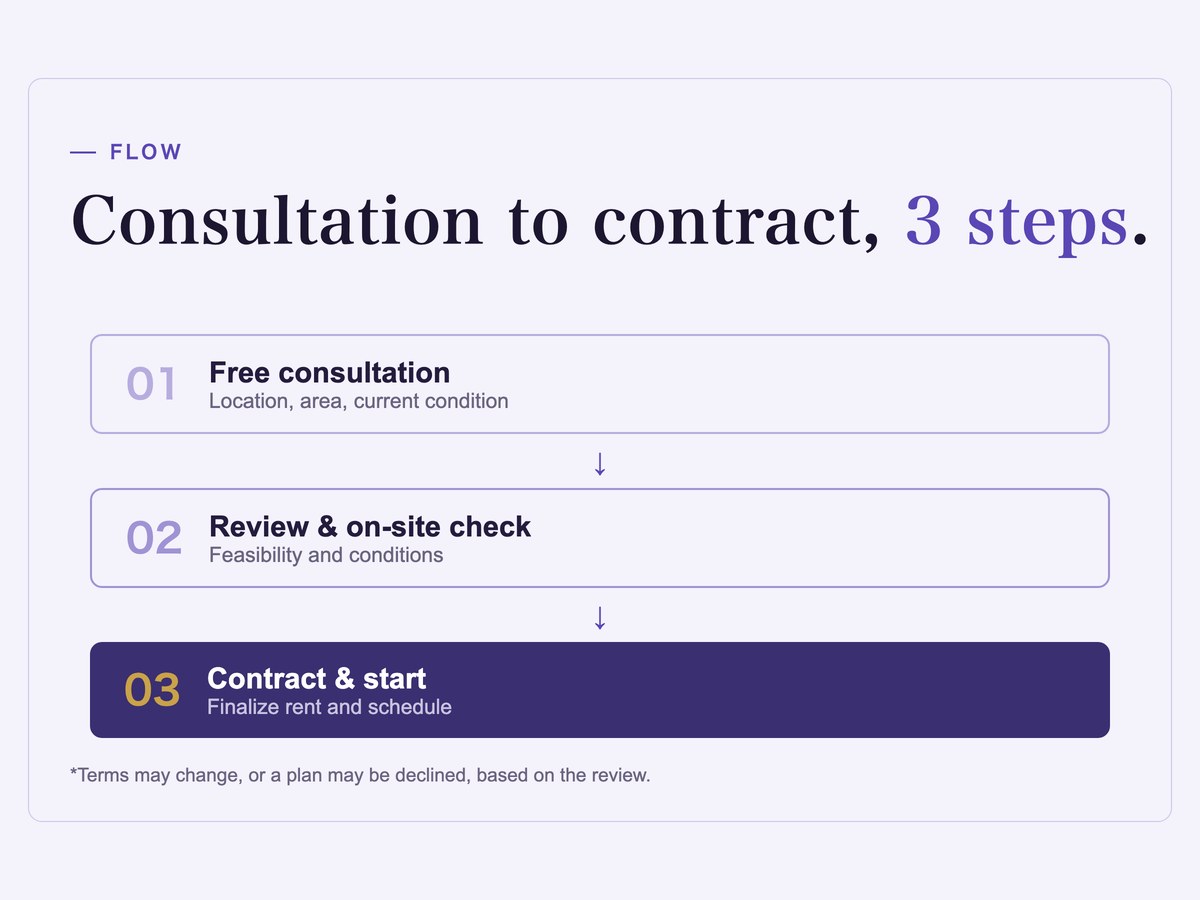
Start with an initial assessment. While checking the conditions, we move on to the contract, construction and operation.
Share the location, area, current condition and so on
Check delivery access, laws and regulations, the surroundings and the grid
We explain the rent, the term and the removal terms
Contract and applications once the details are agreed
After the equipment is installed, rent starts according to the terms
* The time required varies depending on grid connection, administrative procedures, construction conditions and so on.
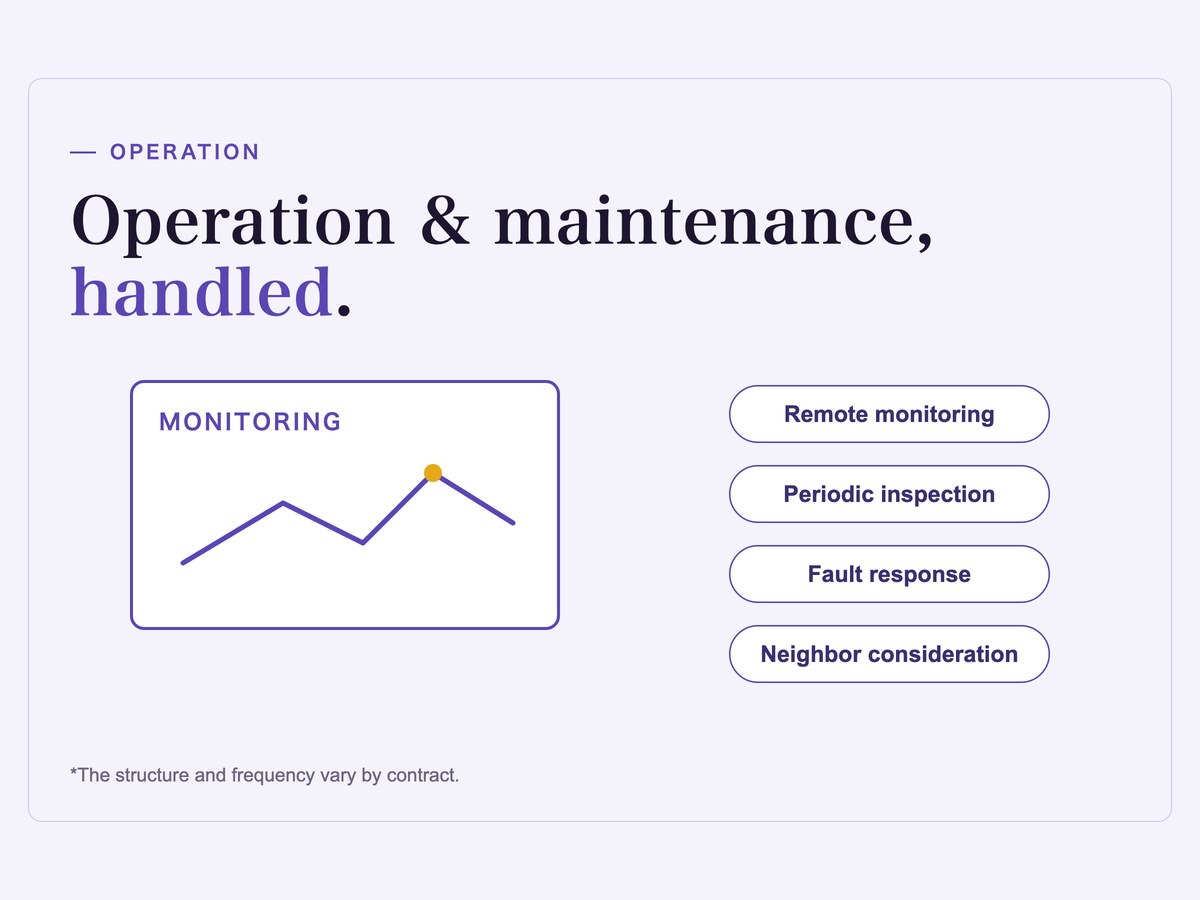
SAFETY & MANAGEMENT
It is not a case of “install it and that is the end.” We set out a design and management plan that fits the equipment specifications and the land environment.
Check clearances, fences and maintenance access routes
Check the position of the equipment relative to homes and so on
Set out the scope of inspections and the contact structure before the contract
Put the equipment removal and land return terms in writing
FAQ
The decision depends on the shape of the land, the equipment layout, the delivery route, clearances and so on. Rather than judging for yourself by area alone, please tell us the location and the approximate dimensions. We will check case by case.
The assumed model on this page is based on a scheme in which the landowner does not bear the costs of installing and operating the equipment. However, this varies depending on the type of contract and the land conditions, so please confirm the formal terms in the individual proposal and the contract.
Checks are needed on farmland conversion, the zoning district, road frontage, grading, existing use and so on. Part of a parking lot or irregularly shaped land may also be considered, but we decide including the administrative procedures and on-site conditions.
At the design stage we check the equipment specifications, clearances, fences, foundations, wiring, drainage, the position of noise sources and so on. We consider the layout and measures according to the surroundings, and proceed in line with the required laws and regulations, manufacturer standards and utility requirements.
How a sale is handled depends on the terms of the land lease agreement. We confirm the conditions for succession and the method of prior consultation before the contract. If you plan to sell in the future, please let us know early.
Before the contract, we put in writing the scope of removal, how the foundations are handled, the standard for restoration to the original condition and the cost sharing. This page assumes that the operator handles this, but the final terms are based on the individual contract.
The free assessment is an initial check to see the potential of your land. After the assessment you can review the terms and decide whether to proceed. An assessment alone does not create any obligation to sign a contract.
START WITH A FREE CHECK
If we know the address and the state of the land, we can go ahead with an initial check. Please also consult us about land you have not decided to sell, or land you have inherited.
After the free assessment, you can review the terms and decide whether to proceed.
Free assessment for land you are not usingChecked individually, from about 6 tsubo
Free assessment