
Creating success in grid-scale battery storage, together.

For landowners | Low-voltage BESS

15-Year Revenue Model

How does monthly rent build up over the long term?
We set out the figures separately, through to the assumed conditions, the factors that change them and the points to check before the contract.

Assumed monthly rent 30,000 yen
Assumed term 15 years
Assumed total 5,400,000 yen

* A simple estimate assuming 30,000 yen a month continues for 15 years. It does not guarantee the actual rent, term or payment terms.

Image of low-voltage grid-scale battery storage installed on a small site in a suburb in Japan
Revenue is estimated individually after checking the location, the connection conditions and the contract details.

BEFORE THE NUMBERS

You cannot judge a land use by the amount of revenue alone.

Just as important as “how much will it be” is checking first “what can change,” “who bears the costs” and “how the land comes back at the end.”

01

Will this land really earn an income?

We decide on several conditions: not only the area, but also road frontage, delivery access, the surroundings and the prospects for grid connection.

02

How far do my costs and management work go?

The division of costs for construction, maintenance, taxes, registration, restoration to the original condition and so on is fixed one item at a time in the contract.

03

Can I lease the land with peace of mind for 15 years?

We decide after checking how things are handled during the term and at the end, such as sale, inheritance, early termination and equipment removal.

15-YEAR SIMULATION

At an assumed 30,000 yen a month, the 15-year total is 5,400,000 yen.

It may look like simple multiplication, but in an actual contract you need to check the start date, the payment frequency, the revision clauses, the tax treatment and so on.

Monthly rent 30,000 yen
12 months 360,000 yen a year
15 years 5,400,000 yen in total

* Reference figures that do not take into account rent revisions, periods without rent, taxes or other costs. The amount you receive changes with the actual contract terms.

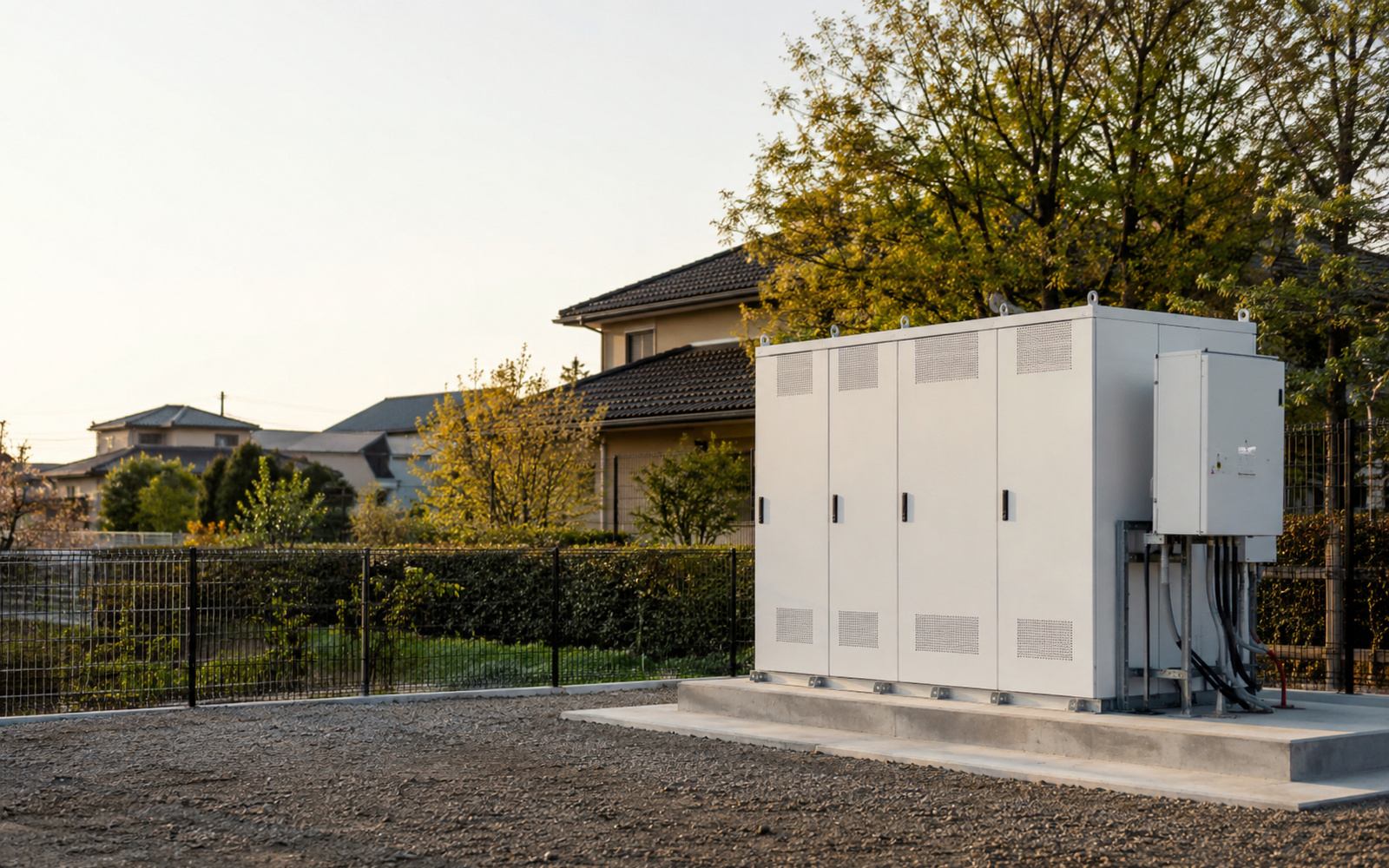
Image of the exterior of a low-voltage grid-scale battery storage cabinet

HOW IT WORKS

Land rent is not the same as the equipment’s revenue from selling electricity.

The model assumes that the landowner does not run the equipment to earn market revenue, but provides the land to the operator and receives rent based on the contract.

  1. 1

    Check the candidate site

    We check the location, area, road frontage, surroundings, rights and so on.

  2. 2

    Check project viability

    We study the prospects for grid connection, construction, delivery access, the equipment layout and so on.

  3. 3

    Present the rent and contract terms

    We confirm them in writing, including the term, the payment terms, the division of costs and what happens at the end.

RENT FACTORS

Rent is not set by the size of the land alone.

Even with the same area, the assessment changes with how easy construction and operation are, whether connection is possible, and the contract terms.

Location and grid conditions

The area, nearby grid equipment, the utility’s response (whether connection is possible and the grid connection construction cost) and so on affect project viability.

Area, shape and road frontage

Space is needed not only for the equipment itself but also for the foundations, clearances, maintenance and delivery.

Construction and surroundings

We check how difficult it is to deal with grading, wiring, noise, disaster prevention, nearby facilities and so on.

Rights and contract terms

The owner, mortgages, inheritance, the contract term, the termination conditions and so on also affect the terms we present.

Image of the surroundings of a candidate site near homes, a road and power transmission equipment

The free assessment starts by checking “whether equipment can be installed.”

Rather than promising a rent first, we check whether the land can be considered as a candidate site, and then make the business terms and the revenue estimate concrete.

See the site requirements and documents

COMPARISON

Compare the nature of the revenue with other land uses.

The question is not which method is better, but which fits the land conditions and the owner’s goals.

Item compared Low-voltage BESS site Monthly parking lot Solar power site Selling the land
Form of revenue Rent based on the contract Rent based on the number of cars parked Rent or business revenue A lump-sum sale price
Revenue outlook Contract terms checked in advance Depends on the occupancy rate Depends on the contract and the rules of the scheme Fixed at the time of sale
Owner’s management work Division of costs confirmed in the contract Finding users, collecting payments, cleaning, etc. Varies with the scheme In principle none after the sale
Do you give up the land? Assumed to be leased while you keep it Run while you keep it Leasing while you keep it is also possible Ownership is transferred
Main points to check Grid, construction, contract, restoration to the original condition Demand, paving, nearby competitors Sunlight, connection, the scheme, removal Price, tax, handover terms

* These are general points of comparison. For the costs and the tax and legal judgments of an individual case, please check with specialists and in the contract.

CONTRACT CHECK

What you actually take home changes with the “division of costs.”

Check not only the rent but also who bears what during the contract and at the end.

Confirm in writing before the contract

Items for the landowner to check

  • Taxes on owning the land, such as fixed asset tax
  • The tax treatment of rent income
  • Rights such as mortgages, co-ownership and inheritance
  • Procedures if you plan a sale or succession

Items that must be set in the contract

  • Who carries out, and pays for, equipment construction and maintenance
  • When rent payments start, how often they are made, revisions and conditions for stopping them
  • How early termination, disasters and the end of the project are handled
  • The scope of equipment removal, foundations, wiring and restoration to the original condition
Leave final tax and legal judgments to specialists.

This page sets out general material for making decisions, and does not guarantee the tax or legal outcome or the revenue of any individual case.

FREE DIAGNOSIS

An estimate for your land, based on its conditions.

Based on the location and the state of the land, we sort out whether it can be considered as a candidate site and whether to move on to a revenue estimate.

  1. 01

    Share the basic information

    Please consult us with what you know, such as the location, area, current condition and photos.

  2. 02

    Check the candidate site conditions

    We check road frontage, the surroundings, rights, the likely equipment layout and so on.

  3. 03

    Guidance on the estimate and next procedures

    Depending on the results, we explain the assumed terms, the documents needed and the next decision points.

Image of consulting about a revenue estimate while looking at land documents

FAQ

FAQ on the revenue model

We have sorted out the questions people often ask before a consultation, from the amount, cost sharing, sale and dealing with the neighbors to what happens after the contract ends.

Q Can I consult you about land slightly smaller than 6 tsubo?
A

Yes. However, the decision takes in not only the equipment itself but also the foundations, wiring, maintenance space, clearances, the delivery route and so on, so whether installation is possible is not decided by area alone. We advise individually after checking the location and the state of the land.

Q Will I definitely receive 30,000 yen a month?
A

It is not a guaranteed amount. This page uses it as an assumed example to help you understand how to think about revenue. The actual rent is presented after checking the location, area, road frontage, the prospects for grid connection, the construction conditions, the contract details and so on.

Q Are there initial costs or management fees?
A

The scope of cost sharing differs with the business scheme and the contract details. Please confirm in writing before the contract who bears what, such as equipment construction, maintenance, taxes on the land, and contract and registration costs.

Q Can I sell the land during the contract term?
A

Whether a sale itself is possible, and the procedures needed, depend on the land lease agreement, the rights set up such as superficies or a fixed-term land lease right, and the conditions for succession by the buyer. If you may sell, please tell us before the contract so that this is taken into account.

Q How are safety and noise for the neighbors taken into account?
A

We check the surroundings, clearances, equipment specifications, operating noise, fences, disaster prevention plans and so on individually. Near schools, hospitals, welfare facilities, particularly quiet residential areas and so on, we may not be able to make a proposal, depending on the conditions.

Q What happens to restoration to the original condition after the contract ends?
A

The scope of removal, how the foundations and wiring are handled, the standard for restoration to the original condition, the cost sharing and the timing need to be made clear in the contract. It is important to confirm in writing, not only through verbal explanations, everything through to the procedures at the end.

Q What is needed for a revenue estimate?
A

The initial check goes more smoothly if you have the location, the approximate area of the land, photos that show the current condition, the road frontage, the name on the land title, your planned timing and so on. We tell you about detailed documents according to the stage.

Q When does rent start being paid?
A

The point at which payments start differs with the contract terms, such as when the contract is signed, when construction starts or when the equipment starts operating. Please confirm in writing before the contract, as an important matter, including whether rent is paid during the survey and application period. * Applying or having a free assessment does not by itself confirm a land lease agreement or rent payments.

Q What about fixed asset tax and other taxes on the land?
A

Taxes that come with owning the land, such as fixed asset tax on the land, generally stay with the landowner. On the other hand, the income category of rent income and how expenses are treated differ with individual circumstances. For specific tax judgments, please check with a tax accountant or the tax office with jurisdiction. * REVIX JAPAN is not in a position to determine individual tax judgments or how to file returns.

START WITH YOUR LAND

Before deciding on an amount,
why not start by checking the land conditions?

You do not need to decide on a contract when you consult us.
We start by sorting out whether the land can be considered as a candidate site, and what needs to be checked.

* This does not guarantee the assessment results, the rent or whether a contract can be made.