Creating success in grid-scale battery storage, together.

High-voltage grid-scale battery storage | For investors and operators

Site requirements and documents,
sorted out early in planning.

This page brings the checkpoints for land, grid connection, regulations and safety together in one place, so you can judge whether a candidate site can go on to the next step.

This page sorts out the general items to study. Whether a site can be connected, the permits and the documents required are checked individually for each candidate site, equipment specification and the latest rules of the operator you apply to.

A candidate site with a high-voltage grid-scale battery storage container and substation equipment

FIRST CHECK Separate the conditions for going ahead from the factors that stop you, first

A site survey checking the road access and surroundings of a candidate site for high-voltage battery storage

Conclusion

Eligibility is judged by stacking 3 conditions together.

A large plot, a high-voltage line nearby, equipment specifications already decided. On its own, none of these is a basis for a viable project.

Only when "land", "grid" and "regulations and safety" all hold at the same time can you move on to a concrete investment decision.

  1. 01

    Land conditions

    We check the equipment layout, clearances, maintenance access, delivery, road access, grading, disaster risk and the surroundings.

  2. 02

    Grid connection conditions

    Through a connection study, we confirm the connection point, grid capacity, reinforcement works, costs, schedule and operating conditions.

  3. 03

    Regulatory and safety conditions

    We sort out land use, electrical safety, fire, the construction plan, the operating structure, cybersecurity and more.

Condition Checklist

Site requirements checklist

Not everything has to be settled at the first consultation. The first step is to separate "confirmed" from "needs further investigation".

Items to confirm Judged case by case

Land and site

  • The location, lot number and boundaries of the candidate site can be identified
  • Batteries, PCS, transformers and control panels can be laid out
  • Maintenance access, service routes and clearances can be secured
  • A delivery route for large vehicles and cranes can be studied
  • Grading, drainage, ground conditions, noise and hazards can be checked
  • There is a plan for the land-use rights or for agreement with the owner

Grid and equipment

  • The expected output, capacity and operating pattern are sorted out
  • The desired receiving voltage and target connection date can be studied
  • A single-line diagram, layout drawing and equipment specifications can be prepared
  • The connection point, reinforcement works and grid connection construction cost can be assessed
  • Charge and discharge constraints and output-control conditions can be studied
  • Whether a new study is needed when the equipment changes can be confirmed

Regulations, safety and operation

  • Confirm the classification under the Electricity Business Act and the safety procedures required
  • Consider the chief electrical engineer, safety regulations and monitoring structure
  • Confirm fire, building, development, land use and municipal ordinances
  • Design protection coordination, testing and the response to incidents
  • Sort out cybersecurity for remote monitoring and control
  • Make clear the division of responsibility for construction, maintenance and emergency contact

* The above are general items to check. The conditions and deliverables change with the equipment classification, location, connecting operator, application type and administrative judgment.

Common Pitfalls

3 oversights that delay a decision.

If they are missed at the early stage, the assumptions can collapse after the connection study or after design, which can lead to extra costs and a revised schedule.

01

"A utility pole nearby" does not mean "it can be connected"

Beyond the nearby facilities, we check the upstream grid, protection coordination, whether reinforcement is needed, construction costs and operating constraints.

02

Land documents alone do not settle the layout and delivery

In addition to the cadastral map and registry, we check the current state, road access, level differences, ground, drainage, neighbors and heavy-machinery routes as on-site conditions.

03

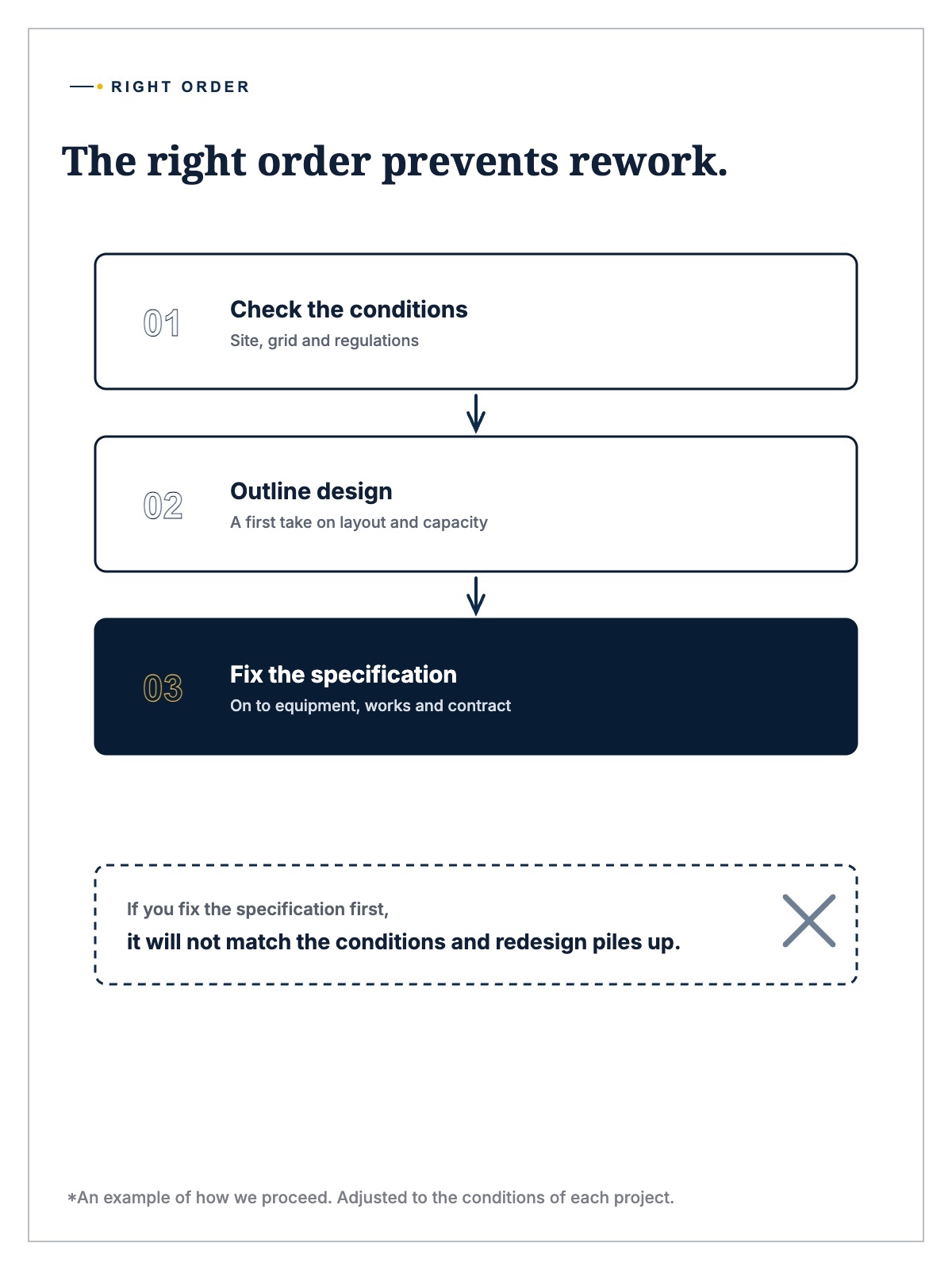
Fixing the equipment specifications first means more redesign

Taking the connection and land conditions into account, we leave room to adjust the output, capacity, transformers, protection and layout.

Checking the doors, louvers and foundation area of a high-voltage battery storage container

REVIX PRE-CHECK

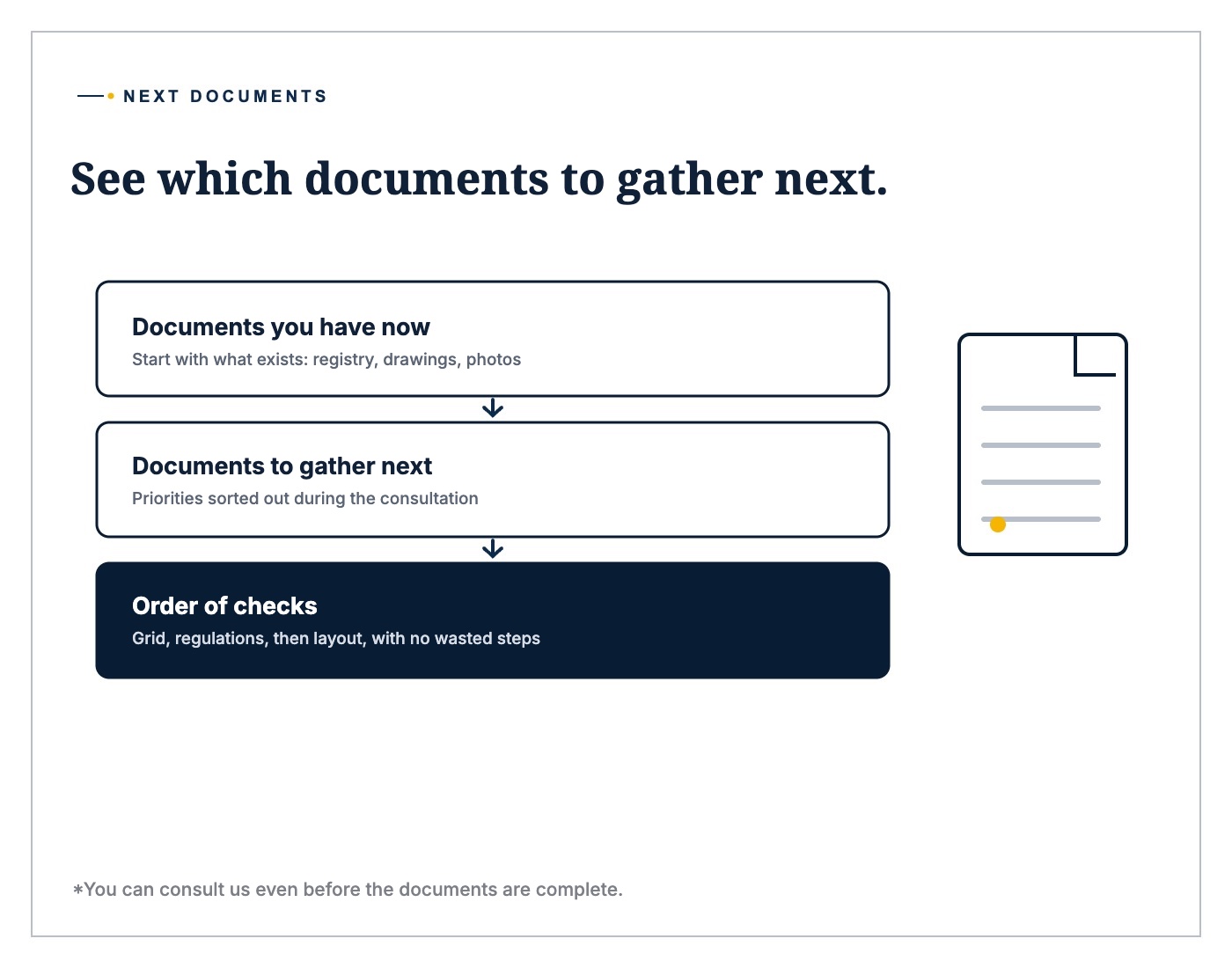
A consultation shows which materials to gather next, and in what order to check them.

This is not a case of "we cannot consult because information is missing". It is an initial consultation to pin down what is missing. We sort out the assumptions behind the candidate site and the business plan, and make visible what has to be confirmed with each party.

  • Initial suitability of the candidate site
  • Missing materials and their priority
  • Checkpoints in the grid procedures
  • Undecided items in the equipment specifications
  • Who to consult on regulations and safety
  • Room to consider alternatives
Discuss your candidate site
A corporate representative and an engineer reviewing the layout plan for high-voltage battery storage in a meeting

Required Documents

The documents required change with each stage of the study.

Documents are not just "for submission". They are design information for lining up the business conditions. The stage-by-stage checklist (initial assessment, then connection study, then contract, design and operation) is on a dedicated page.

The initial assessment starts from the location of the candidate site, its registry information and on-site photosDocuments for the connection study and contract stages are guided individually for each project

Stage-by-stage checklist of required documentsSee what to submit, when and why, listed stage by stage

See the required documents page →

Next Steps

How to proceed to the decision to go ahead

Decide the order in which to gather materials, and feed the result of each stage into the next design step.

  1. 01

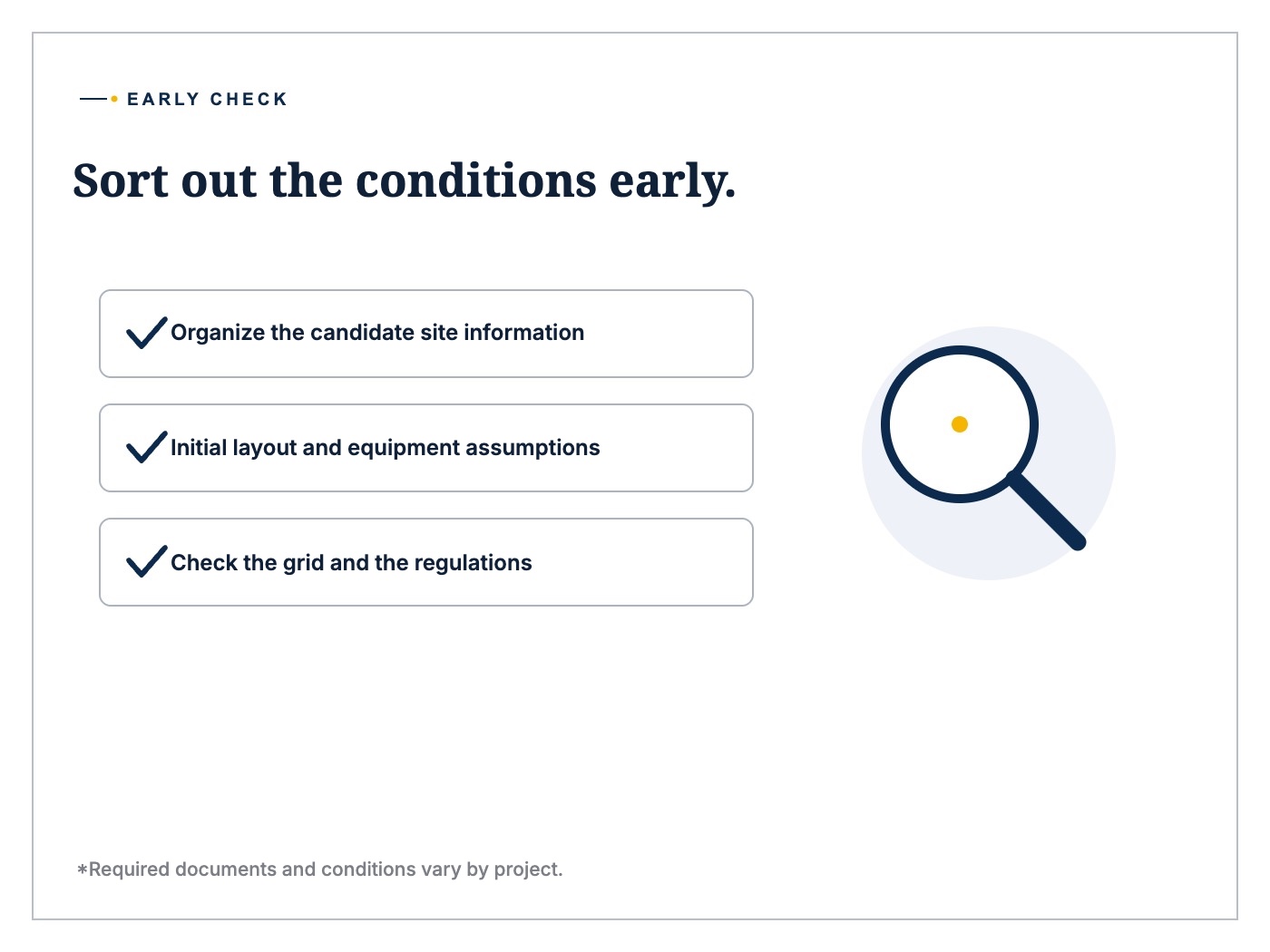
    Sort out the candidate site information

    Check the location, lot number, photos, road access and status of the rights.

  2. 02

    Initial layout and equipment assumptions

    Provisionally set the capacity, output, layout, delivery and maintenance routes.

  3. 03

    Grid access procedures

    Apply for a connection study on the latest forms and obtain the conditions.

  4. 04

    Update regulations, design and economics

    Reflect the construction costs, schedule, permits and operating conditions.

  5. 05

    Investment and contract decision

    Line up the assumptions and risks and move to the final decision.

A candidate site for high-voltage battery storage where a different layout or connection conditions can be considered

WHEN CONDITIONS DO NOT MATCH

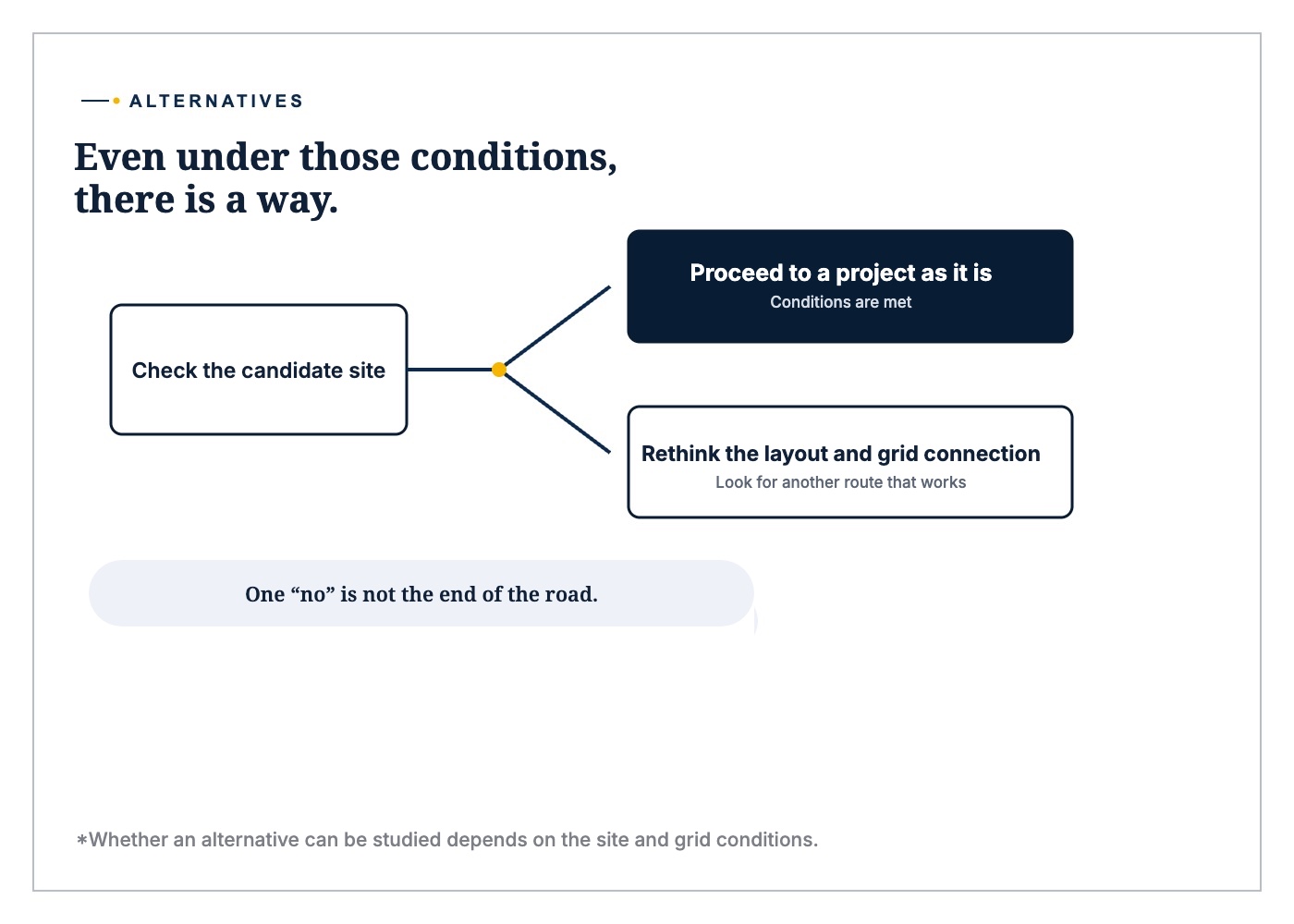
Even if a site is not eligible, breaking down the reasons lets you consider alternatives.

Rather than stopping at the result "the conditions are not met", we break down which of land, grid, equipment or schedule is the constraint. If there are assumptions that can be changed, we check whether there is room for a second look.

  • Revising the output, capacity and equipment configuration
  • Changing the layout, maintenance access and delivery plan
  • Reconsidering the connection point, receiving voltage and schedule
  • Comparing another candidate site or nearby land
Discuss why a site is not eligible

FAQ

Frequently asked questions about site requirements and documents

Common early-stage concerns, sorted in the order decisions are made.

How much land does high-voltage grid-scale battery storage need?

It cannot be judged by a fixed area. The area needed changes with the battery capacity, the configuration of the PCS, transformers and other equipment, clearances, the fire and safety plan, maintenance access and the delivery plan, so we check it together with the layout plan.

Can I connect if there is a high-voltage line or utility pole nearby?

Being close by does not settle whether connection is possible. Grid capacity, the connection point, protection coordination, reinforcement works, the grid connection construction cost, charge and discharge conditions and more have to be confirmed in a connection study.

What should I prepare for the first consultation?

It is easier to sort things out if you have the location of the candidate site, registry information or the cadastral map, on-site photos, road access and delivery conditions, and materials showing the expected equipment scale. Even if these are not all in place, you can consult us with what is known.

Can I consult you before the land-use rights are settled?

An initial check of site suitability is possible. However, at the stage of grid access procedures, contracts and the start of construction, land-related confirmation documents and the rights to the land may need to be sorted out.

Are the cost and response time of a connection study the same nationwide?

They differ with the general transmission and distribution operator you apply to, the equipment scale, the scope of the study, and the forms and practice in place at the time of application. We check the latest official guidance and treat it as an assumption at the planning stage.

If the conditions are not met, is stopping the plan the only option?

It may be possible to look again by revising the capacity, layout, connection point, delivery route, schedule or candidate site. We break down the reasons a site is not eligible and check whether there are alternatives.

Which permits and notifications are needed?

Items to check include the safety procedures under the Electricity Business Act, fire, building, development and land-use rules, and municipal ordinances. Because they differ with the equipment specifications, location and scope of works, we confirm them individually with the authorities concerned.

A high-voltage grid-scale battery storage yard and maintenance access at dusk

START WITH THE FACTS

Shall we first sort out the conditions that let you go ahead, and the ones that stop you?

It is fine if you only have part of the information about the candidate site. We sort out what is known now, what needs further investigation and who to check with next, and create the entry point to a decision on going ahead.

Discuss site requirements free of charge