
Creating success in grid-scale battery storage, together.

For landowners who want to use their land without selling it

Entrust your site, and widen your options for using it.

We sort out the site information and the connection conditions, and support matching with investors and operators considering grid-scale battery storage (BESS). Including the option of continuing to own the land, we first check business feasibility.

*The contract form, costs, income terms and scope of investigation differ for each project. The terms for publication are confirmed individually.

Sorting out how to use the land,
including keeping it

  • 01

    How entrustment works
    and how it differs from a sale

  • 02

    Conditions and risks
    checked in the preliminary DD

  • 03

    How we proceed, from consultation
    to proposals to operators

Landowner concerns

You want to use your land without giving it up.
But you lack the material to decide.

For a battery storage site, we look not only at the area and location but at several conditions, including the content of the reply to the connection study, the construction period, hazards, road frontage and the surrounding environment. REVIX sorts out the information one item at a time and determines whether it is “a project we can propose”.

  1. Not sure how to use the land other than by selling it

    There are few chances to compare ways of using the land while keeping it, or the forms of contract with operators, so it is hard to know what to consult about first.

  2. Cannot make sense of the conditions in the utility’s response

    Information that shapes business feasibility, such as the construction period, the grid connection construction cost and the special notes, is technical, which makes it hard to judge the value of the project.

  3. No contact with investors or operators

    It is unclear to whom, and in what state, to present the site information so that a review moves forward, and negotiations and document preparation take time.

What REVIX supports

By entrusting your site,
you reach a point where its potential can be judged.

Rather than selling the site straight away, we first sort out the information and check business feasibility, and get it ready to propose to operators that match the conditions.

01

Keeping the option to continue owning the land

Including rental and the setting of rights, we consider whether the land can be used while you retain ownership. The contract form is sorted out individually according to the land conditions and the operator’s intentions.
02

Preparing the project information from a specialist perspective

From public information and the documents entrusted to us, we identify the issues to check, such as hazards, noise, buried cultural properties and connection conditions, and make clear the investigations needed next.

03

Supporting proposals to investors and operators

Once the material for a decision is ready, we propose the project to candidates that match the conditions. We confirm the scope of introductions, the costs and the contract terms before going ahead, and we do not force the process forward.

A meeting to consider terms with candidate operators based on site documents

Matching model

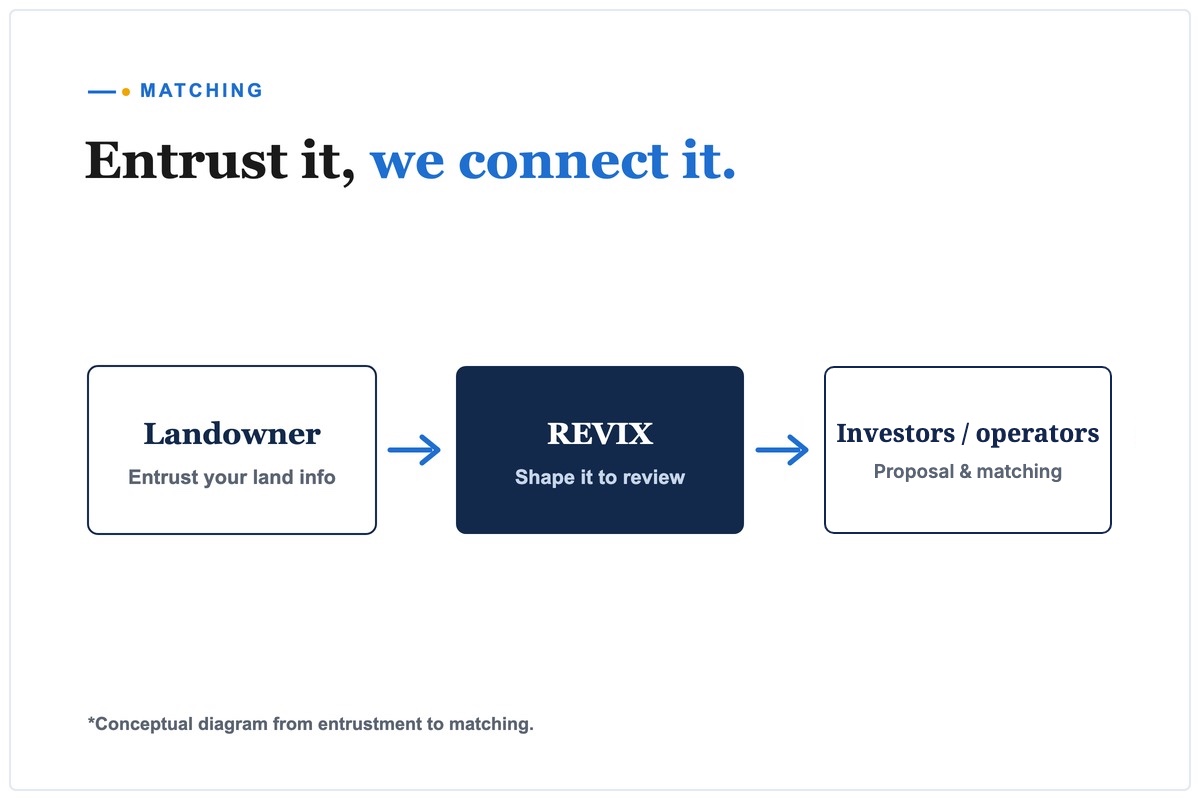
Entrusting your site information means
shaping it into “a project that can be reviewed”.

Rather than handing over the land itself straight away, we check the location, the rights, the connection information, your preferred terms and more, and organize them into documents that operators can decide on.

  1. 1

    We receive the site information from the landowner or broker

  2. 2

    Preliminary DD using public information and documents

  3. 3

    Sorting out the conditions and sharing the items needing further checks

  4. 4

    Proposal to suitable investors and operators

  5. 5

    On-site check and individual discussion of contract terms

Due diligence

Before seeing the site,
narrow down the issues in a desk review.

At the early stage, we check mainly public information and the documents provided, and sort out the items to look at in the on-site survey. The scope and accuracy of the investigation depend on the documents available.

A surveyor checking the road frontage and surroundings of the land

FIELD / SITE

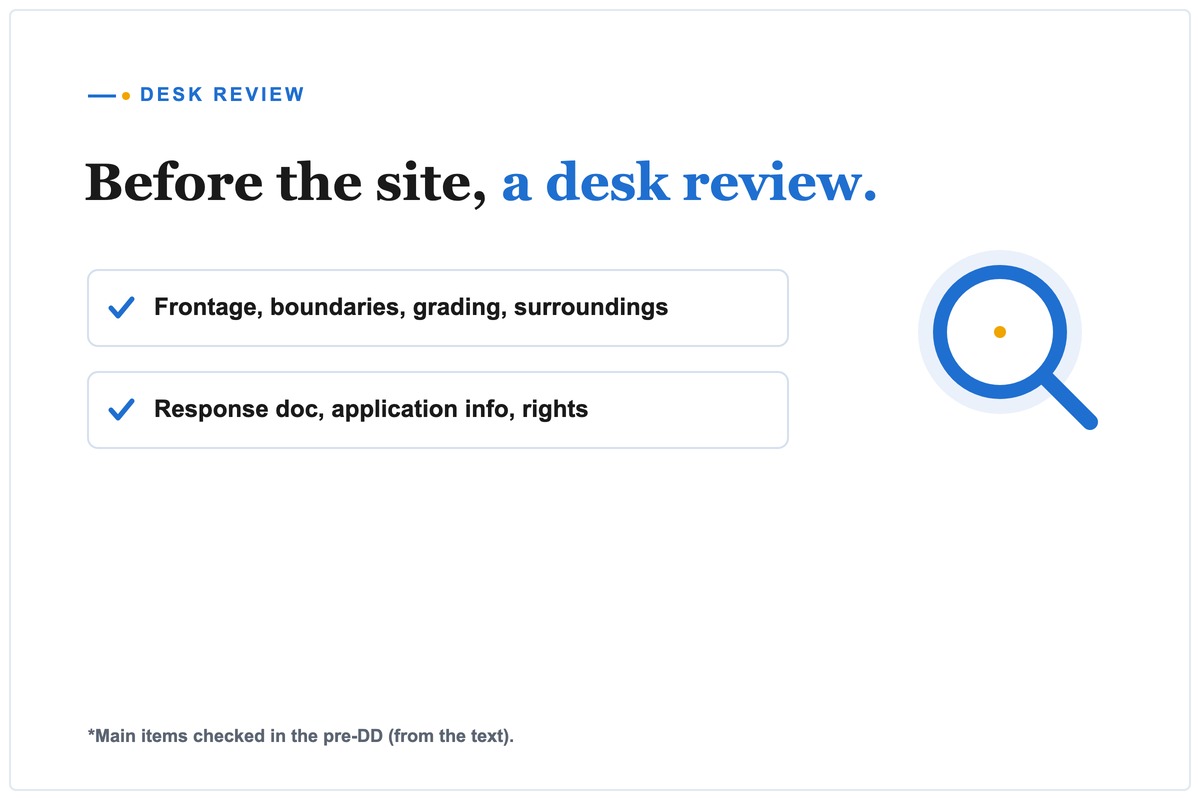
Road frontage, boundaries, grading and surroundings

We check conditions that affect construction and operation, such as entry for large vehicles, the equipment layout, the distance from neighbors and how difficult the grading will be.

Reviewing documents such as the reply to the connection study and maps

DOCUMENTS / GRID

The response, application information and rights

We check the construction period for connection, the grid connection construction cost, the special notes, landowner consent and more, and sort out the information that can be presented to operators.

Screening criteria

Main items checked in the preliminary DD

We do not decide on a single condition, but combine several conditions to check business feasibility. The formal decision is made after the on-site check and after further documents are obtained.

Grid connection and construction periodCheck the reply to the connection study
We check conditions that affect the project schedule and profitability, such as the construction period, the grid connection construction cost, the special notes and voltage fluctuation.
Land rights and consentSort out the rights
We check the prerequisites for proposals and contracts, such as the owner, landowner consent, collateral and rental status, and boundaries.
Hazards and lawsPreliminary check from public information
We check flooding, landslides, noise, buried cultural properties, zoning and more, and sort out whether further investigation or measures are needed.
Construction and delivery accessConsider the layout and access routes
We look at conditions that bear on whether the project can be built, such as road frontage, road width, differences in ground level, grading, equipment clearances and entry for construction vehicles.
Preferred termsClarify the landowner’s intentions
We ask about your intention not to sell, the contract period, the use, your wishes for earning income, local circumstances and more, and prepare the approach for the proposal.

*Separate consent is required for a formal investigation, entry onto the site, investigations by specialists and contract terms. The eligible conditions and costs are to be confirmed before publication.

Compare options

Comparing “selling” and “entrusting the land to put it to use”

Which is right depends on when you want to convert the land to cash, whether you intend to keep owning it, the land conditions and the business risks.

Item comparedSellEntrust and consider using the land
OwnershipTransferred once the sale is completedCan be considered on the basis of continued ownership. Specific contracts are discussed individually
Conversion to cashThe approach is to receive the sale price in a lump sumThe timing and method of income differ by contract form
Information needed to decideValuation, rights, contract termsIn addition to those on the left, connection, construction period, operating period and operator conditions
Suited toThose who put priority on early conversion to cash or on removing the burden of managementThose who want to consider long-term use without giving up the land
Main cautionsAfter a sale, the land cannot be used in the futureFor the project to go ahead, DD, contracts, permits and connection conditions must be checked

Even without all the documents, you can consult us starting from the location.

First, please tell us where the land is, its ownership status, whether there is a connection study, and how you would like to use the land.

Process

The process from consultation to matching

We do not ask you to sign a contract right after the initial consultation; we move to the next stage after checking the documents and sorting out business feasibility. The details of each step are gathered on a dedicated page.

01Inquiry and sharing an overview 02Receiving documents and preliminary DD 03Sharing the check results 04Proposal to candidate operators 05On-site check and contract discussions

The process up to site entrustment and the start of use (main guide)A timeline explaining the points to check, the documents needed and the cautions for each step

See the entrustment process →

Documents

What we would like you to tell us,
as far as you know, when you consult

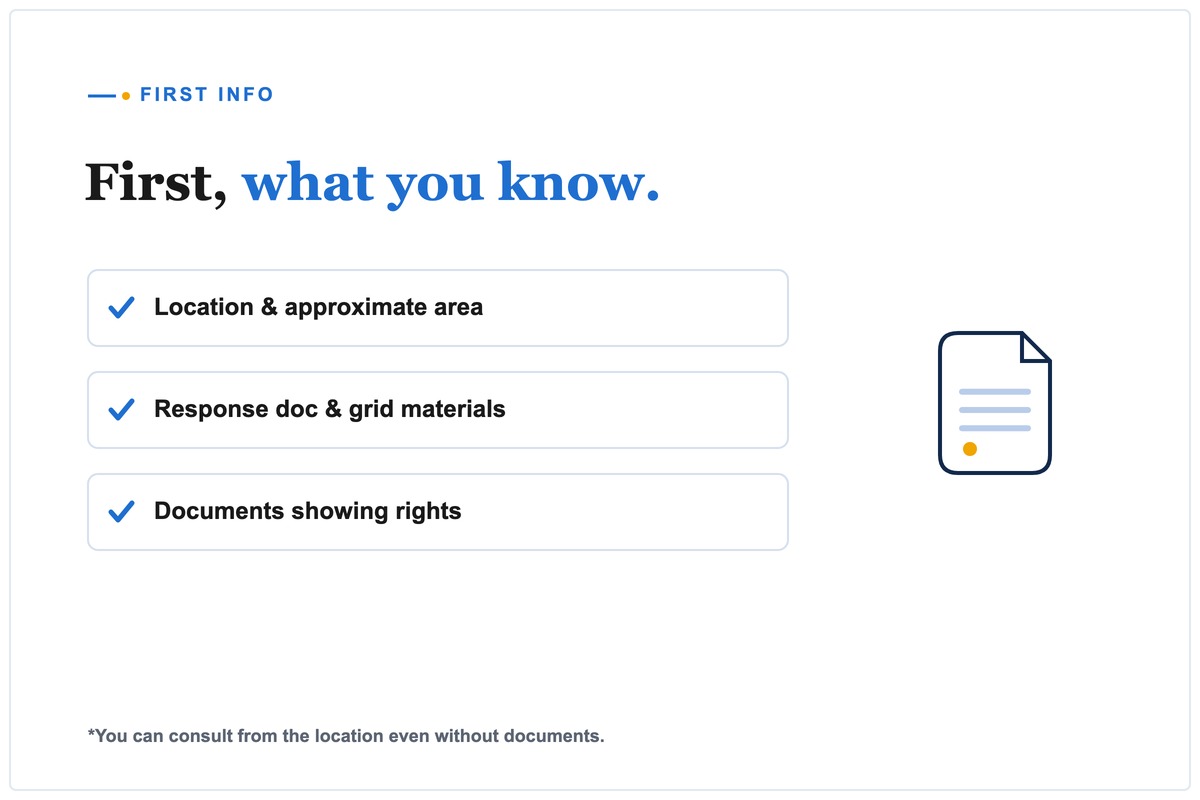
Items for the first check

  • Location of the land, a location map and the approximate area
  • The relationship between the owner, the broker and the person consulting us
  • Whether there is a reply to the connection study, and when it was received
  • Landowner consent and intentions regarding rental or sale
  • Your preferred way of using the land and your deadline for deciding
  • Known hazards, road frontage, boundaries and neighborhood conditions

You can have an initial consultation even if you have not obtained the response. However, further documents may be needed for formal entrustment of a project or for proposals to operators.

Land documents and connection study documents being organized on a desk

FAQ

Frequently asked questions

We have gathered the questions we often receive before a site is entrusted and put to use.

Can I consult you about land that has no reply to the connection study?

Yes, an initial consultation and a preliminary check using public information are possible. However, for formal entrustment of a project or a proposal to operators, we may check documents such as the reply to the connection study and your copy of the application. We advise you based on the documents you have.

Can I put the land to use without selling it?

It is possible to consider how the land could be used while you continue to own it. The specific contract form, such as rental, the setting of rights or a joint business, is sorted out individually based on the land conditions, the connection conditions and the operator’s intentions.
If the land falls under a hazard, is it always excluded?

The decision depends on the type and depth of the hazard, whether measures are possible, the equipment layout and more. If the risk is high, we may not be able to handle the site, but we sort out the public information and the site conditions and check individually.

Is there a fee for a consultation or the preliminary assessment?

We intend to offer the initial consultation and a preliminary check based on public information free of charge. The costs and fees for on-site surveys, specialist investigations and the conclusion of a contract differ depending on the conditions, so we explain them individually before carrying anything out. The terms for publication are still to be confirmed.

What kind of land is considered?

We judge by combining road frontage, boundaries, grading, hazards, the surrounding environment, connection conditions, the construction period and more. Area alone does not decide whether a site is suitable. First, please tell us the location and which documents you have.

Can I consult several companies at the same time?

We expect to proceed without assuming an exclusive contract at the consultation stage. However, the conditions at the formal proposal and contract stages differ for each project, so please check the individual contract.

How soon after consulting will I know the results?

The period varies with whether documents are available, the site conditions, the content of the utility’s response and the need for further checks. After the initial check, we tell you the documents needed and the outlook. We do not guarantee a uniform period.

FREE CONSULTATION

Sell, or entrust?
Check the land’s potential before you decide.

From the location of your site and the documents you have, we tell you the points to check in the preliminary DD. You can start with an initial consultation that does not assume a contract.

*The assessment results do not guarantee that the project will go ahead or any earnings. We may not be able to handle a site depending on individual conditions.