


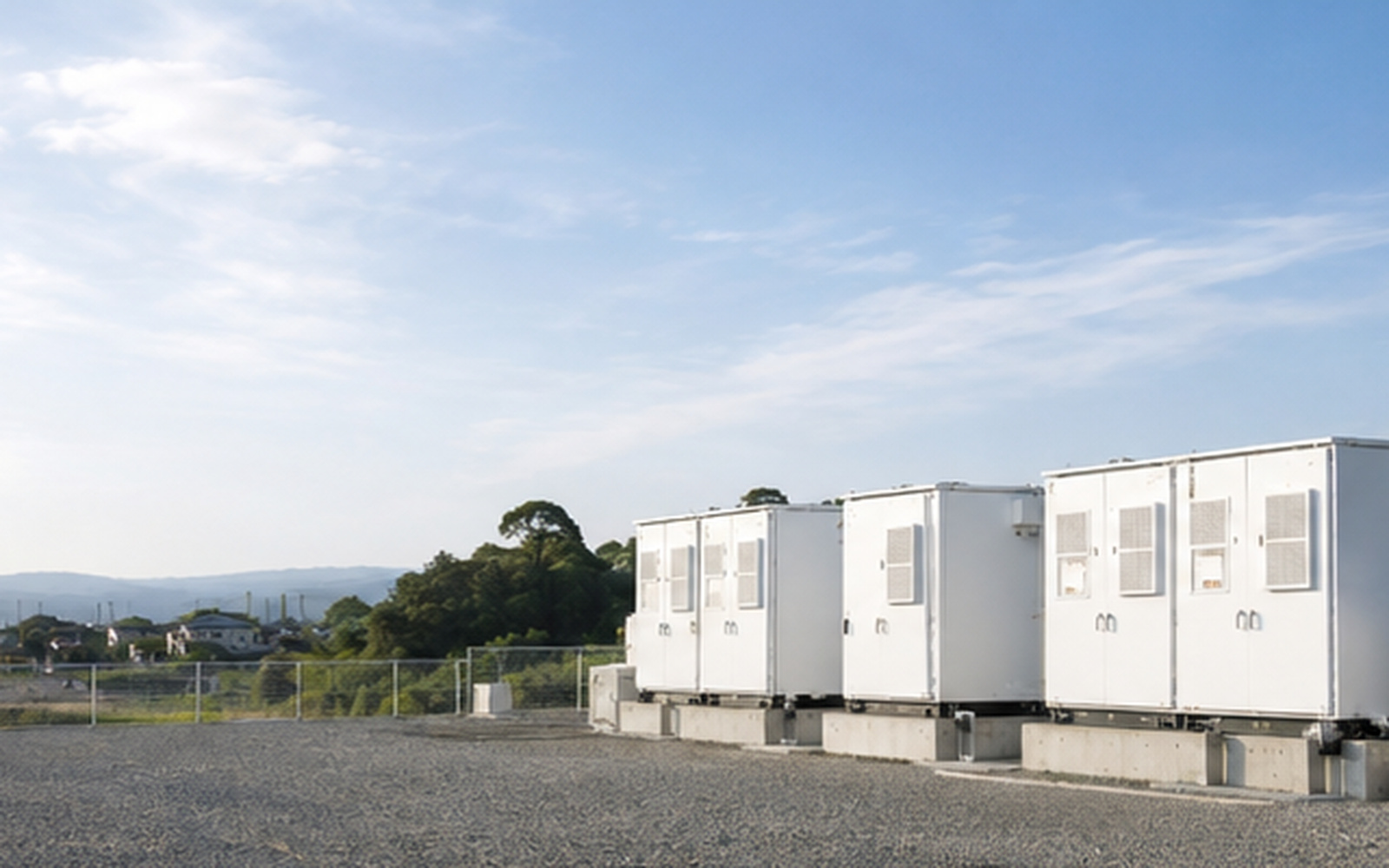
LOW-VOLTAGE BESS / INVESTOR
Look at the downside first.
Low-voltage BESS: investment risks and downside factors
Do not base an investment decision on the upside; check the conditions needed to achieve it and whether it can be repeated. Rather than changing revenue, costs and degradation all at once, checking the influencing factors one at a time shows which conditions to examine first.
Key points on this page
- The factors that cause revenue to vary can be sorted into 6: market prices, availability, operating costs, equipment conditions, grid connection conditions, and tax and financing.
- If market revenue changes by ±20%, the expected yield (not guaranteed) is 13.7% to 25.1% (base 19.4%, subject to the stated assumptions).
- The expected yield is not a guarantee. For an individual project, we verify profitability under several scenarios.
RISK FACTORS
6 factors that cause variation
A change in just 1 of them is enough to change the economics
Market prices
Price levels in the power markets vary. We check the assumed unit prices and verify them under several scenarios.
Availability
While the system is down there are fewer trading opportunities. We factor in changes in availability due to inspections and fault response.
Operating costs
Running costs such as maintenance costs, insurance premiums and aggregator-related costs vary with the conditions.
Equipment conditions
The usable capacity changes with the number of charge and discharge cycles, temperature, SOC operation and other factors, and this affects the volume that can be traded in the future.
Grid connection conditions
The connection conditions and the grid connection construction cost differ case by case and affect the start date and the initial cost.
Tax and financing conditions
The profitability you actually keep changes with the borrowing terms and whether particular tax schemes can be applied.
EQUIPMENT & EXIT
Points to check for equipment and exit risks
Items to confirm in writing before signing a contract
Faults and downtime
While the system is down there are fewer trading opportunities, and depending on the contract terms, additional costs may arise. We check in advance the warranty scope, maintenance response times, remote monitoring, spare parts, the recovery process and the scope of insurance cover.
Battery degradation
The usable capacity changes with the number of charge and discharge cycles, temperature, output, SOC operation and other factors. A revenue estimate needs to factor in the degradation curve, the replacement and expansion policy, and the warranty terms.
Exit and sale
Whether it can be carried out depends on the land contract, the grid connection, equipment ownership, financing, the operating contract and the conditions for transferring the warranty. Before installation, we sort out the options of continuing to hold, transferring the business or renewing the equipment.
TABLE
Sensitivity analysis: if market revenue changes by ±20%
The figures and categories follow the Low-Voltage Simulator currently published
| Scenario | Market revenue | Expected yield (not guaranteed; 20-year average, pre-tax) |
|---|---|---|
| Downside | −20% | 13.7% |
| Base | ±0% | 19.4% |
| Upside | +20% | 25.1% |
* These are assumed values based on the published estimate in the Low-Voltage Simulator (land purchase, set assumptions) and do not guarantee revenue or yield. The values change with the input conditions.
Go to the Low-Voltage Simulator (estimate form with sensitivity analysis).
FAQ
Frequently asked questions
About the assumptions and how to check them
Is revenue guaranteed?
Will I earn the same revenue every month?

Once you have seen the risks, run an estimate on your own conditions
Enter your land conditions to check the payback outlook, including the downside scenario.
Check the sensitivity in the Low-Voltage Simulator →